Showing posts with label mussel. Show all posts

Wednesday, 24 July 2019

Grand Tour 2: Cumbrian Lakes and Seashore

Crummock Water, Cumbria, UK


Let me take you back 500 million years. Crummock Water, now one of fourteen beautiful lakes in The Lake District, was on the sea bed, a bed made up of sand and black, glutinous mud. Since then, that sediment has been squeezed, scunched and uplifted (and continues to be so) to form the fells that surround the lake, in this, the oldest part of the National Park. To the south of this are the eroded outcrops of hard lavas and ashes formed as a result of catastrophic volcanic eruptions 450 million years ago. It is here that you will find the highest peaks including Scafell Pike, England's highest at 3,209 feet (978m). To the south of this lies the gentler sedimentary rocks of southern Lakeland. These mudstones, sandstones, siltstones and limestones made up of billions of crushed seashells were formed upon the sea bed around 420 million years ago. The result is an area of truly outstanding natural beauty.

Let us take a walk around the woodland at the edge of the lake. It feels primaeval with its moss covered rocks and trees where red squirrels scamper around in the canopy and warblers and finches sing from unseen branches. Rows of bracket fungi adorn fallen branches and down by the water's edge bilberries are just starting to form. Look at the mosses more closely and you can see that the moss growing on the rocks (Thuidium sp.) and the moss climbing the trees (Hypnum sp.) are entirely different, occupying, as they do, completely separate ecological niches.


We'll track north now to Allonby Sands, a long, sandy beach on the edge of the Solway Firth. It is the middle of May and the Hawthorn bushes up on the dune ridge are just coming into flower. Floating all around them, long legs trailing, are the Hawthorn flies (Bibio marci). These harmless little insects (they don't bite) have a tendency to hatch in large numbers on or about the 25th April – the males sometimes about a week earlier – which is St. Mark's Day. This gives them their alternative name of St. Mark's Fly. Having completed their mating cycle many of them finish up on the surface of lakes, rivers and streams where they provide a seasonal bounty for the fish.
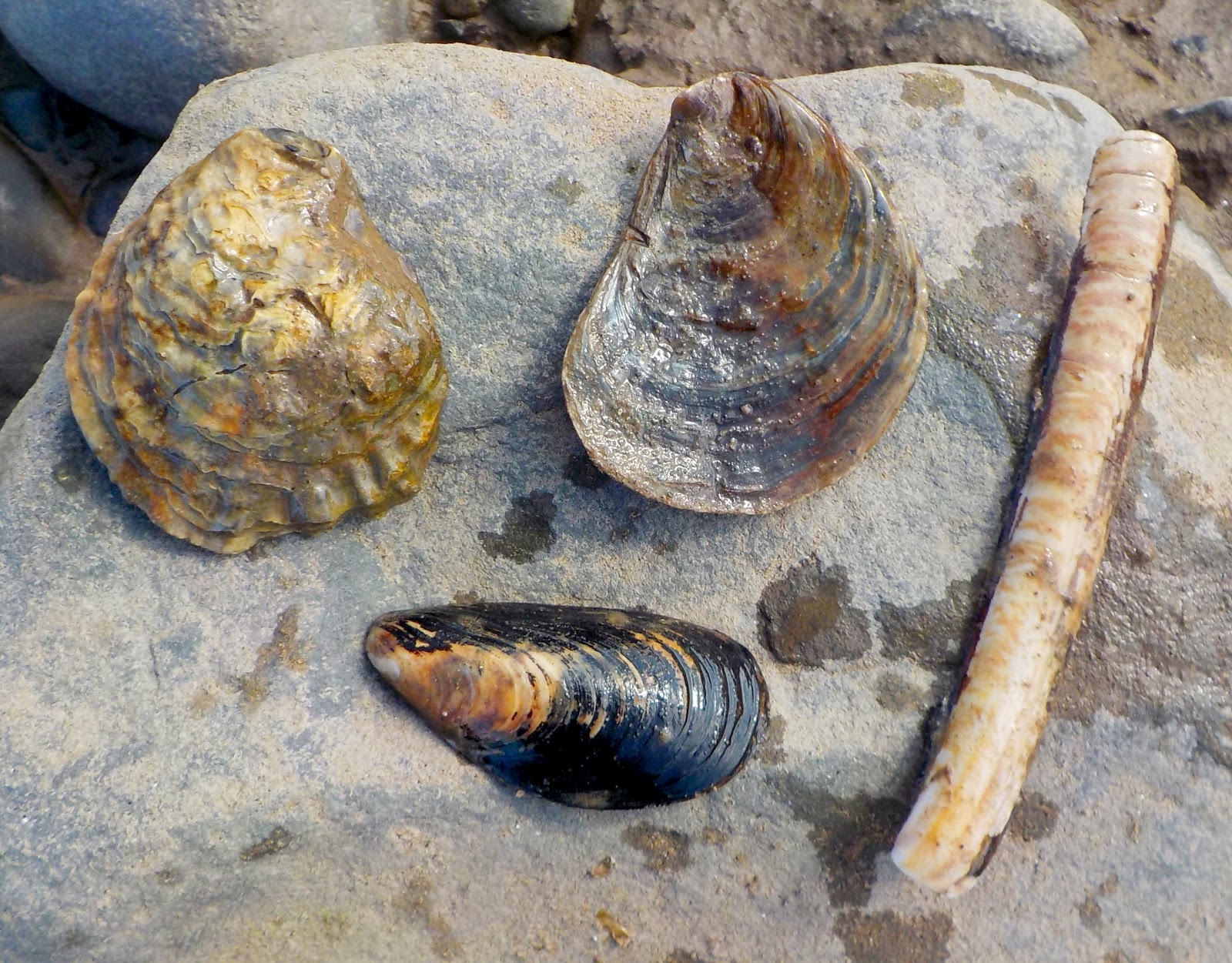
Coming down onto the shoreline and peering into the rock pools (or guddling in the local dialect) we find a treasure trove of shells of edible molluscs; oysters [top], mussels [bottom] and razor shells [right]. Unfortunately the original inhabitants of these shells are no longer present so no 'Allonby Chowder' recipe this week. It's a dish more suited to the depths of winter so, maybe on our next visit. And we must include smoked kippers! Around the turn of the 18th century, the village of Allonby was the centre of the local herring fishing industry, salting and packing the herring in barrels and kippering them in the smoke house.


From the remote geolical past, through more recent history, we come to the present. Out beyond the shoreline, where the oystercatchers, knots and dunlin probe the sands for their lunch, lies the Robin Rigg offshore wind farm. Sixty 260ft (80m) high towers with four 144ft (44m) blades apiece turning at an average 170 miles per hour produce enough electricity to power half the houses in Cumbria. There are concerns of course. You can't plant a forest of turbines in somewhere like the Solway Firth without shaking it up a little and the ecology is being carefully monitored. But, whichever way you look at it, it means a heck of a lot less fossil fuel has to be burnt to keep the lamps lit over half the county.


Crete Nature Catch-up

Steve's Books (well, just the one at the moment but 'The Quick Guide to Creepy-Crawlies' is well under way and should be available later in the year).)

Not Just For Twisted Women by Steve Daniels 
A light-hearted look at life through the eyes of the fairer sex.
Kindle Edition 1.99 pounds sterling (or equivalent).
Paperback Edition 4.99 pounds sterling (or equivalent)..
Read snippets, samples and stuff at Steve's Books


*********************************************************************
LINKS:
Share your nature thoughts, photos and comments on Naturalists (the facebook page that accompanies this blog)

Explore the region with the #CreteNature interactive Hiking and Nature Map


Wednesday, 25 June 2014

The Bottomless Lake of Agios Nikolaos


We’re entering the world of human civilization this week with a trip to the town of Agios Nikolaos on the northern shores of the island. Towns are not my natural habitat because, although I like most people that I meet, I find humanity en masse just a little bit too much of a good thing. However, the old jalopy needs a service and that’s where the garage is so pile in the back and let’s go and see what we can find. 

The one place I always make for when I’ve a few hours to kill in Ag. Nik. (as it is known to the expat community who have trouble with the number of vowels in the full place name) is Lake Voulismeni. This is a small lake at the sea end of the town connected to the harbour  by a short channel dug out in 1870. The locals will tell you that the lake is bottomless. Actually it is 64 metres to the bottom, or just over 200 feet in sensible measurements which, for something scarcely wider than a village pond, is as bottomless as makes no difference. 

Boxlip Mullet

As we walk around the lake trying to ignore the pleas of the restaurant “getters-in” on our left we can look down in the shallows between the boats and see that it is teeming with life. Small fish are plentiful most probably because they know that humans will happily feed them bread from dawn to dusk. Now I don’t claim to be an expert on fish but those thick upper lips on the rather elongated specimens down there lead me to believe that they are Boxlip Mullet which have been on the Mediterranean menu at least since Roman times.


Mussels
And look down here attached to this mooring rope. If my eyes don’t deceive me those are mussels. This I find rather exciting as I’ve only ever found one little colony of Blue Mussels before and they are quite rare in the Mediterranean. Fascinating things mussels; they have a symbiotic relationship with a bacterium which can produce vitamin B12 (something no animal, plant or fungus can do) which has at its core a somewhat rare element called cobalt. Cobalt is associated with the colour blue and is used for making blue glass amongst other things. I wonder if it is this that gives mussel shells their blueish tinge?  Do you notice those white dots on the shells?  They are barnacles which are crustaceans related to crabs and lobsters . The mussels themselves are molluscs which puts them in the same category as octopi and garden snails. (Technically they are bivalve molluscs and lack the rasping tongue-like structure called the radula wich is one of the defining features of other molluscs, but they share other characteristics that place them in this animal group).


Ivy-leaved Toadflax
Lets take our eyes away from the water for a moment as I spy some little plants growing in the cracks in the walls at the back of the esplanade here. Beautiful little things when you look at them closely aren’t they? These are Ivy-leaved Toadflax and the fascinating thing about these plants is their cunning method of seed dispersal. The stalk of the flower is light sensitive (phototropic) and initially, like many flowers, it turns to face the sun. After it has been pollinated and begun to set seed it reverses its phototropism and moves towards the dark and as the darkest place around is the nearest crack in the wall that is where the seed is deposited – in the place where it is most likely to germinate. Clever or what?


Robber Fly
We’ll leave the lake now and have a short walk up through the cliff garden. Now here is someone who seems to have been following us about all month and to whom I have yet to introduce you. This rather handsome moustachioed fellow is a Robber or Assassin Fly although Mugger Fly might be more appropriate. Despite his innocent appearance he’s notoriously aggressive and ambushes other insects in flight before stabbing them with that short, sharp proboscis. This lethal weapon injects the victim with paralysing neurotoxins and enzymes that begin to digest and liquefy it from the inside while it’s still alive. The fly then sits back and drinks up the juices through the proboscis as coolly as drinking a milkshake through a straw.


Grey Heron
Talking of milkshakes, it’s getting rather hot, does anyone fancy a drink? What say we mosey on back to one of those lakeside tavernas for a little preprandial libation? Although we’ve seen a bit this morning (don’t we always?) there is someone I’m missing. My old friend the grey heron. On all my previous visits he’s been down here among the boats scrounging fish from the fishermen. He’s a beautiful bird and a great illustration of what nature can do with simple shades of black and white (think of all the wild animals that use this simple colour combination: heron, avocet, badger, zebra, skunk, Newcastle United supporter etc.). I expect the heron has flown north. A few heron spend the summer with us on the island but most pass through on their way from sub-Saharan Africa to Eastern Europe.


I see we’re back at the tavernas.

“Come, come pliz – we have finest food on the island.”

No mistaking the fact that we’re back in tourist-town.

“You English? We hef pizza and cheeps.”

“Aaarrrghhh!!” 

Until next week – happy hunting.


***********************************************************************************
LINKS:
Naturalists (the facebook page that accompanies this blog)


Recent Posts