Showing posts with label Sage. Show all posts

Sunday, 19 November 2017

Steve's Nature Quiz #25

In this week's #CreteNature blog we were looking at herbs but which is the correct pronunciation of the word 'herb'?

a) herb

b) 'erb

c) both are correct.


It all rather depends on when and where you lived. 'erb used to be the accepted pronunciation in England and it is still the accepted pronunciation in America. It wasn't until the nineteenth century that the Brits decided that as the H was there it may as well be used and herb became the standard. So the answer is c) both are correct.

Not only were we discovering herbs or 'erbs this week but also butterflies, lizards and spiders with a bit of ancient history thrown in for good measure. Join us for our weekly wander around the idyllic Cretan countryside with this week's walk Further Back in Time to Praesos

Wednesday, 15 November 2017

Further back in Time – to Praesos

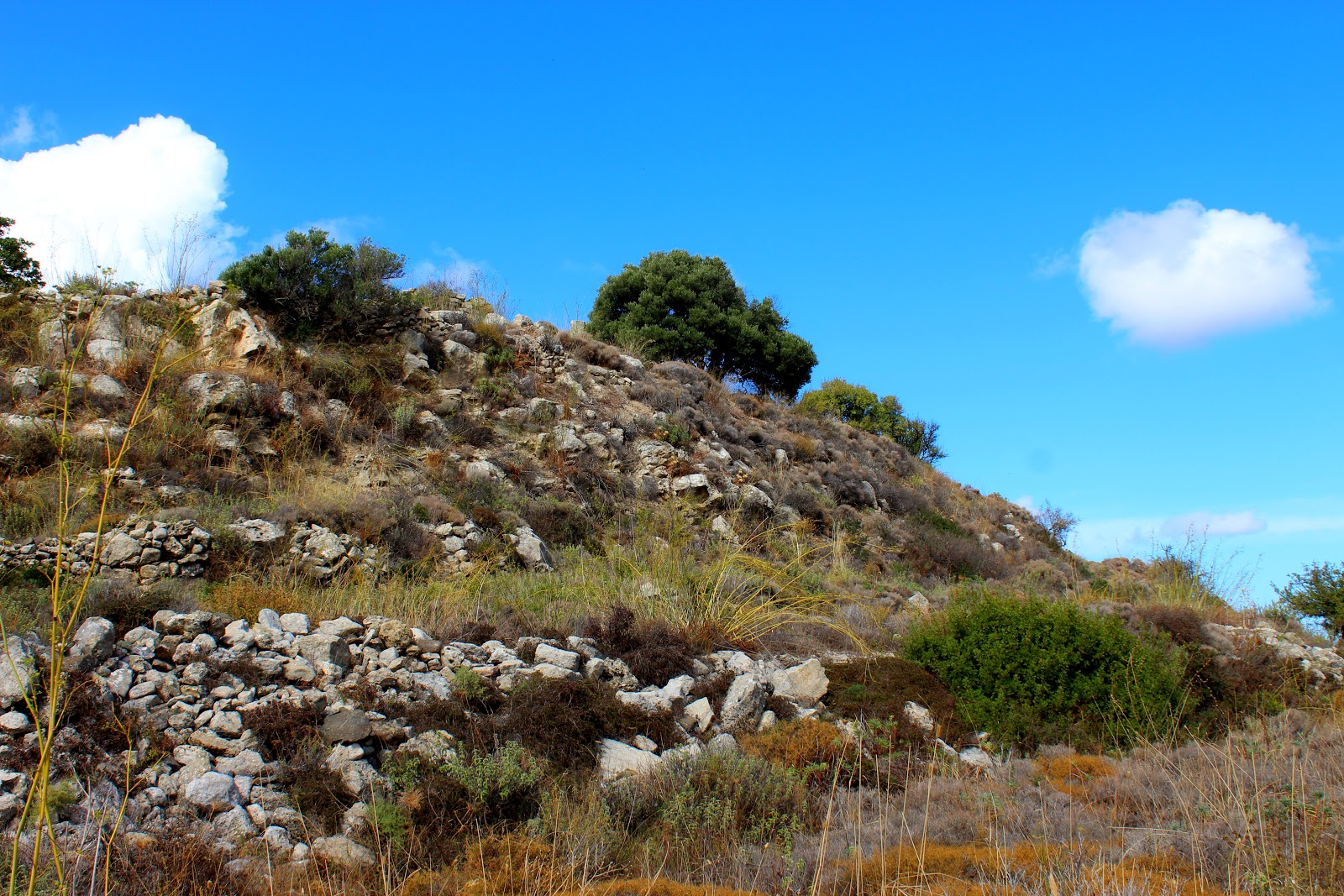
Praesos archaeological site
A couple of weeks back we were overlooking the Venetian hill fort of Monte Forte and this week's little excursion takes us even further back in time to the Ancient town of Praesos. It's pretty well an old pile of stones now and nobody lives there but hopefully we'll find some wildlife. Well, here it is and it looks like we've got a hill to climb so I'll tell you what I know about the place on the way up. Two thousand two hundred years ago it was inhabited by the descendants of the Minoans and they were having a pretty hard time of it. This was because most of Crete had been taken over by the Dorians from mainland Greece and Praesos was one of the last outposts. These Dorians held Itanos to the north and Ierapetra to the south and Praesos finally fell to the Ierapetran Dorians in 155BC. Incidentally Praesos is also a genus of Geometer moths but as to why is a bit of a mystery as they are found in Australia I believe. 

When they weren't being attacked they lived pretty well. There were more animals about in those days including deer and boar which are no longer here and they farmed both livestock and crops. Roasted and stewed meats were both on the menu along with green vegetables and, looking around, they certainly seemed to have a wide variety of herbs to flavour things up with. Just in this small area I can see Sage, Fennel and even some Pot Marjoram. Such a redolent array is also very attractive to butterflies of course and I can see quite a number flitting about. Let's try to get on closer terms with some of them.

Wall Butterflies, Lasiommata megara
Hmm, voyeuristically close it would seem. These are a pair of Wall Butterflies,  doing what comes naturally. The female is underneath with her wings spread while the male is on top, facing backwards, with his wings closed (a position I doubt you'll find in the Kama Sutra). Often, when they are not mating, they hold their wings two thirds open on a flat surface (such as a wall which is how they got their common English name) in order to get the warmth from both direct and reflected sunlight. However, in the heat of the Cretan day you are as likely to find them sheltering in the shade.


Huntsman Spider, Eusparassus walckenaerius
Oh look, a little room. I wonder if there's anybody in? I've found someone under a stone in the corner – come and meet her. This lady (and I think that from her size we may assume that she's a lady) goes by the delightful name of Eusparassus walckenaerius and she and her kin are fairly common Huntsman Spiders here in Crete. I appreciate that if you are not fond of spiders then she may give you the heebie-jeebies and this is why you've just demonstrated the old stage direction 'exeunt omnes in divers alarums' (or something of that ilk) but she's an incredibly useful little predator. For one thing she'll take on some of the larger insects like cockroaches which none of us particularly want hanging about the house. Anyhow, I'll gently replace her stone and we'll see if we can find something a little cuter to have a look at.

Balkan Green Lizards, Lacerta trilineata
How about these fellows? You've got to love a lizard and they're darting about all over the place up here. These are Balkan Green Lizards and they are the largest lizards that you will find on Crete, or indeed, in Greece. Yes, I appreciate that they are rather small and brown but that is because they haven't grown up yet. When they do they will be big and bright green. Their scientific name is Lacerta trilineata, the trilineata bit referring to the three lines which you can clearly see when you look down upon them. When they mature and turn green you rather lose sight of these lines and the English name becomes more descriptive than the scientific one.

We are now at the top so it seems to be a good place to lounge with the lizards in the sunshine and admire the view. That's Sitia that you can see in the distance nestling on the shores of the Aegean.

The Extra Bit

It is about this time of the year that I start to feed the birds at home and this year I've set up the trailcam to record the various species and any other non avian visitors to the table. So far I've only had a trio of Great Tits and a handful of Italian Sparrows but it's early days yet. I'll keep you posted.

P.S. Iris the Mediterranean Mantis is still clinging to the Fennel by the gate.


Photographic Bit

Many of you have asked me what photographic equipment I use so here's a quick rundown on the cameras used for each picture. For details of aperture settings, shutter speeds etc. my pictures will be on Flickr within a few days and that has all the geeky stuff.

Picture 1 Canon EOS 1300D
Insets
Picture 2 Nikon COOLPIX S33
Insets Canon EOS 1300D
Picture 3 Canon EOS 1300D
Insets
Picture 4 Nikon COOLPIX S33
Insets Canon EOS 1300D
Picture 5 Nikon COOLPIX S33
Insets Canon EOS 1300D
Extra Bit pictures Trail Camera RD1000

Pictures were edited with FastStone Image Viewer and combined with Microsoft Paint.


*********************************************************************
LINKS:
Share your nature thoughts, photos and comments on Naturalists (the facebook page that accompanies this blog)
See detailed pictures on Flickr
Read more about the flora and flora of the island in The Nature of Crete (Flipboard Magazine)
Explore the region with the #CreteNature interactive Hiking and Nature Map

Wednesday, 22 April 2015

In The Arms of Giants


Did anyone think to bring a bullwhip? A pity because after last week’s leisurely stroll Along The Ardefsi I have a feeling that today’s excursion is going to be a bit more Indiana Jones. Our objective, ladies and gentlemen, is to examine the area around and on top of that grasping claw-like edifice down there. There’s a second one in the distance, beyond the ardefsi. It’s not hard to imagine one of the Giants of Greek mythology, Pallas or Porphyrion say, taking a breather during their battle with The Gods and resting here with his hands upon his knees, gazing out to sea wondering how and when the battle would end. From such landscapes were the Greek myths concocted. The Giants lost by the way, after a bit of chicanery from Zeus prevented Ge from finding a magic herb. Anyhow let’s get down there and see what magic herbs and other wonders of nature we can locate today.

Darkling Beetle, Lower Chafer and Long-horned Beetle
Now somehow we’ve got to find a way up there but before we do it seems we are in the middle of a beetle drive. Firstly, when we left the road we had a little Darkling Beetle mooching about on that parasitic Dodder plant that we came across a couple of weeks ago (rather worryingly it has now spread to a second clump of Cretan Ebony thirty paces further down the hill). Then, here on this Cistus we have a Flower Chafer, a name it derives from the Old English word ceafor meaning beetle. And finally, our friend from last week, the Long-horned Beetle tucking into another Asphodel. Three beetles from three different families, that’s a good start to the day.


Honey Bees on Sage
Well, that wasn’t too bad was it? Now we’re up on top of the Giant’s hand the views are stupendous and the air is full of the scent of wild herbs and the soft drone of pollinating insects. It seems as if we have entered a honey factory. It’s this purple flowering Sage that seems to be attracting the Honey Bees. Not all bees make honey of course; of the twenty thousand or so known species of bee there are only seven species that make the honey for our table.  The sage that they’re working on is a wonderful plant. Apart from being a delicious accompaniment to pork dishes it has been recommended for virtually every ailment known to man at various times. Even its scientific name, Salvia, comes from the Latin salvere meaning to save. Modern research has proved it to have many useful properties from anti-sweating agents to blood fat reduction through to the management of mild to moderate Alzheimer’s disease. Perhaps this was the magic herb that Ge was looking for before Zeus thwarted her plans.

Great Tit in the Pines
Let’s leave the honey bees to their industry and go and rest awhile in the shade of the fir trees. Isn’t it amazing how they seem to grow out of solid rock? Lying here is like listening to nature’s orchestra with the bees providing the bass drone, the crickets and grasshoppers on percussion and the birds providing the melodies. The greenfinches and the chaffinches counterpointing one another and the loud pitchoo of the great tit providing the main theme.  It’s strange; although the Great Tit is quite common in these parts I’ve never seen a Blue Tit down here. I’ve seen them in Rethymno and on the Omalos Plateau but never here in Lassithi.  I wonder if there is a line across the island beyond which they will not venture.

 [A quick survey for those of you who live on the island – let me know where you do see (and where you don’t see) Blue Tits on Crete and I’ll try to build up a map.]


Mediterranean Slant-faced Grasshopper Nymph
If we stroll along the Giant’s forearm towards its elbow, as it were, I fancy we’ll find a somewhat less arduous way of getting back to our start point. Quite a few more orchids among the stones here and a little Restharrow I haven’t seen before… and who’s this lurking at my feet? A young Mediterranean Slant-faced Grasshopper. Do you remember the cheeky adult which perched on my pack up at The Hidden Plateau? This is a youngster of a closely related species. Between egg and adult insects have two different ways of growing up. Some, like the beetles and butterflies hatch into larvae and eat like mad for a bit before going into a sort of suspended animation called a pupa where they change their body shape completely. This is known as complete metamorphosis. Others such as grasshoppers and crickets don’t entertain all that palaver but hatch as miniature adults, gradually changing their appearance in a series of moults as they grow bigger. This is known as incomplete metamorphosis. The various stages are called instars and, particularly the late instars when they are almost fully grown but look quite different to the mature adult, can fool you into thinking that you have found a completely new species. So we’ll photograph this little chap and add him to our species record for future reference. So, a pleasant perambulation back through this garden of The Gods and then a little lunch somewhere I think.

Until next week – happy hunting.


***********************************************************************************
With special thanks this week to Michael Geiser,  Cosmin Manci and Apostolos Trichas of the  Coleoptera Group for providing me with detailed information on the various subfamilies of the Tenebrionidae Darkling beetles and also to Axel Hochkirch at The Orthopterists' Society for recognising the Mediterranean Slant-faced Grasshopper nymph and suggesting the species.

LINKS:
Naturalists (the facebook page that accompanies this blog)


Recent Posts