Showing posts with label Wall Butterfly. Show all posts

Wednesday, 15 November 2017

Further back in Time – to Praesos

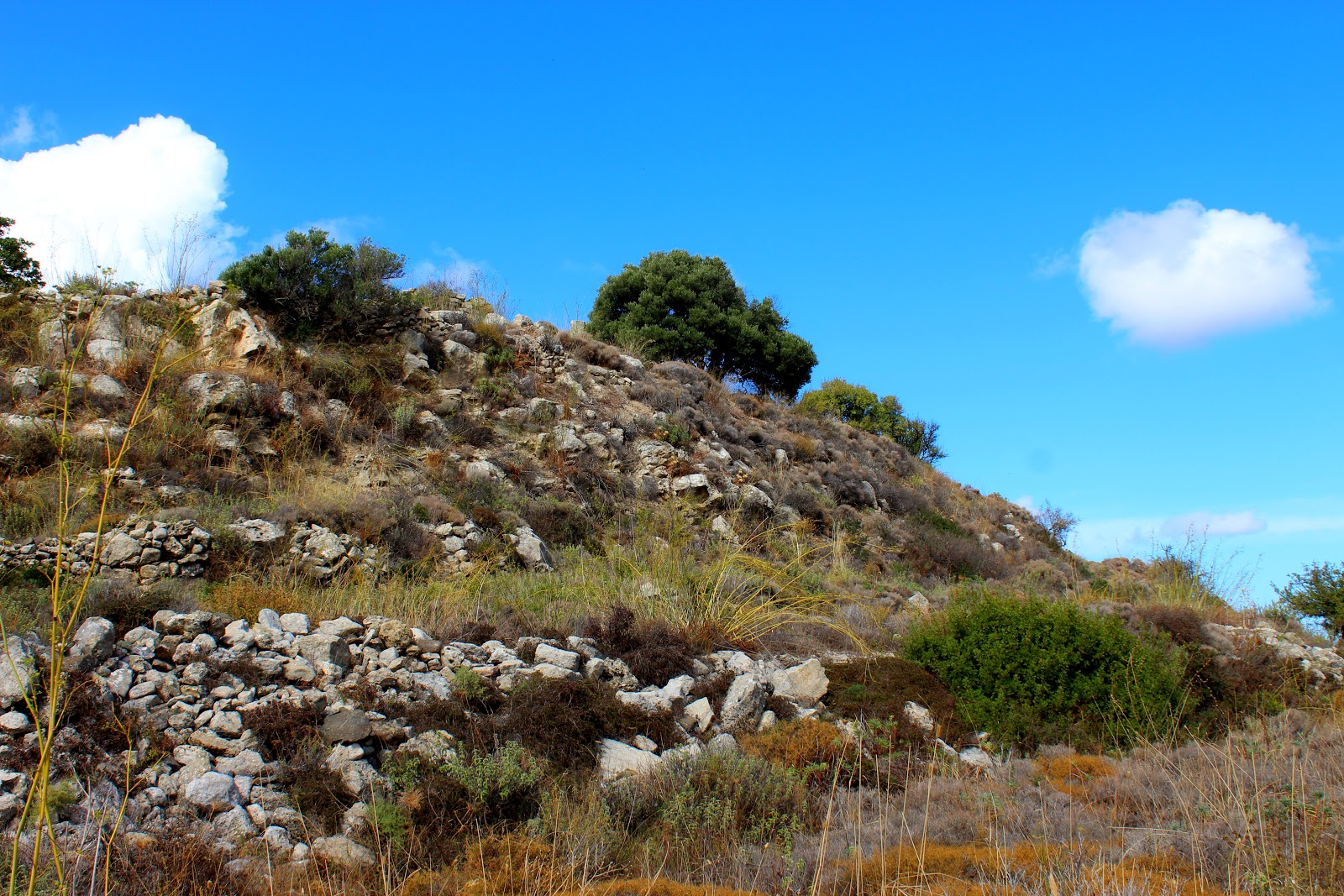
Praesos archaeological site
A couple of weeks back we were overlooking the Venetian hill fort of Monte Forte and this week's little excursion takes us even further back in time to the Ancient town of Praesos. It's pretty well an old pile of stones now and nobody lives there but hopefully we'll find some wildlife. Well, here it is and it looks like we've got a hill to climb so I'll tell you what I know about the place on the way up. Two thousand two hundred years ago it was inhabited by the descendants of the Minoans and they were having a pretty hard time of it. This was because most of Crete had been taken over by the Dorians from mainland Greece and Praesos was one of the last outposts. These Dorians held Itanos to the north and Ierapetra to the south and Praesos finally fell to the Ierapetran Dorians in 155BC. Incidentally Praesos is also a genus of Geometer moths but as to why is a bit of a mystery as they are found in Australia I believe. 

When they weren't being attacked they lived pretty well. There were more animals about in those days including deer and boar which are no longer here and they farmed both livestock and crops. Roasted and stewed meats were both on the menu along with green vegetables and, looking around, they certainly seemed to have a wide variety of herbs to flavour things up with. Just in this small area I can see Sage, Fennel and even some Pot Marjoram. Such a redolent array is also very attractive to butterflies of course and I can see quite a number flitting about. Let's try to get on closer terms with some of them.

Wall Butterflies, Lasiommata megara
Hmm, voyeuristically close it would seem. These are a pair of Wall Butterflies,  doing what comes naturally. The female is underneath with her wings spread while the male is on top, facing backwards, with his wings closed (a position I doubt you'll find in the Kama Sutra). Often, when they are not mating, they hold their wings two thirds open on a flat surface (such as a wall which is how they got their common English name) in order to get the warmth from both direct and reflected sunlight. However, in the heat of the Cretan day you are as likely to find them sheltering in the shade.


Huntsman Spider, Eusparassus walckenaerius
Oh look, a little room. I wonder if there's anybody in? I've found someone under a stone in the corner – come and meet her. This lady (and I think that from her size we may assume that she's a lady) goes by the delightful name of Eusparassus walckenaerius and she and her kin are fairly common Huntsman Spiders here in Crete. I appreciate that if you are not fond of spiders then she may give you the heebie-jeebies and this is why you've just demonstrated the old stage direction 'exeunt omnes in divers alarums' (or something of that ilk) but she's an incredibly useful little predator. For one thing she'll take on some of the larger insects like cockroaches which none of us particularly want hanging about the house. Anyhow, I'll gently replace her stone and we'll see if we can find something a little cuter to have a look at.

Balkan Green Lizards, Lacerta trilineata
How about these fellows? You've got to love a lizard and they're darting about all over the place up here. These are Balkan Green Lizards and they are the largest lizards that you will find on Crete, or indeed, in Greece. Yes, I appreciate that they are rather small and brown but that is because they haven't grown up yet. When they do they will be big and bright green. Their scientific name is Lacerta trilineata, the trilineata bit referring to the three lines which you can clearly see when you look down upon them. When they mature and turn green you rather lose sight of these lines and the English name becomes more descriptive than the scientific one.

We are now at the top so it seems to be a good place to lounge with the lizards in the sunshine and admire the view. That's Sitia that you can see in the distance nestling on the shores of the Aegean.

The Extra Bit

It is about this time of the year that I start to feed the birds at home and this year I've set up the trailcam to record the various species and any other non avian visitors to the table. So far I've only had a trio of Great Tits and a handful of Italian Sparrows but it's early days yet. I'll keep you posted.

P.S. Iris the Mediterranean Mantis is still clinging to the Fennel by the gate.


Photographic Bit

Many of you have asked me what photographic equipment I use so here's a quick rundown on the cameras used for each picture. For details of aperture settings, shutter speeds etc. my pictures will be on Flickr within a few days and that has all the geeky stuff.

Picture 1 Canon EOS 1300D
Insets
Picture 2 Nikon COOLPIX S33
Insets Canon EOS 1300D
Picture 3 Canon EOS 1300D
Insets
Picture 4 Nikon COOLPIX S33
Insets Canon EOS 1300D
Picture 5 Nikon COOLPIX S33
Insets Canon EOS 1300D
Extra Bit pictures Trail Camera RD1000

Pictures were edited with FastStone Image Viewer and combined with Microsoft Paint.


*********************************************************************
LINKS:
Share your nature thoughts, photos and comments on Naturalists (the facebook page that accompanies this blog)
See detailed pictures on Flickr
Read more about the flora and flora of the island in The Nature of Crete (Flipboard Magazine)
Explore the region with the #CreteNature interactive Hiking and Nature Map

Wednesday, 1 April 2015

The Chamomile Lawn


We had a nice little relaxing stroll last week along the banks of the Milonas stream but a bit more effort will be required this week as we’re heading further up into the valley where the stream shows a totally different side to its character. We’ve got a lovely day for scrabbling around the hills, about twenty degrees C with a little cloud cover and with the rain we’ve had over the past week the flowers and insects should really be bursting into life.

Orange Blossom Bugs on Yellow Asphodel
At the beginning of the year we were looking for the first Yellow Asphodels and now they are dying off but they are not without their attractions, especially to these bugs. Smell is very important in the natural world and plants produce various aromatic chemicals to attract different insects. As their name suggests these bugs, (Horistus infuscatus to give them their scientific name) are attracted to sweet smelling orange blossom. However they have also been documented as being attracted to certain Arum lilies that smell of dung. As far as I know no-one has documented their relationship with dying Yellow Asphodels. Stick your nose in one and tell me how it smells will you? It’s a bit like marketing, each plant uses a different slogan as it were to attract a particular demographic. 

Crag Martins and a Buzzard over the ravine
We seem to have reached a point where the valley below us narrows considerably and just look at the cliff face opposite us. These are sedimentary rocks and you can see quite clearly how they have been formed layer by layer. We’re looking at slices through time here, an ancient sea bed laid down over millennia. The flying black dots you can see flitting around the face are Crag Martins, dusky relatives of the more familiar House Martin. And look, there’s our old friend the Buzzard patrolling the skies above. We’ve climbed to about 200 metres now so let us push on through this rocky terrain as it slopes down towards the edge of the ravine.


Orchids galore and a Malthodes Soldier Beetle
I expected to see a few flowers today but I don’t think I’ve ever seen so many Orchids as we have up here, you can hardly put your foot down without treading on one. Some of these, the so called Bee Orchids, use another marketing strategy to attract pollinators. They’ve evolved to look like the backs of female bees which attracts male bees like, well, bees round a honey pot to coin a phrase. We all know that sex sells but orchids knew that long before Madison Avenue. Cast your mind back a fortnight to when we came off The Hidden Plateau. Do you remember we found a Malthodes Soldier Beetle of which nine species have so far been discovered on the island (and there may be others waiting to be discovered)? Just look up in the top right of that Butterfly Orchid, I do believe we’ve found another one. We’re right off the beaten track here in a relatively unexplored part of the island so just maybe, we’re the first people ever to see this particular species of beetle. That’s an exciting thought.


A Wall Butterfly on the Chamomile lawn
Now doesn’t that look inviting? After all that clambering over rocks and pushing our way through bushes we can stretch out and relax on a chamomile lawn a la Mary Wesley (although she left the ‘h’ out). There are many of these daisy like plants that are commonly called something Chamomile but only Matricaria chamomilla (German Chamomile) and Chamaemelum nobile (Roman Chamomile) are generally used for making Chamomile tea. Even my inadequate nose tells me that it is not either of those and I rather suspect that it’s one of the Field Chamomiles of the closely related Anthemis species. Nevertheless it’s very pleasant to lay down in for a bit and watch the butterflies.

Fritillary and Valerian
Come on, if we stay here much longer I shall be lulled to sleep by the drone of the insects in the warm sun. Let’s see if we can get to the lip of the ravine. Now that is what I call a dramatic view. I don’t suffer from vertigo as such but I have a healthy respect for heights and the distant ground below and have no wish to fill the intervening space between with something me shaped so I suggest we watch our footing very carefully here. And what a bonus, a plant I haven’t come across before. It’s a Fritillary which derives from the Latin for dice box although I believe the Americans call them Mission Bells which seems an even more apt name. Although many species contain poisonous (even deadly) alkaloids, extracts are combined with loquat in traditional Chinese cough medicines. The other plant which seems particularly abundant up here is Valerian. Now this plant, who’s name derives from the Latin valere meaning to be healthy, has been used since Hippocrates time particularly to relieve insomnia and the jury is still out as to whether it is an efficacious substitute for anxiety relieving drugs such as benzodiazepines. Whichever, if you suffer in this regard and are currently a benzo-addict, there are few known side effects and it may be worth looking into as an alternative to (but not in conjunction with) such drugs. Check it out with your doctor first though. Personally I find that our best cure for stress is to do just what we’re doing today – get out in the open air and marvel at the fascinating world around us.


Until next week – happy hunting.


***********************************************************************************
LINKS:


Naturalists (the facebook page that accompanies this blog)


Recent Posts