Showing posts with label sea rocket. Show all posts

Wednesday, 13 July 2022

Umami


Sweet, sour, salty and bitter. Until 1985, these were the four basic tastes that the human tongue was thought to recognise. Then came Umami. First proposed by Japanese scientist, Kikunae Ikeda in 1908, it took 77 years for the scientific establishment to accept it. It can best be described in English as savouriness and involves taste receptors recognising two organic molecules present in some foodstuffs called glutamates and nucleotides. They also give food that moreish quality, and food manufacturers have latched onto this in a big way by adding Monosodium glutamate (MSG) to processed foods ever since. Today we've come down to the sea shore, here on the Solway Firth, to find a natural source of Umami.


The best time for foraging the sea shore is an hour or two before low tide. If you're lucky, you can find oysters, mussels and even scallops if it's a particularly low spring tide. We're not so lucky today, the only oysters I've seen are empty shells. Maybe I haven't got my eye in. Oysters try very hard to look like the rocks and pebbles they nestle amongst. You have to try and find a bit of rock that seems to be trying just that bit too hard. Plenty of mussels but they're rather small. Check your local by-laws for minimum sizes of shellfish you are allowed to collect. All shellfish are sources of Umami, but they're not what we're after today.
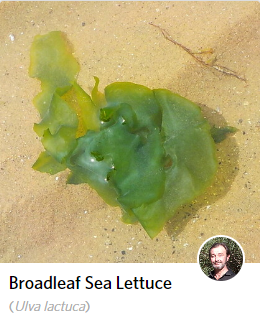


This is what we're after, sea lettuce. Unlike foraging for plants or mushrooms, seaweeds are completely safe. There are no poisonous seaweeds to be found upon the sea shore. The only caveat is pollution. Avoid taking seaweeds from harbours or places where the water quality is dubious. Information on sea water quality is readily available online. Seaweed is packed full of glutamates and the best source of natural Umami. Don't strip a whole rock, just take a few bits here and there until you have a bagfull.


We'll go home and hang it in a supermarket vegetable bag outside until it's dry. But first, on our way back there are a couple of shore plants that I spotted that also make good eating. This first one is Sea Sandwort, which can be eaten raw or cooked and is packed full of vitamins A and C. The second is Sea Rocket, which you can use like ordinary rocket. It's bitter if cooked but if you want it in a hot dish, quickly blanching it in boiling water is OK.


So now we have our dried seaweed, (which keeps almost indefinitely by the way) what to do with it? My favourite way is to quickly deep fry it for about 10-15 seconds. You can add it to any dish, and although it does not have a strong flavour of its own, the glutamates really enhance the flavour of everything else on the plate. Mushrooms taste more mushroomy nad meat more meaty. Tonight we'll have a simple chicken cordon bleu laid on a bed of deep fried seaweed. Delicious.


Beetles and Butterflies; spiders and scorpions; woodlice and worms. How do you tell them all apart? To say nothing of crane flies, dragonflies, bee flies and yet more butterflies. Are they all flies? If not, why call them so? If you're fascinated but confused by the beautiful world of the very small, then this is the book for you.

82 pages of information on all aspects of the world of minibeasts, with over 100 photographs and illustrations, this book will help you track down and identify any arthropod, in its adult or juvenile state, anywhere in the world.

See all of my books at author.to/SteveDaniels


I've recently started a new set of blogs called 'Steve's History of Things'. So if you're interested in history as well as natural history, take a look.


Steve's History of Things 1 – Introduction

Steve's History of Things 2 – 5 Good Reasons to Buy EPNS


All the best,


Steve


Follow me on Steve's Nature Plus

and also on


Steve's Nature


Steve Daniels Naturalists


Steve Daniels Cumbria


Wednesday, 20 June 2018

Crete Nature Almanack 2018 – Summer


Summer is here, the temperatures are regularly over 30C (86F) and sometimes over 40C (104F), so there is only one place to be; the sea. The shallow waters are teeming with fish like these (Yellowtail Barracuda I think) whilst Brittlestars clamber among the rocks and Sea Hares mate among the seaweed fronds.


Flowers are few and far between in the height of summer but as you wander along the beach look out for Sea Daffodils, Yellow Horned Poppies and Sea Rocket.


If you wander inland through the grasses see if you can find some of these amazingly beautiful insects. It's a Cretan Bright Bush Cricket and you'll only find it here on Crete (if you're lucky!)


And finally... towards the end of August watch out for the massed congregations of European Barn Swallows as they gather together for their migration to sub-Saharan Africa.


The Extra Bit

The Crete Nature Blog will take its annual summer vacation now but I'll be back in the autumn with more delights of the Cretan countryside. Have a great summer folks (or winter if you're in the southern hemisphere).

LINKS:
Share your nature thoughts, photos and comments on Naturalists (the facebook page that accompanies this blog)

Explore the region with the #CreteNature interactive Hiking and Nature Map


Wednesday, 19 April 2017

Taking It Easy


What a lovely day for wandering along the beach and taking it easy after our exertions down the valley. I see that we have another of those Bee flies that we were discussing a few weeks back (see The Sweet Smell of Rain) investigating the sand. Quite an absorbing pastime and there are hobbyists who collect sand, studying its composition from places around the world. The bit that the bee fly is studying for instance contains dark grains, pure white grains and at least fifty shades of grey in between. The colours are determined by the mineral content and the shape depends upon whether it has been washed down from the hills or transported by wind and waves. Ours is angular suggesting that it has come down the valley like us and the colouration is typical of quartz and chert with that odd orange bit by his abdomen probably coming from one of the iron bearing rocks that we observed in How To Get Blood Out Of A Stone.

Let's walk along the back of the beach and see what else we can find. Those bunches of strap like leaves will throw up fragrant blooms of white Sea Daffodils in the summer but we have one common beach plant blossoming here and now and that's Sea Rocket. The seed pods have a very high concentration of erucic acid which is an omega 9 fatty acid and has a bit of a story behind it. You may be familiar with great yellow fields of rape, from which we get rapeseed oil. Rape and sea rocket are closely related and both contain high levels of this acid. We cultivate rapeseed oil for biofuel, animal feed and edible oil but the high levels of erucic acid became a cause of concern after laboratory tests in the 1970s showed that if you stuffed rats full of the stuff then it had a toxic effect on the heart. To be honest, if you pig out exclusively on anything it will probably do you harm – even water can poison you in high enough doses. Enter two bright sparks from the University of Manitoba in Canada who bred rapeseed low in erucic acid and called it Canola oil. Nowadays we just genetically modify the plant of course and canola is widely marketed as the healthy cooking oil. I'll let you make your own mind up on that one.

Here's a pretty little lady, she's a Long tailed Blue. Not as showy as the male who has a lot more blue on his upper wings but it pays not to be too conspicuous when you're sitting there egg laying. This maybe what she has in mind now. Her caterpillars feed on a wide range of leguminous plants in the Fabaceae family such as this Cretan Ebony which is just coming into flower. Shall we take a wander down to the sea and clamber along those interesting looking rocks over there?


That seems like a nice place to stop and watch the marine world go by. Not much in the way of fish today... the odd shore crab scuttling about... but there's some seaweed down there which may be harbouring some microscopic life. Let's have a look. Ah, our old friends the diatoms, the very basis of the food web. These are marine diatoms and different to those that we found under the dripping stalactite in A Recipe For Life.
Those wedge shaped ones often cluster together, narrow ends facing inwards, so that they make a complete circle like a flower head. I expect that we disturbed them when we rudely hauled them out of the sea and plonked them on a microscope slide. I think we'll rinse the slide and put them back. You know, it's almost warm enough to join them in there. Maybe in a couple of weeks. When the sea's had a chance to warm up a bit.

The Extra Bit

If you'd like to become an arenophile and collect sand as a hobby there's a society just for you: http://sandcollectors.org/become-a-collector/


*********************************************************************
LINKS:
Share your nature thoughts, photos and comments on Naturalists (the facebook page that accompanies this blog)
See detailed pictures on Flickr
Read more about the flora and flora of the island in The Nature of Crete (Flipboard Magazine)

Recent Posts