Showing posts with label seaweed. Show all posts

Wednesday, 5 October 2022

Watching Out For Watercress


Just to the south of St. Bees, in an area known as Seamill (named after a now demolished grain mill by the sea), Pow Beck flows into the Irish Sea. Our reason for visiting here today is to look for watercress. I know it can be found here because I searched 'watercress' 'Cumbria' on iNaturalist and up popped a picture of watercress and a map showing its location. (iNaturalist is a very useful app. for foragers). Unfortunately, I can't see any about today, only some Fool's Watercress, which often grows in conjunction with true watercress. Fool's watercress is edible, and is harvested in many Mediterranean countries, but it can be confused with the similar looking Lesser Water Parsnip (Berula erecta). Although an infusion of this plant is said to be good for Athlete's Foot, it is probably best not to eat it.


There is also some Comfrey growing along the bank, being pollinated by a busy Carder Bee. This is another medicinal plant, known in the olden days as Knitbone. Other cultures have similar names alluding to its efficacy in healing broken bones. And whilst we're looking at insects, there's a pair of Small Whites mating over there. The female, with the single wing spot, is underneath, and the male, with the double wing spot, is on top. And now, my annual plea to gardeners: please don't cut your ivy back. Ivy is one of the late flowering plants that is a godsend to nectar feeding insects at this time of year. This bush, near my home, had no less than seven Red Admiral butterflies feeding on it the other morning.


Now, that's strange. It looks to be a perfectly normal waymarking stone, of the type found all over Cumbria, but Mattie won't go anywhere near it. Indeed, she's very reluctant to even walk past it. Has anyone else had similar experiences with their dogs?

What's up, Mattie? Have you been eating those mushrooms back there?”

I ask, because those mushrooms are Liberty Caps, and they contain three different psychoactive compounds. Back in 1799, a family accidentally included these, which they'd collected in Green Park in London, in a family meal, and got more than a trip to the park. The effects are similar to, but not as intense, as LSD. And just in case you're thinking, 'I might just go and find me some of those', beware! There are some very similar looking poisonous fungi out there. In Austria, a healthy young man confused them with Deadly Webcaps and required a kidney transplant.


We're on much safer ground with seaweed (see Umami), so let's go and have a look in those rock pools and see what we can find. A fair amount of Irish Moss, also known as Carrageen. It has been used as a food additive to promote gelling since the 16th century. In Europe it is the source of E407. Not all E numbers are unnatural. I'll be putting up a new seaweed recipe in Steve's Wild Kitchen later in the week.


A bit of other news now. Hopefully, if all goes well, my first full length novel, The MONOM, will be released later this month. The MONOM stands for The Magic of Nature of Magic. There are three main characters in the book: A 19th century naturalist called Singent Hellington-White, myself (as narrator) and you, the reader. Of course, we have a Nemesis, and one of your first tasks will be to identify him, her or possibly even, them. You will be in danger. You will be frightened. But always remember Singent's Maxim -


Magic is the application of natural forces that, as yet, we do not fully comprehend”.


For this is a book about the natural, and the supernatural, world. You can keep up with all my blogs, books, recipes, and a lot more by scrolling down to the bottom of Steve's Nature Plus and hitting the Subscribe button.


All the best,


Steve


Beetles and Butterflies; spiders and scorpions; woodlice and worms. How do you tell them all apart? To say nothing of crane flies, dragonflies, bee flies and yet more butterflies. Are they all flies? If not, why call them so? If you're fascinated but confused by the beautiful world of the very small, then this is the book for you.

82 pages of information on all aspects of the world of minibeasts, with over 100 photographs and illustrations, this book will help you track down and identify any arthropod, in its adult or juvenile state, anywhere in the world.

See all of my books at author.to/SteveDaniels

Follow me on Steve's Nature Plus

and also on


Steve's Nature


Steve Daniels Naturalists


Steve Daniels Cumbria


Wednesday, 13 July 2022

Umami


Sweet, sour, salty and bitter. Until 1985, these were the four basic tastes that the human tongue was thought to recognise. Then came Umami. First proposed by Japanese scientist, Kikunae Ikeda in 1908, it took 77 years for the scientific establishment to accept it. It can best be described in English as savouriness and involves taste receptors recognising two organic molecules present in some foodstuffs called glutamates and nucleotides. They also give food that moreish quality, and food manufacturers have latched onto this in a big way by adding Monosodium glutamate (MSG) to processed foods ever since. Today we've come down to the sea shore, here on the Solway Firth, to find a natural source of Umami.


The best time for foraging the sea shore is an hour or two before low tide. If you're lucky, you can find oysters, mussels and even scallops if it's a particularly low spring tide. We're not so lucky today, the only oysters I've seen are empty shells. Maybe I haven't got my eye in. Oysters try very hard to look like the rocks and pebbles they nestle amongst. You have to try and find a bit of rock that seems to be trying just that bit too hard. Plenty of mussels but they're rather small. Check your local by-laws for minimum sizes of shellfish you are allowed to collect. All shellfish are sources of Umami, but they're not what we're after today.


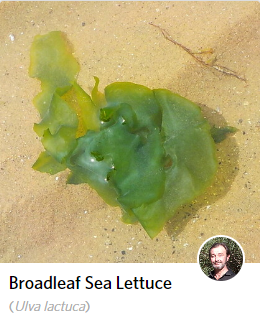
This is what we're after, sea lettuce. Unlike foraging for plants or mushrooms, seaweeds are completely safe. There are no poisonous seaweeds to be found upon the sea shore. The only caveat is pollution. Avoid taking seaweeds from harbours or places where the water quality is dubious. Information on sea water quality is readily available online. Seaweed is packed full of glutamates and the best source of natural Umami. Don't strip a whole rock, just take a few bits here and there until you have a bagfull.


We'll go home and hang it in a supermarket vegetable bag outside until it's dry. But first, on our way back there are a couple of shore plants that I spotted that also make good eating. This first one is Sea Sandwort, which can be eaten raw or cooked and is packed full of vitamins A and C. The second is Sea Rocket, which you can use like ordinary rocket. It's bitter if cooked but if you want it in a hot dish, quickly blanching it in boiling water is OK.


So now we have our dried seaweed, (which keeps almost indefinitely by the way) what to do with it? My favourite way is to quickly deep fry it for about 10-15 seconds. You can add it to any dish, and although it does not have a strong flavour of its own, the glutamates really enhance the flavour of everything else on the plate. Mushrooms taste more mushroomy nad meat more meaty. Tonight we'll have a simple chicken cordon bleu laid on a bed of deep fried seaweed. Delicious.


Beetles and Butterflies; spiders and scorpions; woodlice and worms. How do you tell them all apart? To say nothing of crane flies, dragonflies, bee flies and yet more butterflies. Are they all flies? If not, why call them so? If you're fascinated but confused by the beautiful world of the very small, then this is the book for you.

82 pages of information on all aspects of the world of minibeasts, with over 100 photographs and illustrations, this book will help you track down and identify any arthropod, in its adult or juvenile state, anywhere in the world.

See all of my books at author.to/SteveDaniels


I've recently started a new set of blogs called 'Steve's History of Things'. So if you're interested in history as well as natural history, take a look.


Steve's History of Things 1 – Introduction

Steve's History of Things 2 – 5 Good Reasons to Buy EPNS


All the best,


Steve


Follow me on Steve's Nature Plus

and also on


Steve's Nature


Steve Daniels Naturalists


Steve Daniels Cumbria


Tuesday, 14 June 2022

Arran Special 2 - In Search of Seals


It's a beautiful morning, so let's head up the west coast to see what we can find. First stop is the village of Blackwaterfoot where Clauchen Water flows into Drumadoon Bay. A beautiful spot for introducing Mattie to the pursuit of rock pooling and for teaching her that not everything is best investigated by trying to eat it. Like this Blue Jelly for example. The sting of this particular species is quite mild but, if you are stung by a jellyfish do not try to treat it with vinegar, alcohol or urine. It will only make it worse. Better to wash it in sea water and take an antihistamine tablet. Next we have a European Green Crab (AKA Shore Crab) which is native to the north east Atlantic and the Baltic. However, it is listed as one of the world's 100 most invasive species and can be found on coastlines almost everywhere. In New England, they have taken to eating them and have even produced a Green Crab Cook Book. Probably go nicely with a bit of pickled Knotted Wrack which we also have here. Decorate with a few boiled Periwinkles and that's lunch sorted.


Well done Mattie! That's the first of Arran's Big 5, The Common, or Harbour, Seal. There are about eight of them on and around those rocks out there. Harbour seals pretty much stick to the same haul out spots, so these are probably resident here. Now that sealing has been banned in UK waters under the Conservation of Seals Act (1970), they can live to their full term, which is 20-25 years for males and 30-35 years for females. Aren't they beautiful? We'll carry on north, have a spot of lunch somewhere, then Ishbel has spotted an interesting looking walk for this afternoon with some intriguing caves to find.


That was different. Cold jacket potato with chilled coronation chicken and salad. I wonder if it was meant to be served like that? Still, it wasn't quite as unappetising as it sounds. We're on the edge of a fir plantation with a little burn running alongside the path. Looks like a good walk for an insect safari. And that's a good start – a beautiful Golden-ringed Dragonfly. At 7-8cm long with a 10cm wingspan this is Britain's longest dragonfly. In comparison, this Large Red Damselfly, despite its name, is only about half that size. Note the wing positions: out straight = Dragonfly; folded along the back = Damselfly. Over here we have the smallest of the Satyrinids or Brown Butterflies , The Small Heath. These are grassland specialists and the caterpillars feed exclusively on grasses, whereas the adults are nectar feeders. We also have a couple of beetles. There's a Gazelle Beetle, so called because of their speed, and my favourite, the Green Tiger Beetle (another speed merchant in the beetle world – see Water, Water, Everywhere). Dragons and Damsels, Butterflies and Beetles are all covered in The Quick Guide to Creepy-Crawlies.


Ah we've reached the caves. Although the biggest one is called The King's Cave, it's doubtful that this is the one used by Robert The Bruce before the Battle of Bannockburn and I don't see any doggedly determined spiders either. I do see a determined little doggy though. What's she found now? Just time to mention a few of the flowers that I've spotted on the walk. Just outside the cave there are Marsh Orchids and Ragged-Robin as well as some English Stonecrop (seems the English are invading Scotland once again). Down by the sea there's Sea Thrift and Sea Campion, and growing in the burn, some rather tasty water mint.


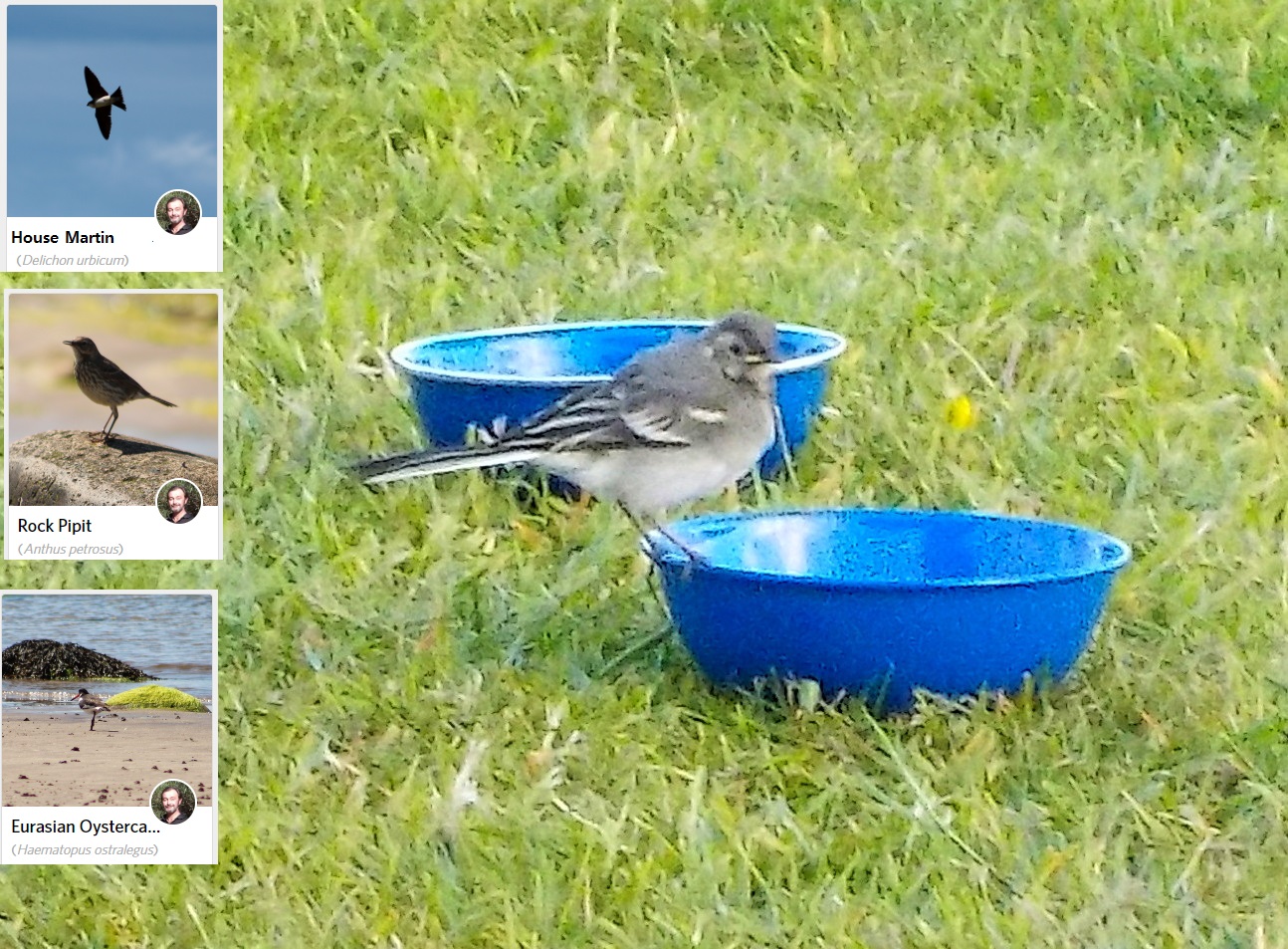
And finally, back at camp, a few more birds to add to our list from yesterday. Firstly, this young Pied Wagtail is being very brave, sipping water from Mattie's bowl, just outside the tent. There are also House Martins flying about, and down on the beach a Rock Pipit and a few Oystercatchers. Tomorrow, we're off to Broddick Castle and we'll take a look around the grounds to see what wildlife we can find there.


Hardback £24.09


Hardback £5.30 Paperback £2.56


Paperback £14.99

Build Your Own Nature Library


See you tomorrow,

Steve

Follow me on Steve's Nature Plus and also on 
Steve's Nature

 Steve Daniels Naturalists

 Steve Daniels Cumbria


Wednesday, 19 April 2017

Taking It Easy


What a lovely day for wandering along the beach and taking it easy after our exertions down the valley. I see that we have another of those Bee flies that we were discussing a few weeks back (see The Sweet Smell of Rain) investigating the sand. Quite an absorbing pastime and there are hobbyists who collect sand, studying its composition from places around the world. The bit that the bee fly is studying for instance contains dark grains, pure white grains and at least fifty shades of grey in between. The colours are determined by the mineral content and the shape depends upon whether it has been washed down from the hills or transported by wind and waves. Ours is angular suggesting that it has come down the valley like us and the colouration is typical of quartz and chert with that odd orange bit by his abdomen probably coming from one of the iron bearing rocks that we observed in How To Get Blood Out Of A Stone.

Let's walk along the back of the beach and see what else we can find. Those bunches of strap like leaves will throw up fragrant blooms of white Sea Daffodils in the summer but we have one common beach plant blossoming here and now and that's Sea Rocket. The seed pods have a very high concentration of erucic acid which is an omega 9 fatty acid and has a bit of a story behind it. You may be familiar with great yellow fields of rape, from which we get rapeseed oil. Rape and sea rocket are closely related and both contain high levels of this acid. We cultivate rapeseed oil for biofuel, animal feed and edible oil but the high levels of erucic acid became a cause of concern after laboratory tests in the 1970s showed that if you stuffed rats full of the stuff then it had a toxic effect on the heart. To be honest, if you pig out exclusively on anything it will probably do you harm – even water can poison you in high enough doses. Enter two bright sparks from the University of Manitoba in Canada who bred rapeseed low in erucic acid and called it Canola oil. Nowadays we just genetically modify the plant of course and canola is widely marketed as the healthy cooking oil. I'll let you make your own mind up on that one.

Here's a pretty little lady, she's a Long tailed Blue. Not as showy as the male who has a lot more blue on his upper wings but it pays not to be too conspicuous when you're sitting there egg laying. This maybe what she has in mind now. Her caterpillars feed on a wide range of leguminous plants in the Fabaceae family such as this Cretan Ebony which is just coming into flower. Shall we take a wander down to the sea and clamber along those interesting looking rocks over there?


That seems like a nice place to stop and watch the marine world go by. Not much in the way of fish today... the odd shore crab scuttling about... but there's some seaweed down there which may be harbouring some microscopic life. Let's have a look. Ah, our old friends the diatoms, the very basis of the food web. These are marine diatoms and different to those that we found under the dripping stalactite in A Recipe For Life.
Those wedge shaped ones often cluster together, narrow ends facing inwards, so that they make a complete circle like a flower head. I expect that we disturbed them when we rudely hauled them out of the sea and plonked them on a microscope slide. I think we'll rinse the slide and put them back. You know, it's almost warm enough to join them in there. Maybe in a couple of weeks. When the sea's had a chance to warm up a bit.

The Extra Bit

If you'd like to become an arenophile and collect sand as a hobby there's a society just for you: http://sandcollectors.org/become-a-collector/


*********************************************************************
LINKS:
Share your nature thoughts, photos and comments on Naturalists (the facebook page that accompanies this blog)
See detailed pictures on Flickr
Read more about the flora and flora of the island in The Nature of Crete (Flipboard Magazine)

Wednesday, 27 May 2015

Creatures of the Blue Lagoon


Last week we finished our wander along the sands of Ferma Bay at a place where a ring of rocks form a sort of lagoon. This is a perfect swimming hole with the water no more than three to four metres deep and it’s absolutely teeming with marine wildlife. So, cozzies on, snorkels to hand and we’ll go and meet some of our watery cousins.


If we occupy this nice big flat rock here it will be ideal for setting out our samples. No, you can’t take half of it with your towel – there will be plenty of time for sunbathing later on. 


Peacock's Tail, Padina pavonica
Just take a look down among the rocks and you’ll see that we have some delicate funnel shaped growths of a seaweed called Peacock’s Tail. It is somewhat unusual in that instead of being brown, green or red like most seaweeds it’s a lovely pearly white colour. Technically it’s a brown alga but the whiteness is caused by deposits of calcium carbonate (as in chalk). If I tell you that it’s scientific name is Padina pavonica some of you of a certain age may be thinking “I’ve heard of that somewhere.” You probably have - Extract of Padina Pavonica or EPP is sold in beauty shops as anti-wrinkle cream. I see that one of the strands down there is growing a blue-green beard which is a trifle unusual and requires investigation. I think we’ll take that home and pop it under the microscope. I wonder if it could cause a similar side-effect in EPP users? Probably not but it’s an amusing thought.


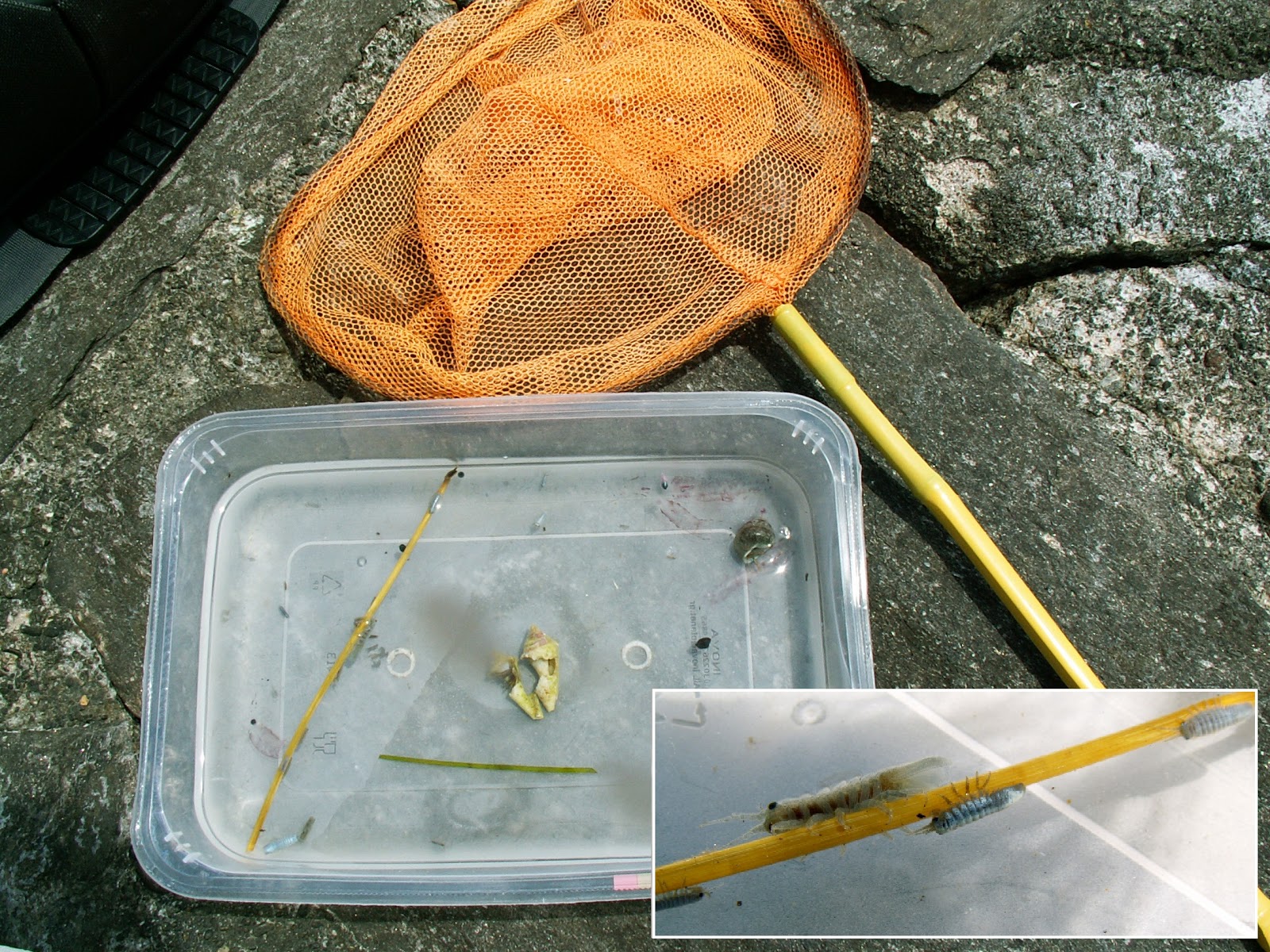
Isopods caught with a simple net and tray
All you need to have hours of amusement down here is a simple net for catching specimens (a couple of euros from any beach shop) and a container to put them in (this one held last week’s pork joint). A quick tip; the net works better if you flatten it at the top. A quick sweep of the surface and one of the floor and we’ll see who’s about. Quite a variety here, including two of the 250+ species of Isopod to be found in the temperate waters of the Mediterranean and the North Atlantic. Isopods are crustaceans, related to crabs and lobsters but working on the theory that more is better they have seven pairs of legs (all roughly similar hence Iso = same and Pod = foot), two pairs of antennae and two penises. Well, if you’ve got it, flaunt it I say.

Crabs are Decapods (Deca = 10 and Pod = foot)
Talking of crabs I see that you have a little Hermit Crab in the tray there. These are the guys that prefer to rent a shell as they go along rather than going for the self-build option that other crabs adopt. They are soft bodied and their abdomens have evolved with a kink to one side, the better to fit into the spirals of discarded mollusc shells. Whilst you’ve been examining him I’ve found a little red job floating around between the rocks. Quite dead unfortunately but in life I suspect he was one of the Spider Crab family which are quite diverse in their appearance but often have a tendency to be red and spiny. A cautious tickling around my heels tells me that while we’ve been investigating them a little Shore Crab has emerged from a crack in the rocks and started to investigate me. Nice to know that curiosity about other species works both ways.


Banded-dye Murex
What else have you got in the tray – a snail giving birth? Let me see. Now that is curious. The animal in question is, I believe, a Murex. Back in ancient times these were big news in the eastern Mediterranean as a magnificent purple-blue dye could be obtained from them. It took so many snails to make one gram of dye that it was prohibitively expensive for all but the highest aristocracy, hence the name for one of the colours it produced: Royal Blue. As to whether it is giving birth, I rather think not. Although some snails do give birth to live young the Muricidae family, to which this one belongs, deposit capsules of eggs in tide pools and the like. However, they’re a carnivorous species, often boring holes into other molluscs to extract the soft parts, so with a small snail like this one maybe they ingest the whole animal, suck out the juicy bits then spit out the shell like we do with olives and their stones.


Baby Squid
On the other hand, this little string of red tinged translucent jelly, squirming around in the tray like someone trying to snuggle down into a duvet with their hands tied behind their back, most definitely is a baby. It’s a baby squid. Squid are related to the Murex and other snails and slugs but they are part of a specific group of molluscs called cephalopods who have their feet attached to their head (kefalo = head pod = foot).  The feet have evolved into tentacles for catching prey and the group includes squid, cuttlefish and octopuses and also the Nautilus which, unlike the other three, has kept its external shell. Maybe we should keep it and raise it to become a politician? After all the best part of presidential or prime ministerial elections are the gaffes made by prospective candidates and cephalopods are always putting their foot in their mouth.


Until next week – happy hunting and I’ll leave you with a video link to watch all these creatures swimming about in the tray.
               
See all the pictures including insets in detail on Flickr


***********************************************************************************
LINKS:
Naturalists (the facebook page that accompanies this blog)


Recent Posts