Steve's History of Things
|
|
|
For
many years I have been writing about natural history. Since moving
back to the old market town of Cockermouth in Cumbria, I have
developed an interest in the past. Initially my interest lay in
scientific instruments and discoveries (John
Dalton, who is
known for his discoveries of atomic theory and colour blindness, was
born In Eaglesfield, a village just down the road). Since then it has
expanded somewhat. My habit of buying interesting items was somewhat
incompatible with living in a bachelor pad, and so I launched Steve's
Vintage Collectables. Now I can buy stuff, live with it for a bit,
and pass it on. This way, I can surround myself with ever changing
interesting things.
.JPG)
From
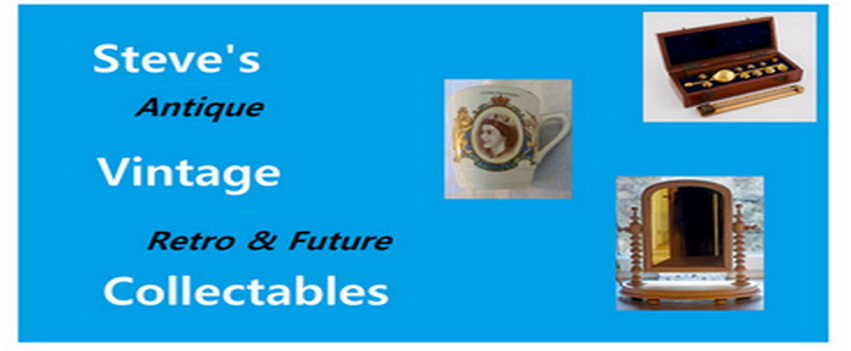
the logo, you can see that I have added Antique, Retro and Future to
Vintage but, what's the difference? Let's start with Antique, as that
is easier to define. It is pretty well universally acknowledged to
mean an object over 100 years old. This barometer, for instance, made
in the late 1800s by James Hicks of London is definitely an antique.
#Vintage
is more difficult to define. Old, but too young to be called antique.
I use it for items 65-100 years old (1922-1957). This
sphygnomanometer (an old fashioned instrument for measuring blood
pressure) probably just about falls into this range. It may possibly
have been made in the early 1960s.
Retro
is even more vague. It simply refers to things people like to collect
from a bygone era, and has more to do with style than age. I use the
term 'retro' on its own for things of the 1960s, 70s and 80s and
'vintage retro' for collectables from the 1920s to the 1950s. Anything after the 80s is too modern for me, but then again I'm bordering on vintage myself.
This model Harrods delivery van candle is a collectable item from the
1980s which I would describe as retro. Etsy's automatic labelling
defines it as 'Vintage Retro from the 1980s'. As I say, apart from
Antique, the terms are not set in stone.

Occasionally,
I buy a job lot at auction. The sphygnomanometer (which I wanted)
came with a presentation German wine bottle from 1982 (which I
didn't). What to do with it? I'd recently created a solar patio light
from a vintage barometer case, for my sister's birthday, which I was
rather proud of. I wondered if I could do something similar with the
bottle. I'm still working on the light distribution, but here is the
work in progress. I shall sign and date it SPD #2 '22. For who knows
what will become collectable in the future? One thing is for certain:
anything signed and dated by the creator of the piece stands a
chance!
This
has been by way of an introduction. Future posts are likely to be
more specific, dealing with periods of history linked to specific
items. I hope that you enjoy them and find them as interesting as I
do. Researching the history of things has been truly fascinating.
All the best,
Steve
Follow me on Steve's
Nature Plus
.JPG)
.jpg)

.JPG)
.JPG)
.JPG)


