Showing posts with label steve's vintage collectables. Show all posts

Wednesday, 1 November 2023

The Badgers of Rydal


Last time we chatted, I mentioned that I was starting work on a new book, looking at the state of British mammals in times gone by and how they are fairing now. On rainy days, I've been poring over old texts, but every now and then, I manage to get out and about with Ishbel and Mattie, and take a few photographs. Such was the case last weekend, when we visited Rydal Water.


And this is the reason. For many decades, the staff at the Glen RothayHotel have been leaving kitchen scraps out for the badgers that live in the hotel grounds. On Friday night, I was rewarded with a brief glimpse. The badger approached, cautious as a kitten and as silent as an owl, but was spooked by people leaving the bar rather noisily, and left with great alacrity. On Saturday night, we watched and waited in the comfort of our room (thanks to a webcam provided by Cumbria Wildlife Trust) and when they appeared, we took it in turns to slip out and meet them. I'm 65 now, and this is the first time I've seen a badger in the wild.


Rather than go straight home on Sunday, we popped next door to Rydal Mount, where Wordsworth spent his final years. He was born in Cockermouth, just upstream from where I am now living, so it seemed rude not to pop in while we were in the area. I fell in love with his garden. Totally unstructured, with paths, lawns and little hideaways all over the place. Plenty of birds... but no mammals.


Until we got back to the car park. And there, in the middle of the day, hopping about without a care in the world, was a wood mouse. Leastways, I'm pretty sure it's a wood mouse. The back legs look too big for a house mouse, but I've yet to have it confirmed.


Illustration from Cassell's Natural History, Martin P Duncan Vol.1 (1896)

The other little fellow that I've been studying is the mole. Fascinating, solitary little creatures. Did you know that a mole's home is called a fortress and that they all follow the same design? No, neither did I. Anyone have any moles on their land, up here in Cumbria, that I can come and photograph?


Steve's Vintage Collectables. (click to visit)


Whilst wandering around Wordsworth's house, I noticed a number of antiques similar to those that I have on sale. Nice to see them in their original settings. Retro, vintage and antiques are tipped to be big sellers on the Christmas present market this year, as people shun modern manufactured goods. Just a thought.


Steve's Books (click to visit)


And books make great Christmas presents. Easy to wrap. Easy to post.


Until next time, all the best,

Steve

Follow me on Steve's Nature Plus and also on Twitter (@Steve's Nature), Facebook (Steve Daniels),and Instagram (Steve Daniels Cumbria)

Or why not join the 3.3k members of our Naturalists group?


All the best,


Steve


Wednesday, 19 July 2023

Where in the World?


If you follow me on facebook or instagram, then you'll know that I've been teasing you all week with clues as to where this week's blog post is set. The first picture I posted gave rise to guesses of Crete and Cyprus. Sandy beach, brilliant blue sky, fantastic rock formations. It is, in fact, Marsden Beach, on the north east coast of England, between the mouths of the rivers Tyne and Wear. Given the ridiculous temperatures around the Mediterranean at the moment, it makes sense to stay in England for the summer holiday and leave the Med for a bit of winter sun. Besides, there's a wealth of sea birds to see. Great Cormorants sunning themselves on the rock stack, Black-legged Kittiwakes nesting on the cliffs, gulls and terns a-plenty, and the occasional Guillemot or two.


Human history, as well as natural history, is also well represented, with the Beamish Living History museum. A grand day out for all the family. I thoroughly enjoyed seeing some of Steve's Vintage Collectables in their natural setting, and I learnt a thing or two. Last year, I wrote a series of blogs called Steve's History of Things. I think it's time to resurrect it. (Just follow this blog to get notifications of new posts from both blogs).


Staying with the historical theme for a moment, The National Glass Centre in Sunderland is well worth a visit. Sunderland has been the centre of the British glass making industry ever since Benedict Biscop brought French glaziers over from Gaul in the 7th century to make some stained glass windows for St. Peter's church (which is still standing and is one of the oldest churches in England). Again, I found that there was more to glass than I ever knew, so you can expect an expansion in SVCs Glorious Glass section, as I hunt around for interesting items.


But to return to natural history; my final teasing picture appeared to be a picture of The Acropolis, which I said was taken from Washington. It is Sunderland's Penshaw Monument and the picture was taken from Washington Wetlands, which is where we're off to next. Incidentally, there is not only a Washington in Tyne and Wear (George Washington's ancestral home) but also a Philadelphia and a New York. But back to the wetlands, which is a full day out and, as you would expect there are plenty of waterfowl, both native and non-native species, bird hides from which to view them and a good scattering of information boards, so you know what you're looking at and why. At the furthest point of the reserve, tucked away in a quiet corner, are the amphibian ponds. Here you will find the rarest of Britain's three newt species, The Great Crested Newt. Their numbers have declined drastically in the past fifty years, as their ponds have been filled in, built over, or just polluted.


And finally, a walk around the estate. By which, I mean housing estate. I was greatly impressed by the amount of green spaces around Sunderland. This massive hay meadow, surrounded by houses and tower blocks, provided a wealth of insects from all different orders – Lepidoptera (butterflies and moths), Hymenoptera (bees, ants, wasps and sawflies), Hemiptera (true bugs), Diptera (flies) and Odonata (dragonflies and damselflies). Sunderland may not be the first place you think of for a summer holiday, but it certainly shouldn't be the last.

Steve's Vintage Collectables. (click to visit)


Steve's Books (click to visit)


Follow me on Steve's Nature Plus and also on Twitter (@Steve's Nature), Facebook (Steve Daniels),and Instagram (Steve Daniels Cumbria)

Or why not join the 2.5k members of our Naturalists group?


All the best,


Steve


Wednesday, 17 May 2023

Buttermere and Crummock Water


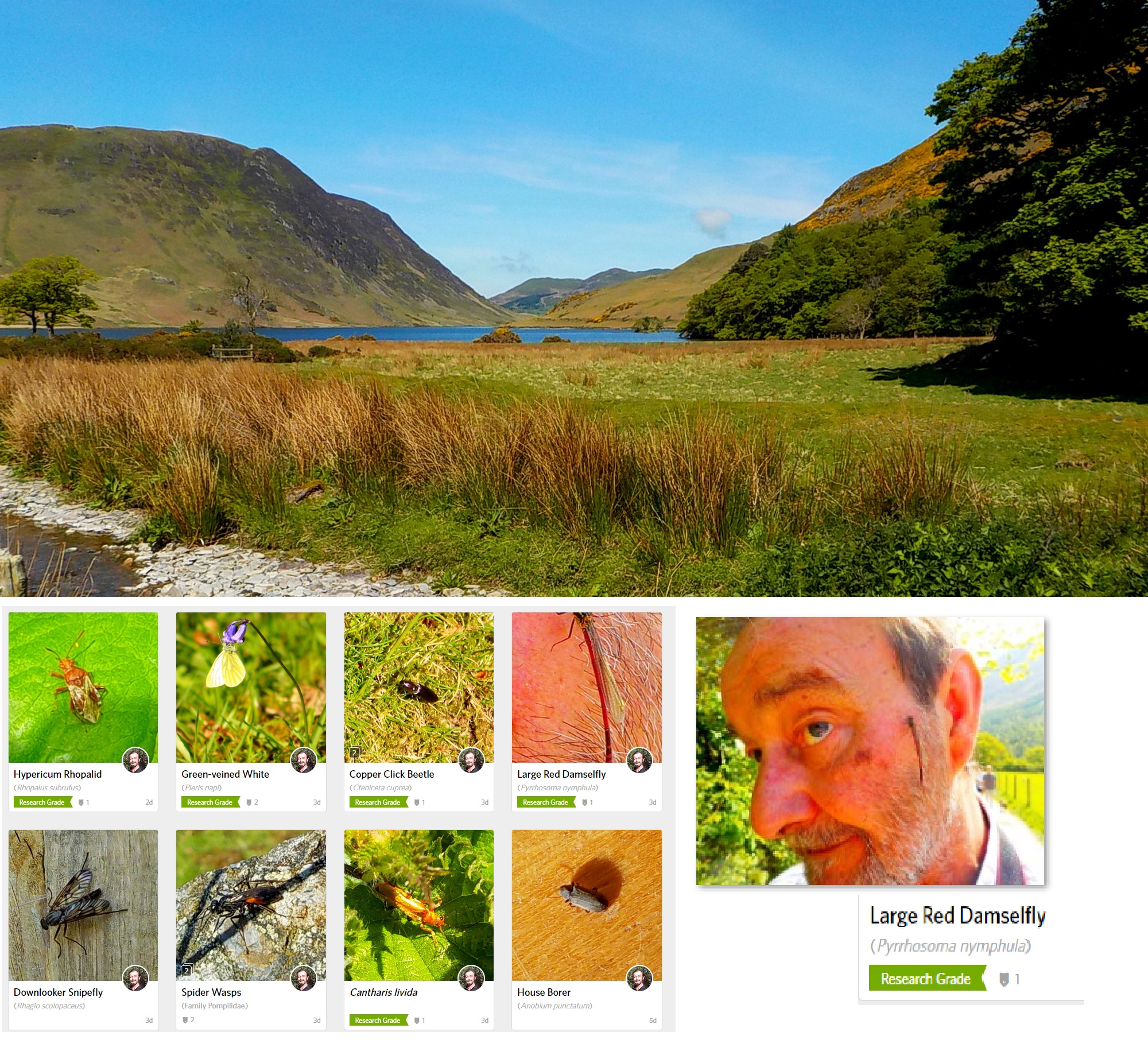
Between Buttermere and Crummock Water, a small stream runs, by the name of Buttermere Dubs, which is where we are taking you this week. Dubs is a Scottish and northern English dialect word for pools of water, or puddles. There is a pleasant walk alongside where the ewes and the lambs lazily graze. With a cuckoo calling in the distance, we are being treated to a black and white birdie show, with Magpie, Pied Wagtail, a Grey Heron and even a White-throated Dipper exploring the banks of the stream. All very idyllic.


Passing through shady glades, more Spring flowers are beginning to appear. Sorrels, who's name means sour, and worts who's name comes from the Old English Wyrt, which simply means plant. Wort was often applied as a suffix to medicinal plants, with the prefix denoting the ailment it was supposed to cure. Thus Stitchworts would cure a stitch in your side and Dropworts may have been used to alleviate dropsy (or oedema, as it is now known). Pimpernel means peppery, but I wouldn't advise eating them as they are somewhat toxic.


Insects are beginning to appear in greater numbers now. Usually, insects are relatively easy to photograph, but when they decide to sunbathe on your face, it can be a bit problematic! We also have our first True Bug of the year. True Bugs are a distinct order of insects, the Heteroptera (as opposed to the generic term bug that can apply to any creepy-crawly). This one is an Hypericum Rhopalid, so called because it is a member of the Rhopalidae family of scentless plant bugs, and it feeds primarily on Hypericums, or St. John's Wort. Here, the wort still identifies it as a medicinal plant, but it doesn't cure you of overbearing saintliness, it is merely that the flowers are traditionally collected around St. John's day on the 24th June. It is, in fact, a natural antidepressant, backed up by medical research.


We've now reached the edge of Crummock Water, so we'll turn back and make our way through the woods, back to Buttermere. Oh look, a Roe Deer. Given the general decline in British wildlife over the last century or so, it's nice to talk about a success story. In the early part of the twentieth century, Roe Deer were pretty much constrained to Scotland and up here in the Lake District. This population has spread south and east, and met up with reintroduced animals in the south of the country which have pushed northwards. They are still uncommon in Wales, but they're getting there.


And here we are, back at Buttermere, where the shallows are positively teeming with minnows. This shoaling behaviour is a defence mechanism against predation. They are only small fish so it pays them to forage in a group. If a predator approaches, some of the braver minnows will go to assess the danger and, providing they come back, will release a chemical which stimulates the shoal to bunch up. Basically it is a fear chemical, and individuals react by trying to get to the centre of the group. Safety in numbers. And now, it's time a spot of lunch. We have sandwiches, crisps, grapes and fizzy pop, but as my beloved has just pointed out, I seem to be a gateau short of a picnic.


Steve's Vintage Collectables. (click to visit)

I was originally going to specialise in old scientific instruments, but that proved to be a bit restrictive (and there was so much more interesting stuff out there). However, I chanced upon a few items at auction last week, and they make ideal Father's Day presents. Better for the planet than buying newly manufactured items. With over 100 items now in stock, at sensible prices, it's worth a look.


Steve's Books (click to visit)


Follow me on Steve's Nature Plus and also on Twitter (@Steve's Nature), Facebook (Steve Daniels),and Instagram (Steve Daniels Cumbria)

Or why not join the 2.5k members of our Naturalists group?


All the best,


Steve


Wednesday, 23 November 2022

China Ducks and Wooden Cats


Once again, it has been great weather for ducks. The Derwent, I am pleased to say, has been behaving itself, the goosanders are back for the winter, the mallards are doing whatever it is that mallards do, and Sally and Harry, the herons, pop by from time to time. Harry Jnr. (AKA Connick) is all grown up and moved on to pastures new.


In the meantime, Ive been spending a fair bit of time at auction houses buying stock for my on-line antiques shop, Steve's Vintage Collectables. Even there, I can't seem to get away from wildlife. Very often, I buy a box of mixed ceramics, if there's something interesting in there. One I bought recently also included this foreign made duck teapot. Not worth auctioning at Christie's, but I think he's absolutely lovely.


At other times, I spot something, tucked away at the back of the room, that just tickles my fancy. Such as this ridiculous one metre tall, hand crafted, wooden cat. He looks marvellous, peering out from behind the foliage, next to the fireplace, at The Old Corn Mill. I suupose that I'll have to sell the cat and the duck eventually, but I think I'll hang on to them for a while.


Meanwhile, as I write books, I thought I'd diversify into the antiquarian book market. I've a box of inter-war children's books to look through, which I picked up yeaterday, in Carlisle. I was also lucky enough to get a very rare, London & Melbourne 1936 edition of Mrs Beeton's Household Management, that turned out to be worth a lot more than I (or the auctioneers) realised. And on the subject of books, I have almost finished proofreading my first novel, The MONOM, (an anacronym for The Magic of Nature of Magic). I hope to get it published before Christmas, so if you get any Amazon vouchers in your Christmas stocking...


We're off to the central lakes at the weekend, to pick up a charity consignment for the homeless, so I'll take my camera, and let you know what's happening on the wet wildlife front, here in soggy Cumbria.


All the best,


Steve


P.S. In common with the rest of the world, I'm running a sale at the moment, in conjunction with Etsy's Cyber Week, so if you're interested in investing in antiques (a better bet than banks and building societies at the moment), or just looking for some Christmas gift ideas, come in and have a browse... Steve's Vintage Collectables.


Follow me on Steve's Nature Plus

and also on Twitter Steve's Nature, Facebook Steve Daniels Naturalistsand Instagram

Steve Daniels Cumbria


Wednesday, 9 November 2022

Fine Weather For Ducks


It's Cumbria. It's November. It's raining. Obviously. The River Cocker is filling nicely, as it exits Crummock Water, wends its way down into Cockermouth, where it joins the Derwent, and flows past my front door. Both rivers are now above their normal high level, but still behaving themselves for the moment. Prodding around in the wet leaf litter, and beneath the bark of rotting logs, turns up a White-legged Snake Millipede. These are one of our commonest millipedes and useful little creepy-crawlies. They chomp their way through decaying vegetation, liberally seasoned with mildew and algae, and return the nutrients to the soil.


The path to the lake takes us through mixed woodland and there are a few fungi to examine. The first one is an important one to recognise, because it looks like a puffball (many of which are edible). However, the edible puffballs are white, whereas this one is a dirty brown colour. It won't kill you but it will make you ill. As young puffballs are one of the best 'shrooms to forage, it's important to recognise this look-alike; the Common Earthball. Wild Food UK has an excellent article on puffballs which you can read here. The other two look to be Honey Fungus (edible when young but can be confused with a nasty little 'shroom called the Funeral Bell), and Yellow Staghorn (which is rubbery and tasteless).


Crummock Water is not looking it's best today, as there seems to be more water in the sky than in the lake. The water temperature is about 5C. This I know, because my little sister went swimming in it the other day. She is in Wim Hof mode. Personally, when it comes to dousing my body in cold water, I'm more Wimp Off. I've just found something I've never seen before. It's a baby Oak tree. I think I'll take it home and watch it grow.


It's fine weather for ducks, so let's go over to Siddick Ponds and see if we can find some. The usual gang of mallards, moorhens and mute swans, but we also have a Little Grebe out there, and a pair of Domesticated Swan Geese. These delightful looking geese originally hail from China and the far east, but escaped domesticated versions can be found almost anywhere in the world. Having said that, they're not common, and I haven't seen them before.


We've some Great Cormorants out there as well, but turn your attention to the path for a moment, because those swathes of orange berries up there are Sea Buckthorn, one of the richest berries in vitamin C that you'll find anywhere. One teaspoon of berry juice will give you all the vitamin C you need for a day. It is also rich in vitamins A, K and E and is ridiculously expensive in health food shops. Grab a handful and make a cup of tea with it.


And finally, back in the lab, look what I picked up at the auction house last week. This beautiful stereomicroscope. It was manufactured by Cooke, Troughton and Simms, probably in the latter part of the 1940s, and has the registration number M60907. I'm intrigued by the ornate brasswork and wooden base, which makes me suspect that it is not a standard production model. The wooden box contains four interchangeable lenses (which I haven't worked out how to change yet) and a Carl Zeiss binocular loupe. As you can see from the inset picture of some moss, it is still in perfect working order. I had intended to sell it through my shop Steve's Vintage Collectables but, somewhat selfishly, I've decided to keep it for myself. There's some pretty nice stuff on the shelves though, if you're looking for ideas for Christmas presents:


All the best,

Steve


And books always make good presents. They're easy to wrap for a start!


£14.99

Beetles and Butterflies; spiders and scorpions; woodlice and worms. How do you tell them all apart? To say nothing of crane flies, dragonflies, bee flies and yet more butterflies. Are they all flies? If not, why call them so? If you're fascinated but confused by the beautiful world of the very small, then this is the book for you.


82 pages of information on all aspects of the world of minibeasts, with over 100 photographs and illustrations, this book will help you track down and identify any arthropod, in its adult or juvenile state, anywhere in the world.


See all of my books at author.to/SteveDaniels


Follow me on Steve's Nature Plus

and also on


Steve's Nature


Steve Daniels Naturalists


Steve Daniels Cumbria


Tuesday, 1 November 2022

Steve's History of Things 9 - Jugs


The humble jug, a vessel for holding, and pouring, liquids has been with us for millennia. We humans have been firing ceramics for about 31,000 years. The word 'jug' is far more recent. Webster's Dictionary dates it to 1530-1540 and both Webster's and Collins suggest that it derives from the pet name given to women named Joan in the sixteenth century.

I've got three jugs for you to look at today, which gives us another chance to play basic, better, best. Look at the jugs, read the descriptions, then rank them in order of value from lowest to highest. I'll give you the answer at the end.


The 2 pint Queen's Ware Jug


If you are regular readers of this series, then you'll immediately recognise this as Jasperware which we discussed in episode 4. This is genuine Wedgwood jasperware, and confusingly marked Queen's Ware on the base. Jasperware is the style, Queen's Ware is the brand. As always, the marks on the base can often give a clue as to the date an item was made. Queen's Ware started in 1940 and continues to this day. However, in 1974 a superscript ® was added to Wedgwood to denote that it was a registered trade mark. This one hasn't got one, so we know that it was manufactured pre-1974, which makes it at least 49 years old, and therefore, I would describe it as retro. Others may describe it as vintage. As I said in the Introduction to this series, apart from antique (100+ years old), other terms are somewhat loose.


I'd like to buy this


The 1 pint Royal Doulton Masonic Jug


This is an interesting little jug. The words 'Lodge of Peace & Harmony No. 3929' obviously denote it as a Masonic jug, the name T.L.Green W M (Worshipful Master) and the date Jan 18th 1924 probably indicates that these were made to commemorate his accession to the post. I say 'these' because this is not the only one in existence. Anyhow, we know it was made after Jan 18th 1924 and presumably in that year. Back to the base marks again. We have Royal Doulton England in a roundel, with four interlocking Ds in the centre, and a lion standing on top of it. The lion, the crown and the roundel is the famous Royal Doulton mark, but hang on, where's the crown? After 1922, there was a short period when the crown was omitted and this piece falls into that period and confirms it (almost) as an antique – only a couple of years to go! One should note that there is a slight chip under the lip.


The 4 pint Big Brown Jug


I don't know why, but this one is my favourite. It's big, and solid, and heavy, and useful for watering my indoor plants. I may just hang on to it. One side shows a rotund gentleman, drinking in a tavern, and on the reverse there's a man with a horse. It all feels rather Bavarian. As far as I can see, there are no markings on it whatsoever.


I'd like to buy this


Basic, Better, Best


So, what do you reckon? I expect most of you decided that the unmarked big brown jug was the basic, and you'd be right. It's a nice big functional jug, but that's all you can say about it. Probably retro, judging by the style, and I'm putting it up for £19 including free UK delivery.

Deciding between the other two is maybe not quite so easy. Wedgwood and Royal Doulton are both famous names. The Royal Doulton is some 50 years older, but has a chip, whereas the Wedgwood is in perfect condition. It all comes down to rarity value. The Queen's Ware jug isn't particularly common, but not particularly rare either. You can find them on the internet for £35-45. I'm putting mine up at £39 including free UK delivery.

The Royal Doulton Masonic Jug, on the other hand, is a rarity. All 1920s Royal Doulton, with the base mark without the crown, is highly sought after by collectors. I shall be putting this one up for auction. An identical one to this, albeit minus the chip, sold in 2013 for just over £200. I'll be happy with half that.


Hope you've enjoyed this little quiz.


Steve's History in association with Steve's Vintage Collectables


10% Off  the Queen's Ware and Big Brown Jug, exclusively for readers of this blog. Use this link

 https://www.etsy.com/uk/shop/SVCwithEtsy?coupon=SVCBLOG

Previous posts in Steve's History of Things


1 Introduction

2 Five Good Reasons to Buy EPNS

3 Fieldings Musical Tankards

4 Jasperware

5 Blood Pressure Monitors

6 Chodov Porcelain

7 The Pottery Detective

8 Royal Memorabilia


Tuesday, 2 August 2022

Steve's History of Things 5 - Blood pressure monitors


Nowadays you can monitor your blood pressure with a wearable wristwatch type device, but it hasn't always been so. Although the ancient Greeks had first come up with the idea of a circulatory system within the human body, it wasn't until 1711 that blood pressure was first measured, when the Reverend Stephen Hales stuck a glass tube into a horse's artery. The horse died. Fast forward 144 years to 1855 and a device with an inflatable cuff to constrict the artery, was used for the first time. It was a beast of a thing, standing five and a half feet (1.68m) tall, and giving somewhat inconsistent results. It took a further fifty years of research and development before a sphygmomanometer like this came into existence.


The beautifully crafted hardwood box and rubber ball and hose were replaced by ugly plastic, probably in the late fifties or early sixties, and in 1974, Panasonic released the first digital blood pressure manometer.

For collectors of vintage and scientific equipment, this is a lovely Accoson hospital model (Inst. No. 108109). It would also make a lovely presentation gift for anyone retiring from the NHS, and at £65 (£58.50 if you use the discount code below) well within the scope of a whip round.


Steve's History in association with Steve's Vintage Collectables


10% Off this item, exclusively for readers of this blog. Use this link

 https://www.etsy.com/uk/shop/SVCwithEtsy?coupon=SVCBLOG5

Tuesday, 26 July 2022

Steve's History of Things 4 - Jasperware


Come with me, if you will, back to the 1759 when Josiah Wedgwood founded his pottery company in Staffordshire, England. The company is still going to this day albeit now owned by Finnish home products maker Fiskars. But going back to the 18th century, Josiah Wedgewood came up with an iconic design called Jasperware, after the mineral jasper, featuring white cameo reliefs based on neoclassical designs on a pale blue background which became known as Wedgwood blue. The design proved to be popular and enduring as this retro ashtray from the 1970s proves.


Although Wedgwood blue is by far the most popular colour, dark blue, lilac, green, yellow and black were to follow. Wedgwood was the first potter to date mark his wares although decyphering the marks is not always easy. This ashtray has 'Wedgwood Made in England' in a single stamp which was introduced in 1970. It also appears to have the number 89, suggesting it was manufactured in 1989, which is strange as I know that this piece was bought in the 1970s unless my memory has gone sadly awry. The letter K baffles me as well. Wedgwood did use single letter codes to denote the month of manufacturer, but K wasn't among them. The letters SG (or possibly SC) could be the potter's intitials but, as I say, decyphering the marks is not always easy. This website may help: https://antiques.lovetoknow.com/Vintage_Wedgwood_China Josiah was a man ahead of his time. Not only did he introduce date stamping he also introduced us to such 'modern' concepts as direct mail, money back guaruntees, self service, free delivery, illustrated catalogues and buy one get one free.


Jasperware proved so popular that other potters also started to make it. One such was Josiah's neighbour William Adams who favoured the cobalt blue background as shown in this magnificent 11 inch (28cm) tall cheese dome with a 9 inch (23cm) diameter. Unfortunately, the dome is unmarked, so I cannot say whether it is an Adams or not. Quite possibly, there was a base to go with it at some point which would have been marked, but the dome is a heavy piece of stoneware and if it were dropped then the base would have stood little chance. Even so, it is a beautiful piece of tableware that would grace any restaurant or quality cheese shop. Similar items by Wedgwood or Adams sell for in excess of £1,000 but as this one cannot be positively attributed, it can be yours for only £199.

Plus - for readers of this blog only - use the coupon code below for a 10% discount on this item!

https://www.etsy.com/uk/shop/SVCwithEtsy?coupon=SVCBLOG4 


Find loads more great stuff at Steve's Vintage Collectables


All the best,


Steve


Follow me on Steve's Nature Plus


Recent Posts