Showing posts with label Romans. Show all posts

Wednesday, 4 May 2022

Walking With Romans at Derventio


Northern Cumbria 1900 years ago

I live in an old corn mill on the banks of the River Derwent, on the borderline between the town of Cockermouth and the village of Papcastle. A quiet little spot in the north west of England, but it hasn't always been so. Go back one thousand nine hundred years to 122AD, when the first foundation stones of Hadrian's Wall were being laid, and Papcastle was a thriving metropolis, and known, in those days as Derventio. It was a major fort and settlement at an important crossroads between Luguvalium (Carlisle), Tunnocelum (Moresby), Alauna (Maryport), and Voreda (old Penrith). Part of the road between Derventio and Alauna (where there is a great little Roman museum) still exists as a footpath, and this is where I'm going to take you today.


The remains of the road at the start is pretty well a stream bed now, but you can still see shaped paving stones in places. The banks either side have a great biodiversity of plants, befitting an ancient roadway. The Bluebells along here are mainly of the common (English) variety as opposed to the introduced Spanish variety. Side by side, they are easy to tell apart. Our native variety has longer flowers of a deeper blue than the paler, blowsier Spanish imports. They are also scented, but the key feature to look out for is this: Common Bluebells flower on one side of the stem only. Spanish Bluebells erupt from all sides of the stem.


At the end of this section, the course of the road moves in to sheep pasture and we can look back over Derventio to the northern fells in the distance. Patches of Dock occur here and there, and this is the home of the Green Dock Beetle. These beautiful iridescent beetles breed from March to October during which the female will lay over 1,000 yellow eggs on the underside of dock leaves (or other plants of the Rumex genus) in batches of 50 or less. 3-6 days later they hatch into larvae which undergo three moults as they munch their way through the leaves, after which they drop to the ground, burrow down a couple of centimetres, and pupate. 6-9 days later they emerge as adults. For those of you following Getting to Know Your Beetles these are Leaf Beetles (Family Chrysomelidae), POLYPHAGANS from the infraorder CUCUJIFORMIA.


We'll leave the Roman road now and cross Priest's Bridge to walk back along the banks of a gently flowing beck and rest awhile in the meadow. Look closely and you can see that the grass is liberally dotted with Field Woodrush. This is also known as Good Friday Grass, presumably because this is when it traditionally appears. There is also an interesting plant called Butterbur here (after which, Tolkein's hobbit, Barliman Butterbur is named). Clinical trials have established that its roots have anti-migraine properties and that it provides relief from hayfever. However, the dosage has to be strictly controlled as it is also carcinogenic, so don't try making home remedies with it! Oh look, we've been joined by a Heron, I wonder if it's Sally? I haven't seen her for a few days down on the main river. Good job she wasn't here in Roman days; she'd have been for the pot. You're not allowed to eat them nowadays as they are no longer considered a game bird, but they were still 'fair game' at the beginning of the 20th century. Apparently, you had to take the meat off the bone before cooking as the bones contained a fluid that was overpoweringly fishy. Who knew?


Whilst at the Senhouse Roman Museum in Maryport (well worth a visit) I chanced upon a trunk of old Roman themed books. Digging through, like a demented archaeologist, I unearthed this little gem. It wasn't for sale so I surreptitiously photographed a few pages of recipes. I'm sure that one, or more, of them will provide inspiration for Steve's Wild Kitchen. Unfortunately, it is no longer in print, but here are a few more modern tomes, if you fancy a bit of 1st century cooking, or a themed dinner party.

Paperback £8.50


Paperback £8.45

Kindle £7.19


Paperback £11.99

Kindle £3.99

Build Your Own Nature Library


I've just remembered that I have written a blog about foraging for a Roman meal, a few years ago, from Crete, featuring a massive Roman fish trap. You can find it here: In Search of a Roman Repast.


All the best,


Steve


Follow me on Steve's Nature Plus


and also on


Steve's Nature


Steve Daniels Naturalists


Steve Daniels Cumbria


Wednesday, 11 November 2020

Greeks, Romans & Cumbrians


Those of you who have known me for some time will be aware that I have recently moved to Cumbria, having spent the past sixteen years on Crete, documenting the flora and fauna of the eastern end of that fabulous Greek island. It will come as no surprise therefore, that my interest is sparked when Greek and Cumbrian history overlap. Which is why I’ve brought you down to the village of Lowca today, on the west Cumbrian coast. This archway, in the grounds of St. Bridget’s church marks the site of the Roman fort of Gabrocentum, part of the defences that extended beyond Hadrian’s wall. The Roman soldiers who manned this fort, the best part of two millennia ago, were Ligonians, from France and Thracians, from Greece. So, as we follow the coastal path, we will be treading in Greek footsteps.


There aren’t so many flowers about at this time of year; a few sprigs of Yarrow, the occasional knapweed and this odd bit of Hogweed, which seems to be attracting a considerable number of Yellow Dung Flies. These are marvellous little creatures who keep the dung from building up in our pastures, and thus protect our cattle from many of the parasites that live within. The only problem is, we also protect our cattle with veterinary medicines.. which also kill the Dung Flies. The presence of drug residues in cattle dung is carefully monitored to ensure that we aren’t doing more harm than good. It’s a messy job, but someone’s got to do it!


Since March, I’ve been moaning on about the lack of my birding camera, which was held up in transit due to the world going into hiding from our most dangerous natural predator, the virus (if you thought that Homo sapiens was the apex predator on planet Earth, think again). Pleased to say that I now have it back, lovingly caressed in my sticky mitt, and a trio of Curlew have just flown in, enabling me to check that it is still in good order after its seven month incarceration. As you can see, it’s working just fine. Down on the rocks, in the sea below us, we also have a Great Black Backed Gull and, what looks to be, a Great Cormorant, but they’re slightly out of range. The cormorant will probably be the other subspecies, Phalacrocorax carbo carbo, to the P.c. sinensis that we saw at Loweswater last time out.


Which reminds me, while we were poking about in the woodlands there, we were discussing the differences between gilled, pored and bracket fungi as an introduction to mushrooming. Having come inland a bit now, via an evil swamp that our intrepid local guide has just led us through, we have a couple of fine looking mushrooms growing out of a compost heap. We can see that they are gilled mushrooms (Agaricales) but the question is, are they nice, edible blewits, or poisonous webcaps?


Welcome to the world of spore printing. Luckily, our intrepid local guide comes equipped with a supply of small mushroom sampling bags, so if we carefully pluck one of these fellows without touching it with our hands, we can take it back and make a spore print. The only thing we need for this is a sheet of paper, preferably pale blue as mushrooms don’t, as a rule, have pale blue spores. Mushroom spores are the reproductive bits and are held between the gills. Now we simply remove the cap from the stem (still in the bag), place it gill side down on the paper, and leave it overnight.

And the following morning, voila!, a lovely streaked pattern of white spores has appeared. That indicates that we have an edible blewit. Poisonous webcaps have reddish brown spores. Anyhow, we won’t go making mushroom omelettes just yet as there are further checks to make to be certain that we’re not going to kill ourselves, but spore printing is one of the most important tools in the bag when it comes to identifying edible fungi. To be continued… as they say.

With thanks to Ishbel Cooke for guiding us around Lowca and avoiding most, if not all, of the treacherous swamps.

Christmas is getting closer. Just saying.

Steve's Books


The Quick Guide to Creepy-Crawlies

All you need to know to identify any type of insect, spider, worm or snail very simply and find out more about it.

Yvonne: This was a gift for a family so that the children can understand what they see on days out. The second was for me. Logical and easy to use. If you know anyone who likes nature you can be confident that gifting this book will give years of pleasure.


The Eggs of Saramova

A science fiction novella for those who don't like science fiction. A fast-paced thriller that is, literally, out of this world (and it starts right here in Crete).

Too new for reviews yet!


Not Just For Twisted Women by Steve Daniels 

A light-hearted look at life through the eyes of the fairer sex.

Janet: If you are short on time but enjoy reading and are maybe not into long extended novels then Not Just For... Twisted Women provides readers with concise stories that stand alone and most certainly entertain with their ultimate twists. Loved it.

Helen: A very good read! Well written and entertaining!

Margaret: Each quick tale gives a glimpse into a character's life and has an often humorous twist at the end. I would love to read more.

Yvonne: These days many people find it hard to find the time to read a novel, so this book of short stories is ideal to dip into. It is also makes a good gift.


See sample pages of all my books and latest blogs, and keep abreast of latest publications here:

http://author.to/SteveDaniels


*********************************************************************

LINKS:

Share your nature thoughts, photos and comments on Naturalists (the facebook page that accompanies this blog)


Explore east Crete with the #CreteNature interactive Hiking and Nature Map


Crete

Cumbria

Cretan Flora


Crete Birding


Greek Butterflies and Moths

Cumbria Wildlife Trust

Cumbria Bodiversity Data Centre

Carlisle Natural History Society


Wednesday, 18 February 2015

The Nature of Archaeology

The National Archaeological Museum, Athens


Those of you who follow my scribblings on a weekly basis will know that last week I had to leave the island in a bit of a hurry and visit the mainland (referred to as Greece in these parts or simply “the up”. Despite Crete being wedded to Greece for 103 years it is still thought of as a foreign country.) I only had the one free day during my visit and you may be forgiven for thinking that I’d have spent it on Lycabettus Hill or the slopes leading up to The Parthenon searching for flora and fauna. Ordinarily I would, of course, but the temperature was only a little above freezing and it was snowing heavily. As the only thing I was likely to find at The Parthenon would have been The Four Norsemen of the Acropolis I did what any self-respecting naturalist would do and scurried indoors. So join me if you will and enter the portals of The National Archaeological Museum and we’ll take a look at the exhibits through naturalists’ eyes.


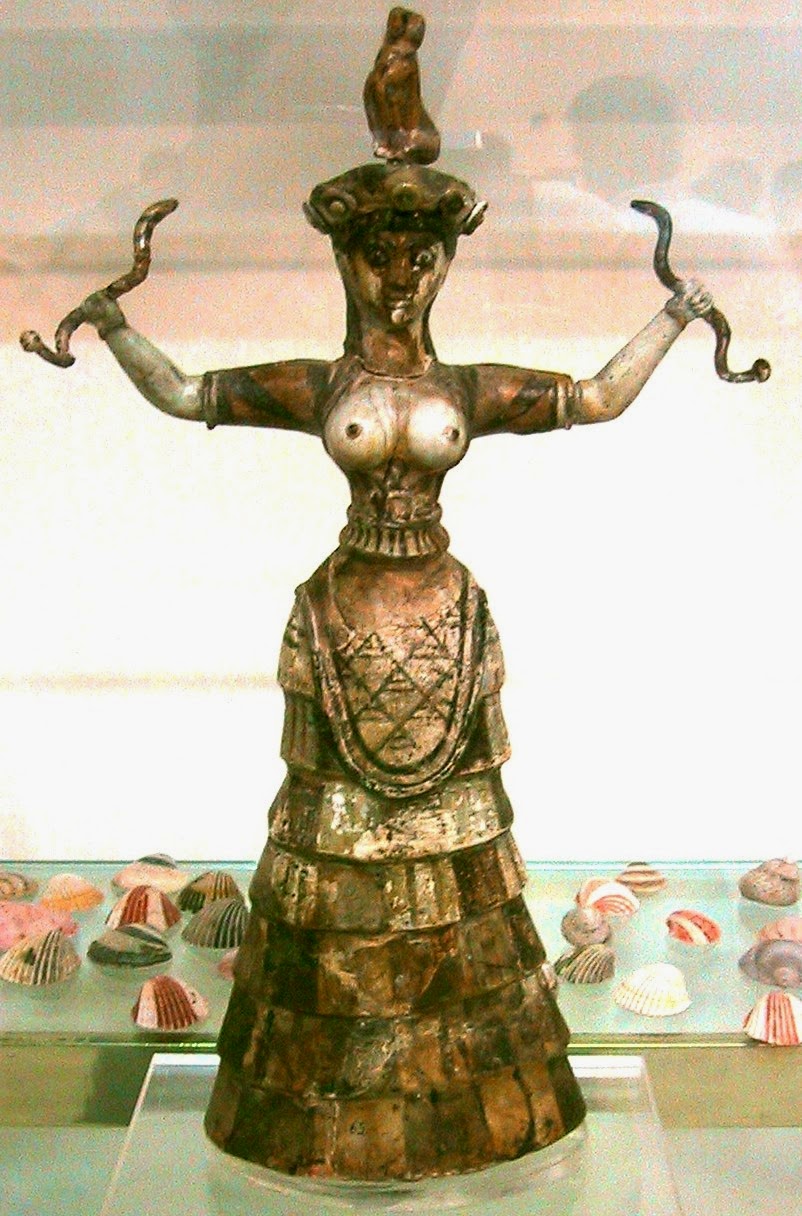
Minoan Snake Goddess (via Wikipedia)
That nature has influenced man for far longer than man has influenced nature goes without saying so let us travel back in time some three and a half thousand years to the beginning of European civilization. And here we are back on Crete with the Minoan Snake Goddess. She is always depicted holding up a snake in each hand which, people who know about these things say, symbolises new life as the snake appears to be born again when it sloughs its skin. Personally I am not convinced, especially as the experts also say that the animal on her head seems to be an imitation of a panther. Me? I think she’s just having a bad hare day.


Mycaenean Bull's Head (vis Wikipedia)


Moving on a few hundred years, Crete has suffered major destruction from a volcanic eruption on the island of Thera (Santorini) which was four times as big as that on Krakatoa (which incidentally is to the west of Java despite the film title: Krakatoa, East of Java). The Mycaeneans, based on the Peloponnese, have now taken control of Crete, Southern Greece as we know it today and most of the Aegean islands. They borrowed heavily from Minoan culture but dropped the snakes in favour of another animal dear to the Minoan’s hearts, the bull. That is not to say that the Mycaeneans just popped up out of nowhere; this bull’s head, with the magnificent gold horns, lips and intricately worked rosette, was crafted at about the same time as the Snake Goddess. It is merely that the balance of power shifted in the region.


Hecate


Jumping on a few centuries more and the centre of power has moved to Byzantium (Istanbul) and a new goddess is on the scene; Hecate.  An interesting lady associated with moonlight, witchcraft and pointing the way at crossroads she was well versed in plant lore and is often represented sitting beneath that most magical of trees, the yew, with her trusty hound beside her. So from a natural history perspective the animal symbolism has progressed from snakes to bulls to dogs and thus getting ever more domesticated as history moves forward and plants now begin to put in an appearance. Hecate’s other great claim to fame concerns a story from 340BC. The Byzantines were under siege from Philip of Macedon when a bright light appeared in the sky (possibly a meteor) accompanied by the howling of dogs just as he was mounting a surprise attack. The Byzantines put this down to Hecate, who also included ‘bringer of light’ on her CV, erected a statue to her and minted coins with her head on the obverse and a symbolized star and crescent moon on the reverse and thus the star and crescent symbol was born.

Roman loutrophos with Acanthus leaves

Having trundled our way through the halls of history picking our plants and animals from among the potsherds and artifacts we now come to a riot of Roman relics. Take a look at this massive loutrphoros over here. It’s meant to be a bathwater carrier for use in funerary rites but it looks as if it would take six men to lift it when it was empty. That however is beside the point; take a closer look at those sculpted leaves – they’re modelled on the leaves of Spiny Bear’s Breech (Acanthus spinosa), a plant I often see back home on Crete and the Romans went mad for it. No sculpture, column or pedestal was complete, it would seem, without a few acanthus leaves. The story goes that a Greek sculptor called Callimachus had been inspired by the leaves growing through a woven basket containing votive offerings on the grave of a young girl. The Greeks fiddled about with the design, the Byzantines copied it here and there but the Romans really went overboard on it. Goodness knows why, it’s not the prettiest leaf in the floral album, maybe it was easy to carve.

The Atrium, National Archaeological Museum

Now here is a sign of great modernity but no little interest: “Café”.  How pleasant, they’ve put it in the atrium and the snow seems to have stopped falling. It’s still bitterly cold though and a steaming mug of coffee would go down a treat. “Ah, that’s better.” I see we have a stone lion prowling through the olive trees which provides a rather tenuous link to our final bit of nature in archaeology and brings us more or less up to date with the Venetians who held sway on Crete after Byzantium was sacked in the fourth crusade in 1204 and the island was sold to Venice. Venetian tradition has it that St. Mark, he of the second gospel, was travelling through Europe, evangelizing as he went, and stopped off at Venice where an angel appeared to him saying “May Peace be with you, Mark, my evangelist. Here your body will rest.” Actually, I think that sounds more like a Mafia death threat than something an angel might say but I suppose it depends on the intonation. Anyhow, the angel was wrong because St Mark was buried in Alexandria. Feeling a bit miffed by this a couple of likely lads called Rustico da Torcello and Bon da Malamocco nipped over to Alexandria in 828, did a bit of stealthy grave robbing and brought him back to Venice where he rests to this day in the Basilica of St. Mark.  Mark’s symbol was the aforementioned lion but with additional wings and a halo symbolizing both power and holiness. So that just about concludes our potted history of the Eastern Mediterranean  over the past three and a half thousand years with reference to the plants and animals symbolized along the way. Until next week when we’re back on home ground and hopefully enjoying a bit of winter sunshine – happy hunting.

***********************************************************************************
LINKS:
Naturalists (the facebook page that accompanies this blog)


Recent Posts