Showing posts with label beetles. Show all posts

Wednesday, 3 August 2022

The River That Came Back From The Dead


This idyllic scene shows a small beck running into the River Keekle, a few miles to the east of Whitehaven. It has not always been so. It has been the site of two coal mines, one in the 1880s and one in the 1980s. In 2010 a plan was proposed to dump low-level nuclear waste here (which was rejected by Cumbria County Council in 2012). From 2019-2020 the West Cumbria Rivers Trust spent one and a half million pounds removing 150 tonnes of plastic from the river bed. The bed had been lined in the 1990s to protect it from mine water contamination. In the intervening thirty years the liner had degraded with bits of it floating downstream causing blockages and localised flooding. The plastic has now been recycled and some of it used to make the bench by the car park.


After yesterday's constant drizzle, today's occasional outbreaks of sun has brought out the butterflies and moths. Two which can be easily confused are the Meadow Brown and the Gatekeeper. Their colouration and markings are very similar but the Gatekeeper is about half the size of the Meadow Brown. These are both members of the Nymphalidae family (which we used to call the browns) but the third one is a Small Copper which is a member of the Lycaenidae family (which we used to call the blues). When dealing with nature, it's a lot less confusing if you use the scientific names. It's not just naturalists trying to sound clever! There are also a couple of moths about. The small one on the Ragwort is one of the Wave Moths, a Lesser Cream, I think, and the last beauty, with the silver Y-shaped markings on it's wings is called, unsurprisingly a Silver Y.


The river meadows are now re-establishing themselves and the summer wild flowers are abundant. There are a couple of wetland specialists in the Marsh Thistle and Marsh Woundwort (so called because it was used to promote the healing of wounds). There is a good distribution of Yellow Rattle which is hemiparasitic on grasses and helps to keep them in check, allowing other meadow flowers to grow. The Odonites, I'm pretty suris a type of Red Bartsia which is also parasitic on grass roots. 


And finally, we have some meadowsweet which the Flea Beetles seem to adore. They have nothing to do with fleas, by the way, but they have highly developed femora which enables them to jump like fleas. We'll pick some of the meadowsweet on the way back, to make a sweet white wine following the generic wine recipe.


Apart from the butterflies and moths, we have some other pollinators about. We have three of the 25 different species of bumble bee to be found in the UK: The Carder Bee, the Red-tailed Bumble Bee and the Garden Bumble Bee. We also have a couple of hoppers. These are both True Bugs (HEMIPTERA) They're called hoppers because they can leap tremendous distances. They have to release the energy in their hind leg muscles exactly simultaneously, otherwise they'd shoot off at odd angles. In order to do this they have one of nature's evolutionary oddities; they have synchromesh gears. I kid you not. You can see photographs of them here.


It will come as no surprise to learn that I am very fond of creepy-crawlies and find them fascinating. They, in turn, are very fond of me and find me fascinating as well, which is fine, but not when they use me as a mobile restaurant. While I was photographing the hoppers, a Deer Tick decided to take a chunk out of my arm. In entomology, insect bites are an occupational hazard and antihistamines usually do the trick. If you don't have any to hand, look out for plantains, one of the original 'nine wayside herbs' mentioned in The Lacnunga, a 10th century herbal. They remove the itching almost immediately. Luckily, the tick doesn't seem to have been infected with Lyme disease, which is present in Cumbria, as it is in many other counties.


That's it on the nature front for this week but the latest episode in The History of Things looks at the fascinating history of the blood pressure monitor.


Steve's History of Things 1


Introduction


Steve's History of Things 2


5 Good Reasons to Buy EPNS


Steve's History of Things 3


Fielding's Musical Tankards

Steves Hstory of Things 4


Jasperware

Steve's History of Things 5


Blood Pressure Monitors


All the best,


Steve


Beetles and Butterflies; spiders and scorpions; woodlice and worms. How do you tell them all apart? To say nothing of crane flies, dragonflies, bee flies and yet more butterflies. Are they all flies? If not, why call them so? If you're fascinated but confused by the beautiful world of the very small, then this is the book for you.

82 pages of information on all aspects of the world of minibeasts, with over 100 photographs and illustrations, this book will help you track down and identify any arthropod, in its adult or juvenile state, anywhere in the world.

See all of my books at author.to/SteveDaniels


Follow me on Steve's Nature Plus

and also on


Steve's Nature


Steve Daniels Naturalists



Steve Daniels Cumbria


Tuesday, 14 June 2022

Arran Special 2 - In Search of Seals


It's a beautiful morning, so let's head up the west coast to see what we can find. First stop is the village of Blackwaterfoot where Clauchen Water flows into Drumadoon Bay. A beautiful spot for introducing Mattie to the pursuit of rock pooling and for teaching her that not everything is best investigated by trying to eat it. Like this Blue Jelly for example. The sting of this particular species is quite mild but, if you are stung by a jellyfish do not try to treat it with vinegar, alcohol or urine. It will only make it worse. Better to wash it in sea water and take an antihistamine tablet. Next we have a European Green Crab (AKA Shore Crab) which is native to the north east Atlantic and the Baltic. However, it is listed as one of the world's 100 most invasive species and can be found on coastlines almost everywhere. In New England, they have taken to eating them and have even produced a Green Crab Cook Book. Probably go nicely with a bit of pickled Knotted Wrack which we also have here. Decorate with a few boiled Periwinkles and that's lunch sorted.


Well done Mattie! That's the first of Arran's Big 5, The Common, or Harbour, Seal. There are about eight of them on and around those rocks out there. Harbour seals pretty much stick to the same haul out spots, so these are probably resident here. Now that sealing has been banned in UK waters under the Conservation of Seals Act (1970), they can live to their full term, which is 20-25 years for males and 30-35 years for females. Aren't they beautiful? We'll carry on north, have a spot of lunch somewhere, then Ishbel has spotted an interesting looking walk for this afternoon with some intriguing caves to find.


That was different. Cold jacket potato with chilled coronation chicken and salad. I wonder if it was meant to be served like that? Still, it wasn't quite as unappetising as it sounds. We're on the edge of a fir plantation with a little burn running alongside the path. Looks like a good walk for an insect safari. And that's a good start – a beautiful Golden-ringed Dragonfly. At 7-8cm long with a 10cm wingspan this is Britain's longest dragonfly. In comparison, this Large Red Damselfly, despite its name, is only about half that size. Note the wing positions: out straight = Dragonfly; folded along the back = Damselfly. Over here we have the smallest of the Satyrinids or Brown Butterflies , The Small Heath. These are grassland specialists and the caterpillars feed exclusively on grasses, whereas the adults are nectar feeders. We also have a couple of beetles. There's a Gazelle Beetle, so called because of their speed, and my favourite, the Green Tiger Beetle (another speed merchant in the beetle world – see Water, Water, Everywhere). Dragons and Damsels, Butterflies and Beetles are all covered in The Quick Guide to Creepy-Crawlies.


Ah we've reached the caves. Although the biggest one is called The King's Cave, it's doubtful that this is the one used by Robert The Bruce before the Battle of Bannockburn and I don't see any doggedly determined spiders either. I do see a determined little doggy though. What's she found now? Just time to mention a few of the flowers that I've spotted on the walk. Just outside the cave there are Marsh Orchids and Ragged-Robin as well as some English Stonecrop (seems the English are invading Scotland once again). Down by the sea there's Sea Thrift and Sea Campion, and growing in the burn, some rather tasty water mint.


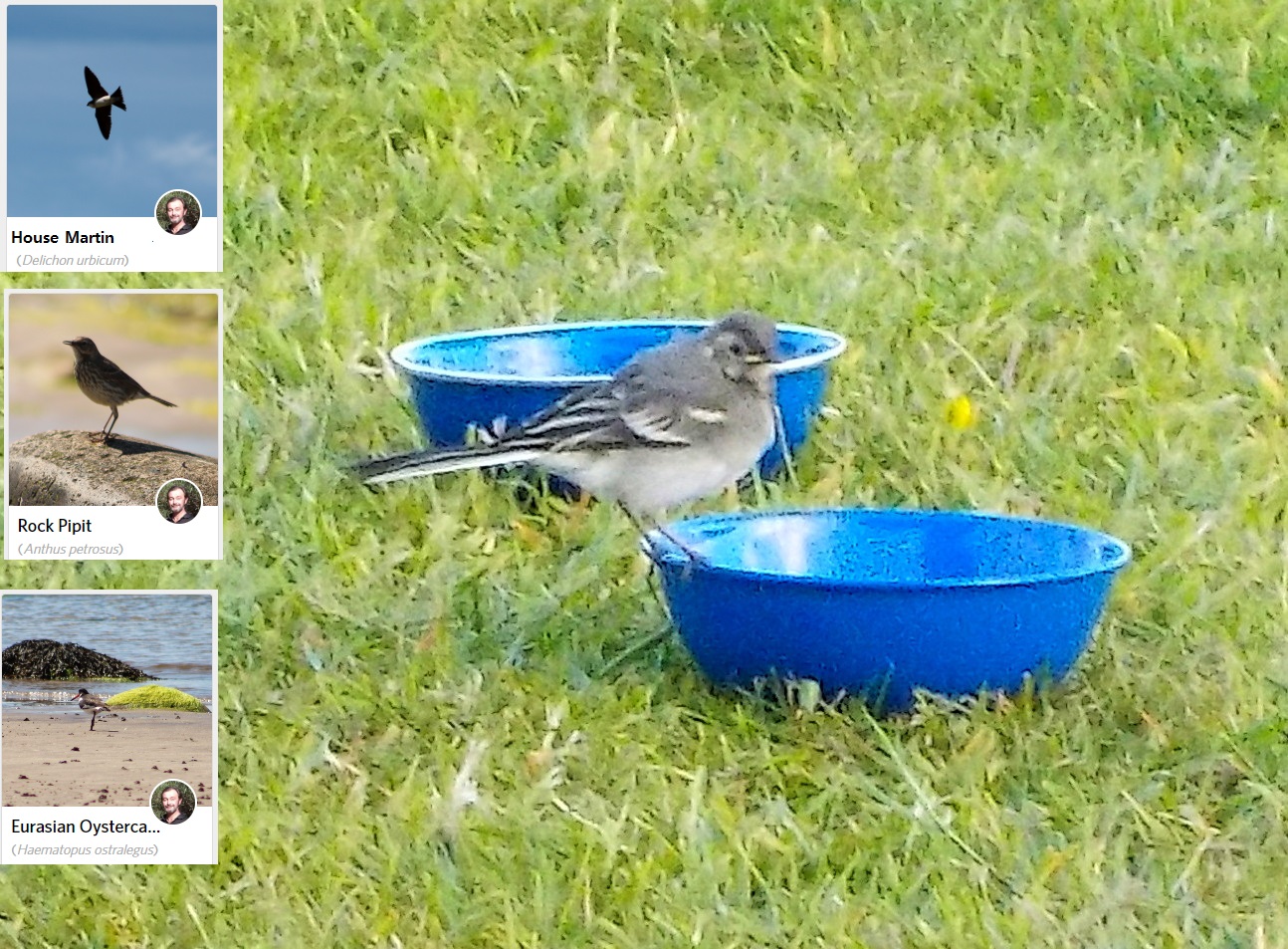
And finally, back at camp, a few more birds to add to our list from yesterday. Firstly, this young Pied Wagtail is being very brave, sipping water from Mattie's bowl, just outside the tent. There are also House Martins flying about, and down on the beach a Rock Pipit and a few Oystercatchers. Tomorrow, we're off to Broddick Castle and we'll take a look around the grounds to see what wildlife we can find there.


Hardback £24.09


Hardback £5.30 Paperback £2.56


Paperback £14.99

Build Your Own Nature Library


See you tomorrow,

Steve

Follow me on Steve's Nature Plus and also on 

Steve's Nature

 Steve Daniels Naturalists

 Steve Daniels Cumbria


Wednesday, 11 May 2022

Here Be Volcanoes! - Eycott Hill

Eycott Hill Nature Reserve, Cumbria, UK


Here be volcanoes! OK, Cumbria may not be the first place that comes to mind when considering the volcanic hotspots of the world, but some 460 million years ago this place was on fire. This was the bed of The Iapetus Sea, which was being squished as continents drifted into one another, setting off volcanoes and lava flows all over the place. Between then and now, this has been land, sea and ice at one time or another and pretty well tilted as you can see from the information board provided by the Cumbria Wildlife Trust. These rocky hummocks are the bits of volcanic lava, still visible after all these years. And how do they know all this? Those neat holes in the rocks are not made by incredibly strong boring beetles, as you may imagine, but by the lesser spotted geologists, who have been taking, and studying, samples of the ancient lava.


The flora up here is pretty special too. There are twenty species of sedge and eighteen species of Sphagnum moss up here (I think I've identified these correctly, but please feel free to put me right). There are marsh violets and mountain pansies and the beautifully lace-like Parsley Fern.


As I said in this month's European Nature Almanack, May is a good month to look out for reptiles and amphibians becoming more active after months of hibernation. This little fellow is a newt. We have three species here in the UK: the Smooth, or Common Newt, the Palmate Newt and the Great Crested Newt. This one has a shallow crest running from neck to tail, and there is no webbing on the back feet, so I think that it's a Smooth Newt. To be absolutely certain I'd have to check that he has black spots on his throat, but I don't want to disturb him.


We have owls and small mammals too. We haven't actually seen any (these are two owls I made earlier, so to speak), but we do have evidence in the form of a regurgitated owl pellet. After half an hours prodding about, I've managed to extract 22 small mammal bones including leg, shoulder, vertebrae and occasional pieces of skull.


Now, it wouldn't be me if I didn't find a couple of insects to play with, and what a pair they are. The first beauty is an Emperor Moth, a grand name for a grand insect. This is one of about 2,300 species of large Saturnid moths, but the only one you'll find in the UK. They only live for about a fortnight as adults, because their only purpose is to mate. They cannot even eat, and have to rely on the food resources they built up as a caterpillar. The other fellow is a Dor Beetle. These are earth boring dung beetles who dig tunnels (up to 2 metres long in some species) beneath a pile of dung. This particular species is coprophagous, that is, it eats dung and provisions its nest with the same, but many Dor Beetles live on a diet of mouldy leaf litter. Can't say that either appeal to me particularly.


And now, a Special Offer for all you budding bug spotters out there. I have 25 signed, limited edition copies of The Quick Guide To Creepy-Crawlies to send out on a first come – first served basis. The standard version is £14.99 on Amazon + p&p but I'm offering you these signed, limited edition copies for only £12.00 + p&p.


Amazon price £14.99 plus p&p

Signed, Limited Edition Offer:

£12 + £1.50 p&p = £13.50

$14.75 + $4.25 p&p = $19.00


14 + €4.00 p&p = €18.00


Remember, there are only 25 and it's first come, first served!

All the best,


Steve


Follow me on Steve's Nature Plus and also on


 Steve's Nature


 Steve Daniels Naturalists


 Steve Daniels Cumbria


Wednesday, 4 May 2022

Walking With Romans at Derventio


Northern Cumbria 1900 years ago

I live in an old corn mill on the banks of the River Derwent, on the borderline between the town of Cockermouth and the village of Papcastle. A quiet little spot in the north west of England, but it hasn't always been so. Go back one thousand nine hundred years to 122AD, when the first foundation stones of Hadrian's Wall were being laid, and Papcastle was a thriving metropolis, and known, in those days as Derventio. It was a major fort and settlement at an important crossroads between Luguvalium (Carlisle), Tunnocelum (Moresby), Alauna (Maryport), and Voreda (old Penrith). Part of the road between Derventio and Alauna (where there is a great little Roman museum) still exists as a footpath, and this is where I'm going to take you today.


The remains of the road at the start is pretty well a stream bed now, but you can still see shaped paving stones in places. The banks either side have a great biodiversity of plants, befitting an ancient roadway. The Bluebells along here are mainly of the common (English) variety as opposed to the introduced Spanish variety. Side by side, they are easy to tell apart. Our native variety has longer flowers of a deeper blue than the paler, blowsier Spanish imports. They are also scented, but the key feature to look out for is this: Common Bluebells flower on one side of the stem only. Spanish Bluebells erupt from all sides of the stem.


At the end of this section, the course of the road moves in to sheep pasture and we can look back over Derventio to the northern fells in the distance. Patches of Dock occur here and there, and this is the home of the Green Dock Beetle. These beautiful iridescent beetles breed from March to October during which the female will lay over 1,000 yellow eggs on the underside of dock leaves (or other plants of the Rumex genus) in batches of 50 or less. 3-6 days later they hatch into larvae which undergo three moults as they munch their way through the leaves, after which they drop to the ground, burrow down a couple of centimetres, and pupate. 6-9 days later they emerge as adults. For those of you following Getting to Know Your Beetles these are Leaf Beetles (Family Chrysomelidae), POLYPHAGANS from the infraorder CUCUJIFORMIA.


We'll leave the Roman road now and cross Priest's Bridge to walk back along the banks of a gently flowing beck and rest awhile in the meadow. Look closely and you can see that the grass is liberally dotted with Field Woodrush. This is also known as Good Friday Grass, presumably because this is when it traditionally appears. There is also an interesting plant called Butterbur here (after which, Tolkein's hobbit, Barliman Butterbur is named). Clinical trials have established that its roots have anti-migraine properties and that it provides relief from hayfever. However, the dosage has to be strictly controlled as it is also carcinogenic, so don't try making home remedies with it! Oh look, we've been joined by a Heron, I wonder if it's Sally? I haven't seen her for a few days down on the main river. Good job she wasn't here in Roman days; she'd have been for the pot. You're not allowed to eat them nowadays as they are no longer considered a game bird, but they were still 'fair game' at the beginning of the 20th century. Apparently, you had to take the meat off the bone before cooking as the bones contained a fluid that was overpoweringly fishy. Who knew?


Whilst at the Senhouse Roman Museum in Maryport (well worth a visit) I chanced upon a trunk of old Roman themed books. Digging through, like a demented archaeologist, I unearthed this little gem. It wasn't for sale so I surreptitiously photographed a few pages of recipes. I'm sure that one, or more, of them will provide inspiration for Steve's Wild Kitchen. Unfortunately, it is no longer in print, but here are a few more modern tomes, if you fancy a bit of 1st century cooking, or a themed dinner party.

Paperback £8.50


Paperback £8.45

Kindle £7.19


Paperback £11.99

Kindle £3.99

Build Your Own Nature Library


I've just remembered that I have written a blog about foraging for a Roman meal, a few years ago, from Crete, featuring a massive Roman fish trap. You can find it here: In Search of a Roman Repast.


All the best,


Steve


Follow me on Steve's Nature Plus


and also on


Steve's Nature


Steve Daniels Naturalists


Steve Daniels Cumbria


Recent Posts