Showing posts with label St. Mark. Show all posts

Wednesday, 24 July 2019

Grand Tour 2: Cumbrian Lakes and Seashore

Crummock Water, Cumbria, UK


Let me take you back 500 million years. Crummock Water, now one of fourteen beautiful lakes in The Lake District, was on the sea bed, a bed made up of sand and black, glutinous mud. Since then, that sediment has been squeezed, scunched and uplifted (and continues to be so) to form the fells that surround the lake, in this, the oldest part of the National Park. To the south of this are the eroded outcrops of hard lavas and ashes formed as a result of catastrophic volcanic eruptions 450 million years ago. It is here that you will find the highest peaks including Scafell Pike, England's highest at 3,209 feet (978m). To the south of this lies the gentler sedimentary rocks of southern Lakeland. These mudstones, sandstones, siltstones and limestones made up of billions of crushed seashells were formed upon the sea bed around 420 million years ago. The result is an area of truly outstanding natural beauty.

Let us take a walk around the woodland at the edge of the lake. It feels primaeval with its moss covered rocks and trees where red squirrels scamper around in the canopy and warblers and finches sing from unseen branches. Rows of bracket fungi adorn fallen branches and down by the water's edge bilberries are just starting to form. Look at the mosses more closely and you can see that the moss growing on the rocks (Thuidium sp.) and the moss climbing the trees (Hypnum sp.) are entirely different, occupying, as they do, completely separate ecological niches.


We'll track north now to Allonby Sands, a long, sandy beach on the edge of the Solway Firth. It is the middle of May and the Hawthorn bushes up on the dune ridge are just coming into flower. Floating all around them, long legs trailing, are the Hawthorn flies (Bibio marci). These harmless little insects (they don't bite) have a tendency to hatch in large numbers on or about the 25th April – the males sometimes about a week earlier – which is St. Mark's Day. This gives them their alternative name of St. Mark's Fly. Having completed their mating cycle many of them finish up on the surface of lakes, rivers and streams where they provide a seasonal bounty for the fish.
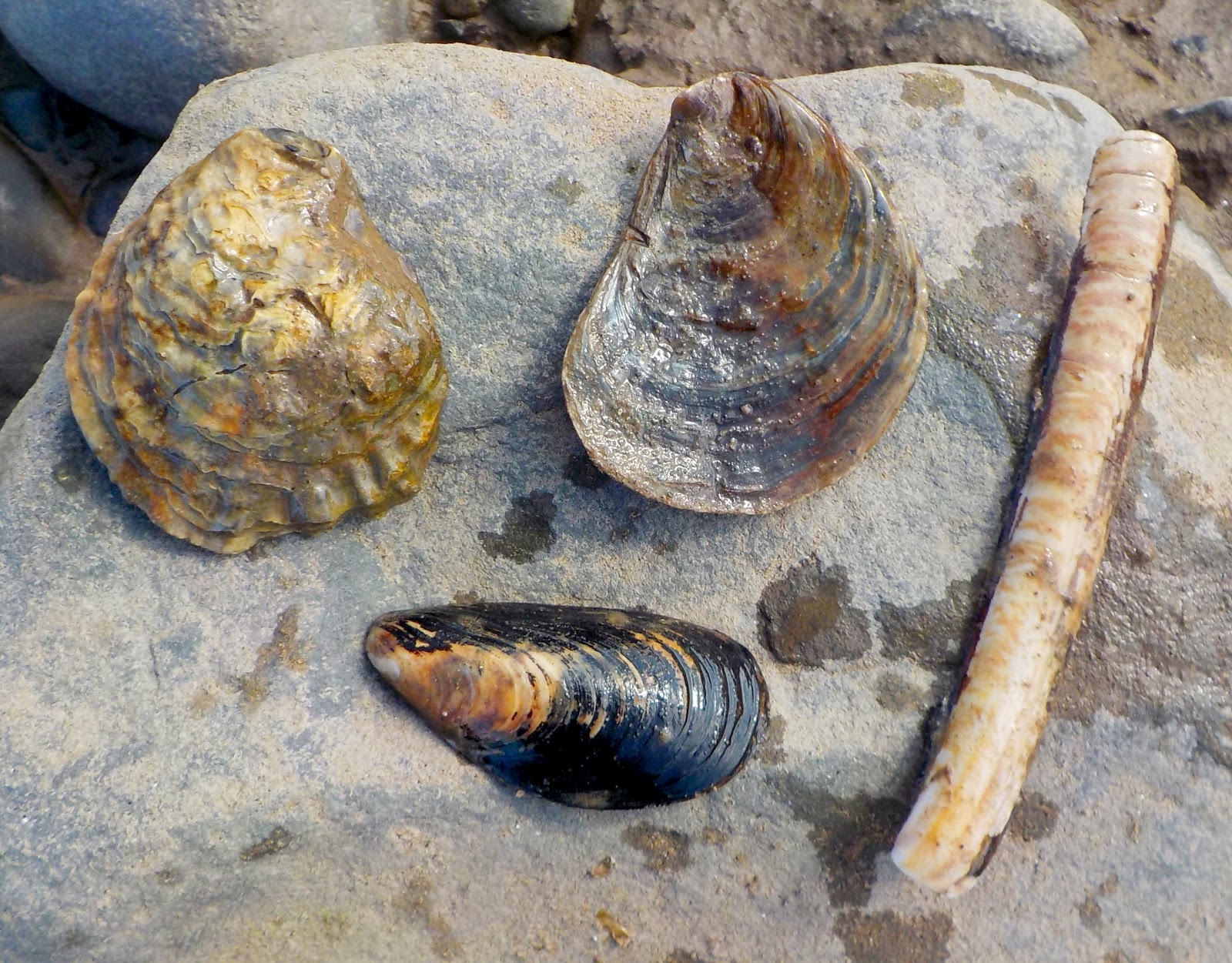
Coming down onto the shoreline and peering into the rock pools (or guddling in the local dialect) we find a treasure trove of shells of edible molluscs; oysters [top], mussels [bottom] and razor shells [right]. Unfortunately the original inhabitants of these shells are no longer present so no 'Allonby Chowder' recipe this week. It's a dish more suited to the depths of winter so, maybe on our next visit. And we must include smoked kippers! Around the turn of the 18th century, the village of Allonby was the centre of the local herring fishing industry, salting and packing the herring in barrels and kippering them in the smoke house.


From the remote geolical past, through more recent history, we come to the present. Out beyond the shoreline, where the oystercatchers, knots and dunlin probe the sands for their lunch, lies the Robin Rigg offshore wind farm. Sixty 260ft (80m) high towers with four 144ft (44m) blades apiece turning at an average 170 miles per hour produce enough electricity to power half the houses in Cumbria. There are concerns of course. You can't plant a forest of turbines in somewhere like the Solway Firth without shaking it up a little and the ecology is being carefully monitored. But, whichever way you look at it, it means a heck of a lot less fossil fuel has to be burnt to keep the lamps lit over half the county.


Crete Nature Catch-up

Steve's Books (well, just the one at the moment but 'The Quick Guide to Creepy-Crawlies' is well under way and should be available later in the year).)

Not Just For Twisted Women by Steve Daniels 
A light-hearted look at life through the eyes of the fairer sex.
Kindle Edition 1.99 pounds sterling (or equivalent).
Paperback Edition 4.99 pounds sterling (or equivalent)..
Read snippets, samples and stuff at Steve's Books


*********************************************************************
LINKS:
Share your nature thoughts, photos and comments on Naturalists (the facebook page that accompanies this blog)

Explore the region with the #CreteNature interactive Hiking and Nature Map


Wednesday, 18 February 2015

The Nature of Archaeology

The National Archaeological Museum, Athens


Those of you who follow my scribblings on a weekly basis will know that last week I had to leave the island in a bit of a hurry and visit the mainland (referred to as Greece in these parts or simply “the up”. Despite Crete being wedded to Greece for 103 years it is still thought of as a foreign country.) I only had the one free day during my visit and you may be forgiven for thinking that I’d have spent it on Lycabettus Hill or the slopes leading up to The Parthenon searching for flora and fauna. Ordinarily I would, of course, but the temperature was only a little above freezing and it was snowing heavily. As the only thing I was likely to find at The Parthenon would have been The Four Norsemen of the Acropolis I did what any self-respecting naturalist would do and scurried indoors. So join me if you will and enter the portals of The National Archaeological Museum and we’ll take a look at the exhibits through naturalists’ eyes.


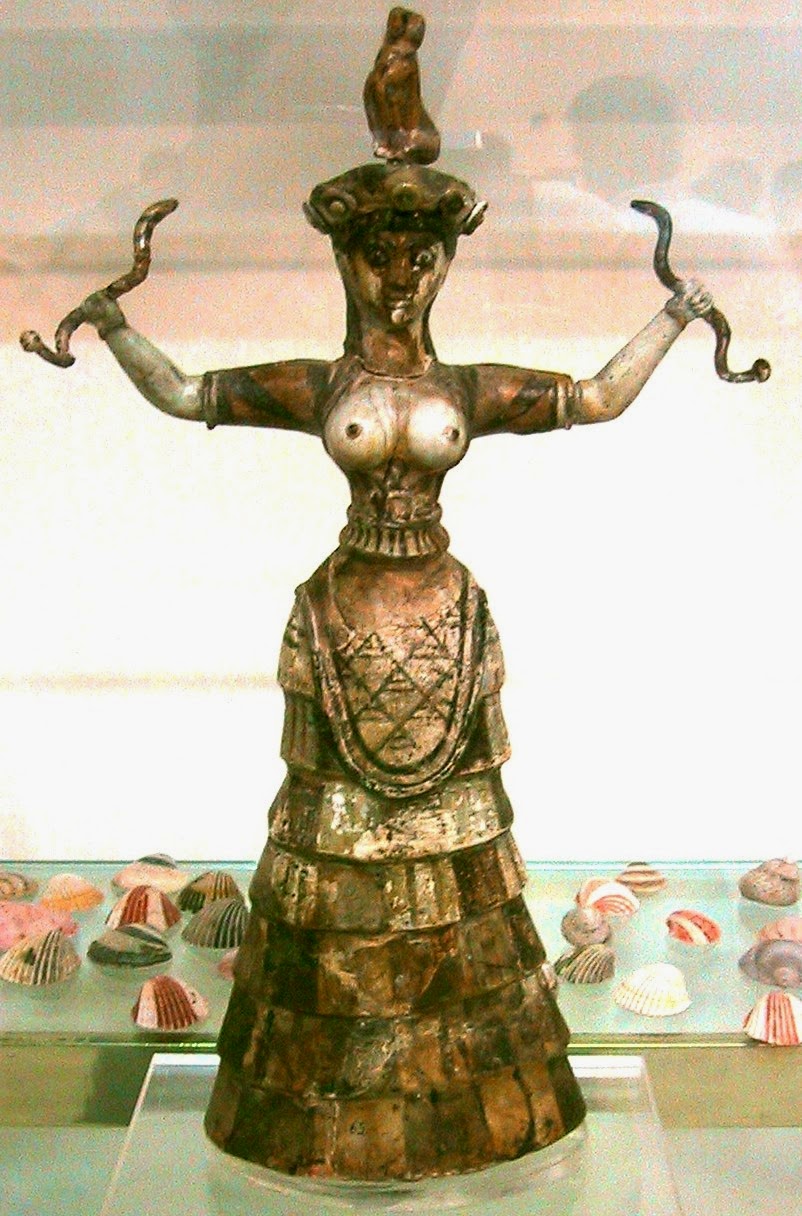
Minoan Snake Goddess (via Wikipedia)
That nature has influenced man for far longer than man has influenced nature goes without saying so let us travel back in time some three and a half thousand years to the beginning of European civilization. And here we are back on Crete with the Minoan Snake Goddess. She is always depicted holding up a snake in each hand which, people who know about these things say, symbolises new life as the snake appears to be born again when it sloughs its skin. Personally I am not convinced, especially as the experts also say that the animal on her head seems to be an imitation of a panther. Me? I think she’s just having a bad hare day.


Mycaenean Bull's Head (vis Wikipedia)


Moving on a few hundred years, Crete has suffered major destruction from a volcanic eruption on the island of Thera (Santorini) which was four times as big as that on Krakatoa (which incidentally is to the west of Java despite the film title: Krakatoa, East of Java). The Mycaeneans, based on the Peloponnese, have now taken control of Crete, Southern Greece as we know it today and most of the Aegean islands. They borrowed heavily from Minoan culture but dropped the snakes in favour of another animal dear to the Minoan’s hearts, the bull. That is not to say that the Mycaeneans just popped up out of nowhere; this bull’s head, with the magnificent gold horns, lips and intricately worked rosette, was crafted at about the same time as the Snake Goddess. It is merely that the balance of power shifted in the region.


Hecate


Jumping on a few centuries more and the centre of power has moved to Byzantium (Istanbul) and a new goddess is on the scene; Hecate.  An interesting lady associated with moonlight, witchcraft and pointing the way at crossroads she was well versed in plant lore and is often represented sitting beneath that most magical of trees, the yew, with her trusty hound beside her. So from a natural history perspective the animal symbolism has progressed from snakes to bulls to dogs and thus getting ever more domesticated as history moves forward and plants now begin to put in an appearance. Hecate’s other great claim to fame concerns a story from 340BC. The Byzantines were under siege from Philip of Macedon when a bright light appeared in the sky (possibly a meteor) accompanied by the howling of dogs just as he was mounting a surprise attack. The Byzantines put this down to Hecate, who also included ‘bringer of light’ on her CV, erected a statue to her and minted coins with her head on the obverse and a symbolized star and crescent moon on the reverse and thus the star and crescent symbol was born.

Roman loutrophos with Acanthus leaves

Having trundled our way through the halls of history picking our plants and animals from among the potsherds and artifacts we now come to a riot of Roman relics. Take a look at this massive loutrphoros over here. It’s meant to be a bathwater carrier for use in funerary rites but it looks as if it would take six men to lift it when it was empty. That however is beside the point; take a closer look at those sculpted leaves – they’re modelled on the leaves of Spiny Bear’s Breech (Acanthus spinosa), a plant I often see back home on Crete and the Romans went mad for it. No sculpture, column or pedestal was complete, it would seem, without a few acanthus leaves. The story goes that a Greek sculptor called Callimachus had been inspired by the leaves growing through a woven basket containing votive offerings on the grave of a young girl. The Greeks fiddled about with the design, the Byzantines copied it here and there but the Romans really went overboard on it. Goodness knows why, it’s not the prettiest leaf in the floral album, maybe it was easy to carve.

The Atrium, National Archaeological Museum

Now here is a sign of great modernity but no little interest: “Café”.  How pleasant, they’ve put it in the atrium and the snow seems to have stopped falling. It’s still bitterly cold though and a steaming mug of coffee would go down a treat. “Ah, that’s better.” I see we have a stone lion prowling through the olive trees which provides a rather tenuous link to our final bit of nature in archaeology and brings us more or less up to date with the Venetians who held sway on Crete after Byzantium was sacked in the fourth crusade in 1204 and the island was sold to Venice. Venetian tradition has it that St. Mark, he of the second gospel, was travelling through Europe, evangelizing as he went, and stopped off at Venice where an angel appeared to him saying “May Peace be with you, Mark, my evangelist. Here your body will rest.” Actually, I think that sounds more like a Mafia death threat than something an angel might say but I suppose it depends on the intonation. Anyhow, the angel was wrong because St Mark was buried in Alexandria. Feeling a bit miffed by this a couple of likely lads called Rustico da Torcello and Bon da Malamocco nipped over to Alexandria in 828, did a bit of stealthy grave robbing and brought him back to Venice where he rests to this day in the Basilica of St. Mark.  Mark’s symbol was the aforementioned lion but with additional wings and a halo symbolizing both power and holiness. So that just about concludes our potted history of the Eastern Mediterranean  over the past three and a half thousand years with reference to the plants and animals symbolized along the way. Until next week when we’re back on home ground and hopefully enjoying a bit of winter sunshine – happy hunting.

***********************************************************************************
LINKS:
Naturalists (the facebook page that accompanies this blog)


Recent Posts