Showing posts with label Winter solstice. Show all posts

Wednesday, 21 December 2022

Happy Yuletide


At 9.47 GMT this evening it will have been dark, here in Cockermouth, for about six hours. All across the northern hemisphere, it is the longest night of the year, as the sun reaches its lowest point, directly over The tropic of Capricorn. It also marks the beginning of Yuletide, twelve days of convivial merriment and good natured mischief, to acknowledge the onset of winter and look forward to the coming of longer days and shorter nights.


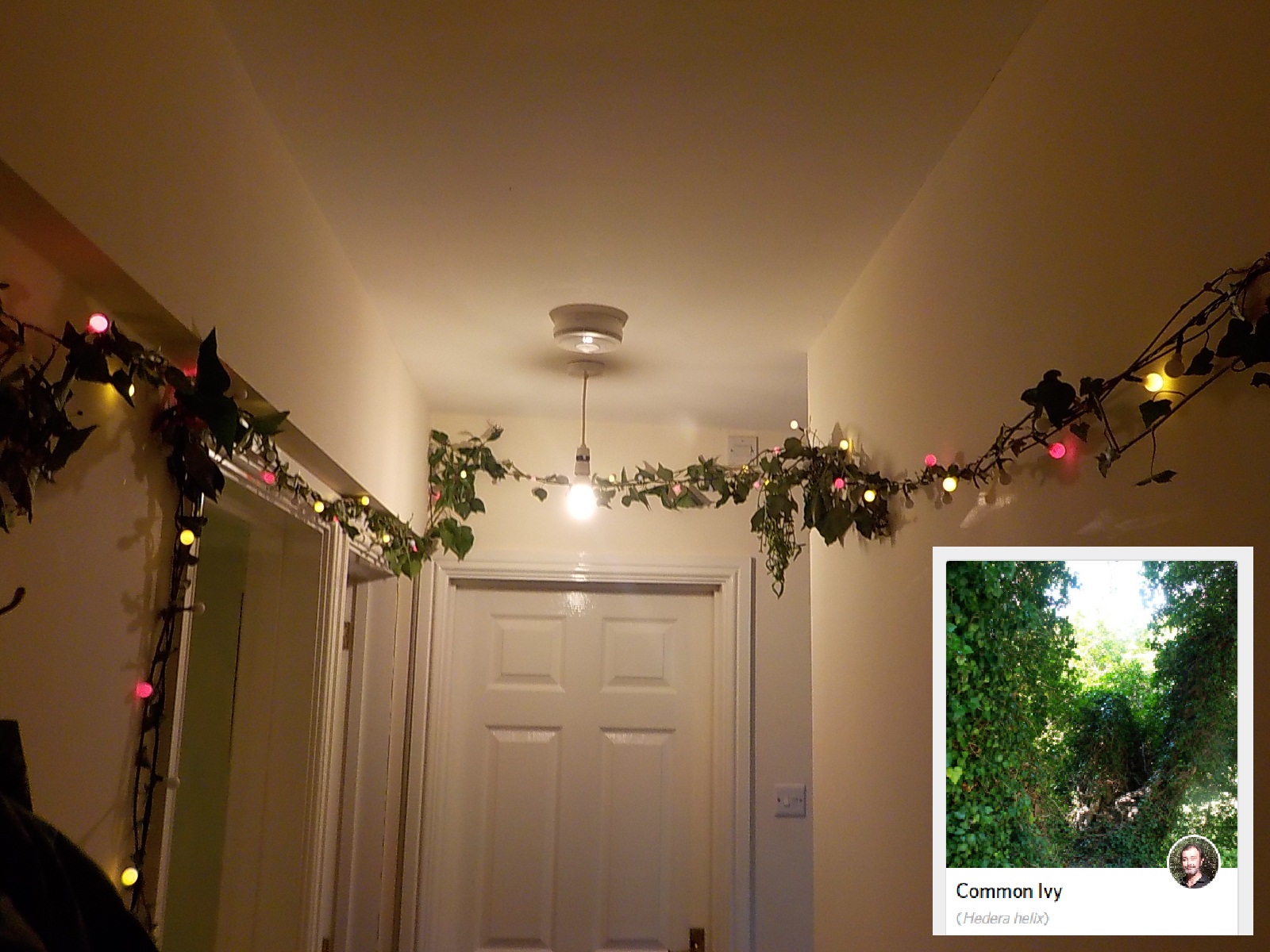
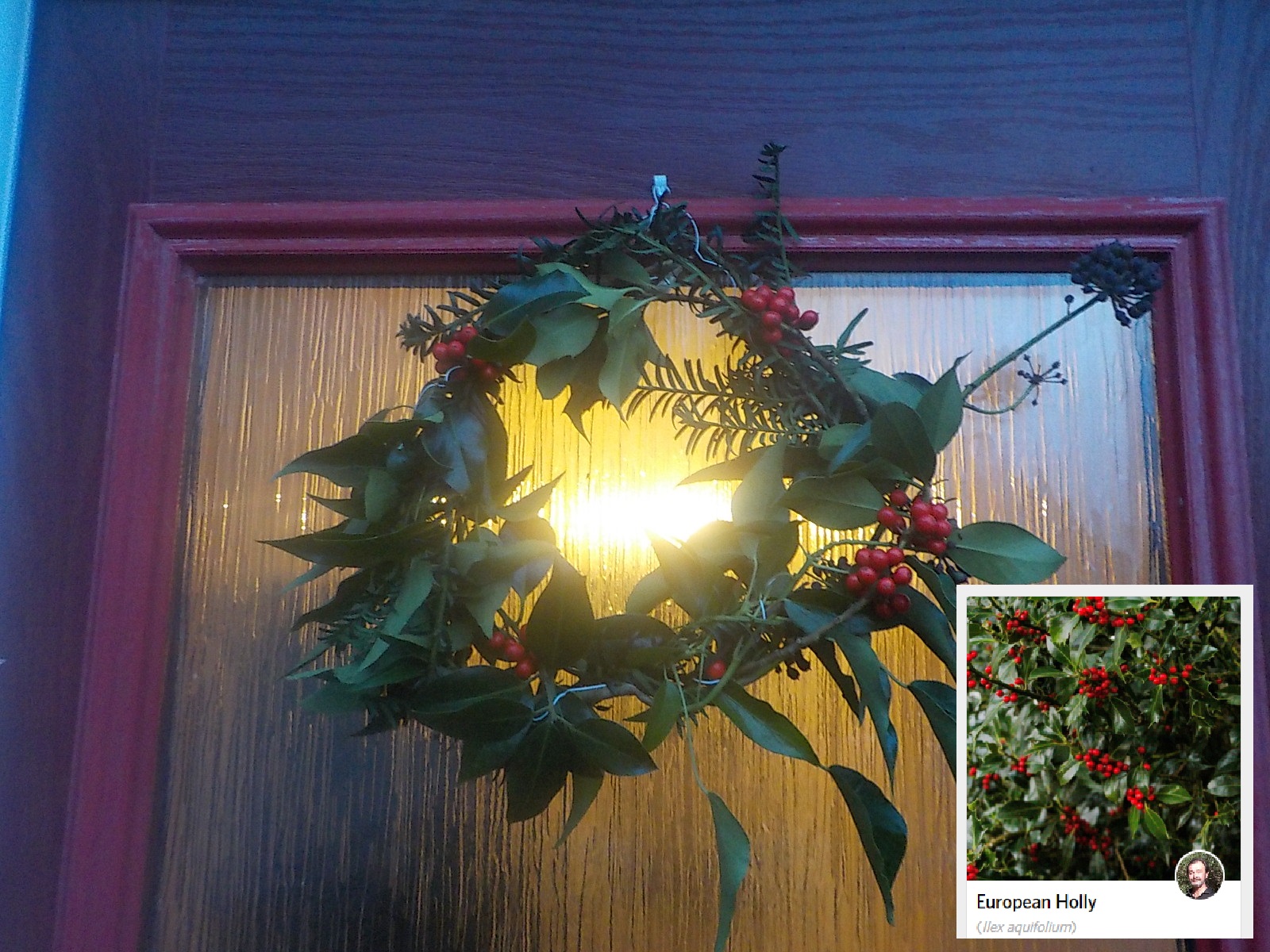
It is also the day when I traditionally decorate my abode with lights and herbage from the hedgerows. The holly and the ivy have been used since pagan times to ward off evil spirits, which is why we put a wreath containing these plants upon the front door.


Ivy, in long strands, when wrapped around a string of lights, makes a highly effective decoration. It is also cheaper, and more environmentally friendly, than shop bought chains imported from the far east.


Similarly, small conifer sprigs and cones can be used for simple, yet effective, centrepieces.


And finally, where would we be without the mistletoe? Mistletoe features in many winter mythologies, but the practice of kissing under it probably only dates from the 18th century. Below stairs, servants were permitted one kiss for each berry plucked from the plant.


Happy Yuletide,


Steve

Wednesday, 20 December 2017

The Purple Ponds of Lithines

The purple ponds are teeming with microscopic life. 
We'll make our way back to the main Sitia-Makry Gialos road to Lithines where there are a few interesting ponds to the north west of the village that are worthy of investigation not least of all for their intriguing colour at this time of year. We are still awaiting significant rainfall and the ponds are very shallow at the moment but packed full of nutrients and it is these that are responsible for their unusual colour. If you check them out under the microscope they are absolutely teeming with microscopic life with nematodes, desmids and the like flitting about at tremendous speeds all over the place. But before we get down to them lets see what we can find on the way.

The first signs of the upcoming change of season are here by the track with these Wood Sorrels or Bermuda Buttercups which will soon be adorning every roadside and olive grove. You can make a nice warming winter soup with these; just bring a pot of chicken or vegetable broth up to the boil, chuck in a handful of cooked rice and a handful of wood sorrel leaves, simmer for about eight minutes. Finally stir in a dollop of cream, salt and pepper to taste and serve with a couple of the flowers floating on the top. (Obligatory word of caution: Wood sorrel contains oxalic acid so if you suffer from rheumatism, arthritis, gout, kidney stones or hyperacidity then it may aggravate the complaint but for the rest of us the odd bowl or two is fine). You can also add flowers or leaves to salads for a sharp, lemony bite if you wish as well. As with all wild plants, wash them well, remove any bugs such as this Shield Bug nymph and pick away from roadsides or other contaminated areas.

There are the ponds down there which we have to find our way down to somehow but first a Small Copper has just landed nearby. They like to lay their eggs on Sorrel which is their caterpillar's food plant and you could be forgiven for thinking that this is rather handy as we have some wood sorrel nearby but not so. This is the old confusion of common names. The Wood Sorrel is Oxalis pes-carpe in the family Oxalidaceae; Sorrels (without the wood) are plants of the Rumex genus in the Polygonaceae family. The ambiguity arises because they are all acidic tasting and the word Sorrel reflects this being derived from the old French 'sorele' meaning sour.

Here we are, down at the ponds without too much difficulty and there doesn't seem to be too much activity on the surface but just take a look at this rainwater ditch nearby where the water is a little more free draining. The dragonflies are having a high old time, there must be six pairs here at least, flying along in tandem with the males clasping the females' necks with their special pincers. These little Darters stay together after copulation and then the female gently dips her abdomen into the water and lays an egg which, if we sit and watch them for a few moments we can witness. There she goes, and another, and another. These will hatch out into extremely predatory nymphs and providing that the ditch doesn't dry up they can spend up to three years in this stage before emerging as adults.

And finally the ponds themselves and what an unusual, attractive colour they are at this time of day. Not entirely devoid of life on the surface, I can see one small, white insect skating along on the surface but what precisely it is I cannot tell. No, I am not going to wade in and take a closer look. I have a strong suspicion that beneath this shallow water there lurks a good few inches or more of evil smelling sludge with which I have no desire to get better acquainted thank you. Well, that just about wraps it up for Autumn. Tomorrow is the Winter Solstice and if you'd care to join me in raising a glass to the shortest day of the year the the time of the solstice, when the Earth is at its furthest point from the sun, is 16.48 Universal Time or almost ten to five Greenwich Mean Time as us oldies prefer to call it. That's a most convivial time for a libation out here in Crete being about ten to seven in the evening. So, wherever you are and whatever you're celebrating, have a good one and we'll meet up again on January 3rd 2018. Cheers!

Photographic Bit

Many of you have asked me what photographic equipment I use so for details of aperture settings, shutter speeds etc. my pictures will be on Flickr within a few days and that has all the geeky stuff. Pictures were edited with FastStone Image Viewer and combined with Microsoft Paint.
*********************************************************************
LINKS:
Share your nature thoughts, photos and comments on Naturalists (the facebook page that accompanies this blog)

Explore the region with the #CreteNature interactive Hiking and Nature Map


Wednesday, 21 December 2016

The Old Olive Press

After last week’s stroll through the village of Agios Ioannis I thought we'd walk down the road for a bit and then cut across into the valley below where there’s an old olive press that I’ve long wanted to prowl around. But first, here growing wild at the side of the road is a magnificent straggling clematis climbing the rocks.


The Buttercup family - Ranunculaceae
Obviously, like anemones and delphiniums, it’s a type of buttercup. No, I haven’t finally taken leave of my senses they are all part of the Buttercup family, the Ranunculaceae. But how can such wildly different looking plants all be closely related? It all comes down to plant systematics, the biological classification of plants. A couple of hundred years before Christ was born, a wandering Greek philosopher called Theophrastus started us off by grouping plants loosely into trees, shrubs and herbs. Another Greek, Dioscorides who was a medic in the Roman army, refined this a few hundred years later when he classified over five hundred plants according to their medicinal properties and this became the standard reference work right up until the sixteenth century. Classifying plants by their similarities in structure then took over culminating in Linnaeus publishing his Species Plantarum in 1753 (he dwelt on their sexual organ arrangements but then, he didn’t get out much). Darwin’s publication On the Origin of Species in 1859 pushed us towards classifying plants based upon their evolutionary relationships and nowadays we use DNA analysis to refine that concept in the science of cladistics (see Taxing Taxonomy and Confusing Cladistics) and that’s why clematis is a type of buttercup – they share a common ancestry.


St. Antony and Balkan Green Lizard, Lacerta trilineata
This little old church here, which was built into the rock about 120 years ago, is dedicated to St. Antony of the desert. I think that we could do no better than adopt him for our journey as he was a great one for going off into the wilderness which is what we’re about to do. He lived variously in a tomb, an abandoned Roman fort and at an oasis, fought demons in caves and had encounters with satyrs and centaurs. Which rather goes to prove that living on your own for too long isn’t necessarily a healthy option. However I expect he had the odd lizard for company which is maybe why this little Balkan Green lizard is basking outside his church. We're going to cut down left by those pines.


Painted Lady, Vanessa cardui and Willow Warblers, Phylloscopus trochilus
This is our wilderness and it used to be a garden by the looks of that remnant of a grape trellis. I see that the Painted Ladies are still with us (I believe that St. Antony was tempted by visions of those as well but not the butterfly variety) and dancing around the ground in amongst the foliage are a couple of Willow Warblers. These are winter visitors and rather similar to chiffchaffs but you can tell the difference by their little pinkish legs; the chiffchaffs are brown/black. Their call is slightly different too and if we stand still under the trellis and call to them they’ll probably call back. It’s a sort of low who-whit whistle (as opposed to the chiffchaffs which is simply whit). Are you ready? Right, whistle. who-whit. There, they’re answering you.

The garden isn’t as abandoned as it first seemed. This small citrus-cum-olive grove appears to be well tended. I wonder what delights it holds in store for us? I’ve found our first mushroom of the season. Here, growing in the roots of this olive tree. I think that it may be a False Chanterelle. The reason I say ‘I think’ is that it’s not easy to tell a False Chanterelle, which at best is inedible and at worst mildly poisonous, from a true Chanterelle which is delicious. An experienced forager may tell you that the edible one has an apricot smell – not helpful if you’re slightly anosmic like me - and a mycologist will tell you that the true Chanterelle has primitive gills which is great if you’re an expert on gill structures. Add to this that the poisonous Jack O’lantern looks pretty much the same as both of them and grows in the same type of habitat and you have a recipe for disaster; quite literally if you’re thinking of cooking them. This specimen is also rather old so we’ll have to leave it with a question mark as to what it is.

Mud Dauber wasp nest Sceliphron genus
Finally we’ve reached the old olive press. It’s rather overgrown with newly emerging giant fennel but I think that we can get in and poke about. Beware of falling masonry. These are out of the ordinary, look up here in the corner. These are the nests of Mud Dauber Wasps and this is the mud that they’ve daubed to create their nurseries. Each cell will hold one larva which will be provisioned, quite often with one of those Cellar Spiders that we found last week. We’ve met these wasps before of course (see Only Connect...A Quiz ) but the nests themselves are interesting.  In Hoodoo magic (not Voodoo) which is practised in the American deep south these nests are collected, powdered down and mixed with other ingredients and used in a variety of spells. Most of these seem to have to do with keeping people coming back be they errant husbands or business customers.

Well, there’s a nice bit of magic to finish the day. The next part of journey seems to take us through the olive groves that once supplied this press and after that I suspect that we’ll be back in the wilderness. See you next week.

The Extra Bit

Here’s a fascinating article on the use of mud dauber nests in Hoodoo magic: A Multipurpose Zoological Curio
…and another on Chanterelles: How to tell a real Chanterelle 

It is that time of year when we’re all celebrating some sort of winter festival so whether yours is Christmas, the Winter Solstice, Hanukkah, Pancha Ganapati or one of your own devising may I wish you a very happy one. Merry Whatever, love Steve x.


*********************************************************************************
LINKS:
Naturalists (the facebook page that accompanies this blog)
See detailed pictures at http://www.inaturalist.org/login  (search - people-stevedaniels-observations)


Recent Posts