Showing posts with label Lizard. Show all posts

Friday, 25 February 2022

The European Nature Almanack - March 2022


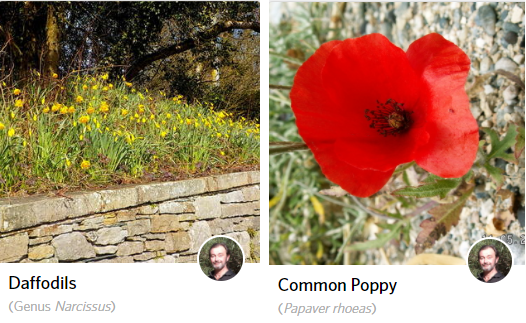
March is now upon us and one cannot live in the home town of William Wordsworth without making Daffodils the flower of the month for those of us in the north of Europe. The hosts of golden, nodding heads provide a wonderful, uplifting burst of colour after the sombre tones of winter. In the south of Europe, around the Mediterranean, Spring is in full bloom this month. I've recorded no less than 378 different plants in flower during March on Crete (as opposed to 109 here in Cumbria during the same period). The flowers I want you to look out for down south are poppies. Poppies belong to the genus Papaver and there are over 100 species. How many can you spot?




As the flowers come into bloom, so the insects start to emerge, and one that is common across Europe at this time of year is the Lady Beetle. This is the name that is being increasingly adopted throughout the English speaking world for these familiar creatures. Here in the UK we have traditionally called them ladybirds (but they're not a bird, obviously), and in the US they were called Ladybugs (but they're not true bugs either). They are part of the Beetle family, Coleoptera. There are over six thousand species worldwide, the most familiar to us in Europe being the 7-spot, Coccinalla septempunctata. The 'Lady' part of the name comes from the Christian 'Our lady' (Mary) who was depicted as wearing a red cloak in early paintings with the 7 spots representing her seven joys and seven sorrows.


Look out also for lady beetle larvae. As you can see, they are very different to the adults. You can tell it is a beetle larva from the hardness of its head (like a beetle's wing case), the six pairs of jointed legs at the front, and the lack of any additional leg-like appendages (called prolegs). A key to terrestrial insect larvae is given on page 77 of The Quick Guide to Creepy-Crawlies as well as explanations of terms like prolegs. A key to aquatic larvae is given on page 78.


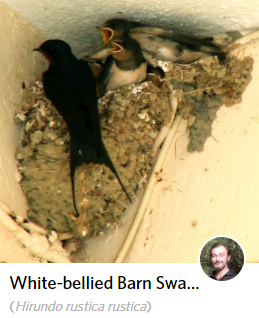
Birds are starting to nest now which gives me a chance to talk about the etiquette of bird photography, particularly with regard to nests and eggs. For many years photographing birds on the nest, or eggs, has been taboo. The reason being that you couldn't get such photos without disturbing the birds. Nowadays, with long distance lenses, and the discrete use of camera traps, it is possible to get photos without interfering with them. So, let common sense prevail. The bird mustn't be aware of your presence. Some birds, such as House Sparrows and these Swallows, nest in and around human habitation and you can take photos from a reasonably close distance. They still wouldn't appreciate you thrusting your phone into their nest though.
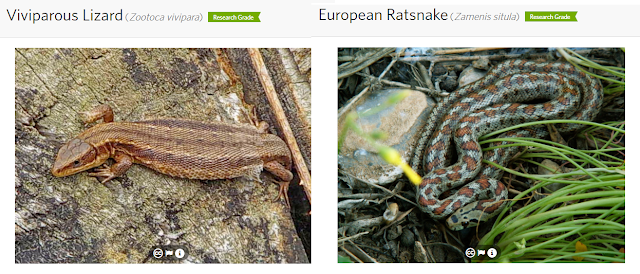


Lizards and snakes are beginning to come out of hibernation as the days get longer and warmer so keep an eye out for reptiles this month such as The Viviparous Lizard in the north and The European Ratsnake in the south. Both of them beautiful creatures.


Steve's Wild Kitchen


In Greece, March is the time to start collecting Xorta, wild spring greens. Many of these are from the Brassica or Amaranth families, but there are many others as well. Even here in the north of Europe there are over sixty different wild plants to forage. My particular favourite is Garlic Mustard (Allaria petiolata) with its subtle blend of both garlic and mustard. An essential ingredient of The Great Cumbrian Breakfast with lamb's kidneys, mushrooms and black pudding.


Wine of the month to try in March will be Meadowsweet (AKA Bridewort). This is a beautifully fragrant herb, with a honey like aroma, which should make a delicious dessert wine (it used to be used as an alternative to honey in making mead). Meanwhile, I'm still waiting for the nettles to reach a suitable height for picking for February's nettle wine. I'll keep you posted.


Steve's Books


Click on a cover for details


Chubby's Crematorium & Burger Bar

A book of humorous poems to cheer, amuse and entertain your friends with.


The Quick Guide to Creepy-Crawlies

All you need to know to identify any type of insect, spider, worm or snail very simply and find out more about it.


The Eggs of Saramova

A science fiction novella for those who don't like science fiction. A fast-paced thriller that is, literally, out of this world (and it starts right here in Crete).


Not Just For Twisted Women

A light-hearted look at life through the eyes of the fairer sex.


See sample pages of all my books and keep abreast of latest publications here:

http://author.to/SteveDaniels


Keep up with me throughout the month on Steve's Nature Plus or join the 1,300 members of our Facebook Group: Naturalists

All the best,


Steve


Wednesday, 26 May 2021

Glasson Moss and The Other Fossil Fuel


We all know the three major fossil fuels; coal, oil and gas but today we're off to a peat bog. Peat is sometimes referred to as the forgotten fossil fuel and is rarely used outside of Scandinavia and the British Isles. It's an amazing material formed by partially decayed organic matter and, what's more, it's terrific at storing carbon. So terrific that the International Union for the Conservation of Nature have calculated that peatlands store more carbon than all other vegetation types in the world combined. The important plant in this ecosystem is this Sphagnum moss. The green bits that you can see contain the usual photosynthesising plant calls, but underneath they have special, barrel shaped cells that soak up water like a sponge, thus creating the bog. Bogs are very acidic and only certain plants, like the Hare's-tail Cottongrass that you can see dotted about, can tolerate these conditions.


Another plant that loves these acidic conditions is Heather which is why we're seeing a lot of Oak Eggar caterpillars about. Despite its name (which derives from the fact that its coccoon is said to resemble an acorn) its preferred caterpillar plant foods are Heather and Bilberries. We also have a Wall Brown butterfly making a flying visit and a small moth hiding in the heather that I can't identify.


To stop our feet getting wet, volunteers have laid hundreds of metres of boardwalks, and as these warm up in the sun, Large Red Damselflies and Viviparous Lizards come out to bask. How do you tell a damselfly from a dragonfly? Dragonflies rest with their wings outstretched, damselflies fold them back in line with their bodies. (One of the many tips to identification that you'll find in
The Quick Guide to Creepy-Crawlies).


As we come to the edge of the bog we come into a small patch of Silver Birch. On some of the dying stumps of trees we have Birch Polypore bracket fungi growing. These grow almost exclusively on birch trees and are also known as the razorstrop fungus because that was what they were traditionally used for. And for those of you who don't remember the days before the disposable safety razor, razor blades used to resemble single blade penknives and had to be regularly sharpened by whetting the blade, back and forth on a strop. We also have a number of small beetles on the leaves. I haven't had them confirmed as yet, but I think that they are Heather Beetles, Lochmaea suturalis.


I haven't mentioned birds yet, but they've been about. Mainly Chaffinches and a few Blackbirds but for most of the morning we've been accompanied by the call of a cuckoo, the first I've heard this year. And for those of you who only read this blog for the birdie bits, here's a Wood Pigeon taking a bath on the track into the nearby village of Glasson.

Steve


Steve's Nature Plus

Minibeast Monday * Podcast Tuesday * #CumbriaNature Wednesday * Foraging Friday * and other odd bits as they happen throughout the week.

Steve's Gallery

If you'd like to see some of the pictures in more detail, you'll find them in the gallery. These are also available for prints or digital downloads for commercial or scientific use.

Steve's Books


The Quick Guide to Creepy-Crawlies

All you need to know to identify any type of insect, spider, worm or snail very simply and find out more about it.

Yvonne: This was a gift for a family so that the children can understand what they see on days out. The second was for me. Logical and easy to use. If you know anyone who likes nature you can be confident that gifting this book will give years of pleasure.

The Eggs of Saramova

You can listen to this book for FREE as it is being serialized on the podcast The Author Reads


£7.50 Paperback edition

Not Just For Twisted Women by Steve Daniels 

A light-hearted look at life through the eyes of the fairer sex.

Janet: If you are short on time but enjoy reading and are maybe not into long extended novels then Not Just For... Twisted Women provides readers with concise stories that stand alone and most certainly entertain with their ultimate twists. Loved it.

Helen: A very good read! Well written and entertaining!

Margaret: Each quick tale gives a glimpse into a character's life and has an often humorous twist at the end. I would love to read more.

Yvonne: These days many people find it hard to find the time to read a novel, so this book of short stories is ideal to dip into. It is also makes a good gift.


£4.99 Paperback
edition


Crete Nature Catch-up

Series 1 - Welcome to Lasithi

Series 2 - The Rhythm Of Life

Series 3 - A Journey Begins

Series 4 - The Milonas Valley

Series 5 - This Is Ferma

Series 6 - Upland Villages

Series 7 - The Forty saints

Series 8 - Sunday Strolls

Series 9 -Stormy Weather

*********************************************************************

LINKS:

Share your nature thoughts, photos and comments on Naturalists (the facebook page that accompanies this blog)


Wednesday, 25 September 2019

Lugano To Venice


As our next port of call, literally, is some distance from the city of Venice I thought I'd book us in at a midway point between the two. By sheer chance the hotel is only a short walk from the 19th century Forte Marghera which is now a cultural centre and wildlife refuge. I think that this will be a good place to start our explorations. A good place to build a fort, surrounded on all sides by a double waterway and the wildlife starts here below the bridge in the shape of this crab mumbling his way through the residents of the green algae.


The place is an absolute haven for insects. There's a Shield-backed Katydid in the grass alongside a Click Beetle; a Mediterranean Spotted Chafer Beetle getting itself covered in pollen as it feeds on a mallow flower and a rather handsome Leaf Beetle of the Lachnaia genus down there. Hang on, I'll just root him out for a second so that you can have a closer look.


Hello, looks like we've got a bit of wildlife action on this Mallow over here. A ground crab spider, Xysticus sp. has taken a fancy to a small bee for its lunch. You can tell that it's a bee and not a fly mimicking a bee because you can clearly see all four wings and flies only have two. Bee mimicking flies also have much shorter antennae than bees but I think that the spider has them in its jaws. Talking of lunch there's a nice rustic looking restaurant here so I propose that we adjourn.


That was delicious and very reasonable. I liked the complimentary bottle of home made wine. I think that all restaurants should adopt that policy. Shall we go and have a look at Venice? Very pretty, now get me out of here. It's full of hat and tat stalls and camera clicking tourists. Let's find a quiet backwater and have a civilised cup of afternoon coffee. If I hear one more person singing 'Just One Cornetto' they're in for a ducking. Giovanni Capurro, who wrote the original lyric to O Sole Mio, must be turning in his grave.


I have another reason for visiting this part of Venice. Did you notice that small park that we passed earlier? That is the Giardini Papadopoli and it is one of the scenes in my novel, The Magic of Nature of Magic which is now complete . I just want to go and soak up the ambiance and sit with the Lizzies for a bit. These are Common Wall Lizards, Podarcis muralis, and I see that we are being watched over by a Yellow-legged Gull, Larus michahellis. These predominate over their pink legged cousins that you find further north.

Talking of books, The Quick Guide To Creepy-Crawlies is now under final revision and proof-reading stage. I was hoping to produce a paperback version and a Kindle version but as Kindle cannot handle internal hyperlinks (What???) I've had to abandon the Kindle version.


Crete Nature Catch-up


A light-hearted look at life through the eyes of the fairer sex.

Kindle Edition 1.99 pounds sterling (or equivalent).
Click on the link to the right to read two complete stories for free.

Paperback Edition 4.99 pounds sterling (or equivalent)..
Read snippets, samples and stuff at Steve's Books


*********************************************************************
LINKS:
Share your nature thoughts, photos and comments on Naturalists (the facebook page that accompanies this blog)

Explore the region with the #CreteNature interactive Hiking and Nature Map


Wednesday, 11 September 2019

Strasbourg to Lugano


After that beautiful stopover in Strasbourg we are now burrowing our way through The Alps like a maggot through Swiss cheese, emerging from long, dark tunnels into beautiful vistas of lakes and snow capped mountains. A quick change at Basle and then on to Lugano on the Swiss Italian border.


Hitched a lift on the local bus up into the mountains and was told where to get off by a beautiful young music student who sat next to me. (No, literally: she informed me where to disembark as her stop was a few before mine). This is the Pensione Agra run by Annemiek and Fritz and was my favourite place of the whole tour.


Surrounded on three sides by Lake Lugano it is a magnificent place for hiking through upland meadows and woodland and we have another free day with which to explore. Walking through the village, lizards scurry along the walls through clumps of Ivy-leaved Toadflax.


Butterflies are everywhere, along with a whole host of other inverterbarates while in the woodlands songbirds of every description orchestrate the air but remain firmly out of sight in the dense summer canopy.


A weird humming noise fills the air which I took to be a swarm of beetles such as this fellow but it turned out to be hundreds of bicycle tyres on tarmac as dozens of Swiss clockmakers hurtled down the hill to make sure that they got to work on time.


Crete Nature Catch-up

Steve's Books (well, just the one at the moment but 'The Quick Guide to Creepy-Crawlies' is nearly complete and I hope to publish it later this month).

Not Just For Twisted Women by Steve Daniels 


A light-hearted look at life through the eyes of the fairer sex.

Kindle Edition 1.99 pounds sterling (or equivalent).

Click on the link to the right to read two complete stories for free.

Paperback Edition 4.99 pounds sterling (or equivalent)..  Read snippets, samples and stuff at Steve's Books


*********************************************************************
LINKS:
Share your nature thoughts, photos and comments on Naturalists (the facebook page that accompanies this blog)

Explore the region with the #CreteNature interactive Hiking and Nature Map


Wednesday, 21 December 2016

The Old Olive Press

After last week’s stroll through the village of Agios Ioannis I thought we'd walk down the road for a bit and then cut across into the valley below where there’s an old olive press that I’ve long wanted to prowl around. But first, here growing wild at the side of the road is a magnificent straggling clematis climbing the rocks.


The Buttercup family - Ranunculaceae
Obviously, like anemones and delphiniums, it’s a type of buttercup. No, I haven’t finally taken leave of my senses they are all part of the Buttercup family, the Ranunculaceae. But how can such wildly different looking plants all be closely related? It all comes down to plant systematics, the biological classification of plants. A couple of hundred years before Christ was born, a wandering Greek philosopher called Theophrastus started us off by grouping plants loosely into trees, shrubs and herbs. Another Greek, Dioscorides who was a medic in the Roman army, refined this a few hundred years later when he classified over five hundred plants according to their medicinal properties and this became the standard reference work right up until the sixteenth century. Classifying plants by their similarities in structure then took over culminating in Linnaeus publishing his Species Plantarum in 1753 (he dwelt on their sexual organ arrangements but then, he didn’t get out much). Darwin’s publication On the Origin of Species in 1859 pushed us towards classifying plants based upon their evolutionary relationships and nowadays we use DNA analysis to refine that concept in the science of cladistics (see Taxing Taxonomy and Confusing Cladistics) and that’s why clematis is a type of buttercup – they share a common ancestry.


St. Antony and Balkan Green Lizard, Lacerta trilineata
This little old church here, which was built into the rock about 120 years ago, is dedicated to St. Antony of the desert. I think that we could do no better than adopt him for our journey as he was a great one for going off into the wilderness which is what we’re about to do. He lived variously in a tomb, an abandoned Roman fort and at an oasis, fought demons in caves and had encounters with satyrs and centaurs. Which rather goes to prove that living on your own for too long isn’t necessarily a healthy option. However I expect he had the odd lizard for company which is maybe why this little Balkan Green lizard is basking outside his church. We're going to cut down left by those pines.


Painted Lady, Vanessa cardui and Willow Warblers, Phylloscopus trochilus
This is our wilderness and it used to be a garden by the looks of that remnant of a grape trellis. I see that the Painted Ladies are still with us (I believe that St. Antony was tempted by visions of those as well but not the butterfly variety) and dancing around the ground in amongst the foliage are a couple of Willow Warblers. These are winter visitors and rather similar to chiffchaffs but you can tell the difference by their little pinkish legs; the chiffchaffs are brown/black. Their call is slightly different too and if we stand still under the trellis and call to them they’ll probably call back. It’s a sort of low who-whit whistle (as opposed to the chiffchaffs which is simply whit). Are you ready? Right, whistle. who-whit. There, they’re answering you.

The garden isn’t as abandoned as it first seemed. This small citrus-cum-olive grove appears to be well tended. I wonder what delights it holds in store for us? I’ve found our first mushroom of the season. Here, growing in the roots of this olive tree. I think that it may be a False Chanterelle. The reason I say ‘I think’ is that it’s not easy to tell a False Chanterelle, which at best is inedible and at worst mildly poisonous, from a true Chanterelle which is delicious. An experienced forager may tell you that the edible one has an apricot smell – not helpful if you’re slightly anosmic like me - and a mycologist will tell you that the true Chanterelle has primitive gills which is great if you’re an expert on gill structures. Add to this that the poisonous Jack O’lantern looks pretty much the same as both of them and grows in the same type of habitat and you have a recipe for disaster; quite literally if you’re thinking of cooking them. This specimen is also rather old so we’ll have to leave it with a question mark as to what it is.

Mud Dauber wasp nest Sceliphron genus
Finally we’ve reached the old olive press. It’s rather overgrown with newly emerging giant fennel but I think that we can get in and poke about. Beware of falling masonry. These are out of the ordinary, look up here in the corner. These are the nests of Mud Dauber Wasps and this is the mud that they’ve daubed to create their nurseries. Each cell will hold one larva which will be provisioned, quite often with one of those Cellar Spiders that we found last week. We’ve met these wasps before of course (see Only Connect...A Quiz ) but the nests themselves are interesting.  In Hoodoo magic (not Voodoo) which is practised in the American deep south these nests are collected, powdered down and mixed with other ingredients and used in a variety of spells. Most of these seem to have to do with keeping people coming back be they errant husbands or business customers.

Well, there’s a nice bit of magic to finish the day. The next part of journey seems to take us through the olive groves that once supplied this press and after that I suspect that we’ll be back in the wilderness. See you next week.

The Extra Bit

Here’s a fascinating article on the use of mud dauber nests in Hoodoo magic: A Multipurpose Zoological Curio
…and another on Chanterelles: How to tell a real Chanterelle 

It is that time of year when we’re all celebrating some sort of winter festival so whether yours is Christmas, the Winter Solstice, Hanukkah, Pancha Ganapati or one of your own devising may I wish you a very happy one. Merry Whatever, love Steve x.


*********************************************************************************
LINKS:
Naturalists (the facebook page that accompanies this blog)
See detailed pictures at http://www.inaturalist.org/login  (search - people-stevedaniels-observations)


Recent Posts