Showing posts with label whelk. Show all posts

Wednesday, 5 April 2023

Shark!


“What do you want to do on your birthday?” asked Ishbel.

“Go hunting for mermaid's purses,” I replied.

Ishbel wasn't phazed. After all, she's getting to know my eccentricities now, and she's savvy enough, natural hitory wise, to know that mermaid's purses are the egg sacs of sharks and rays. And so, on the bright sunny morning of April 3rd, we went off to Allonby on the Solway Firth to begin our hunt. This is part of a citizen science project, details of which can be found at https://www.sharktrust.org/greateggcasehunt if you want to take part.
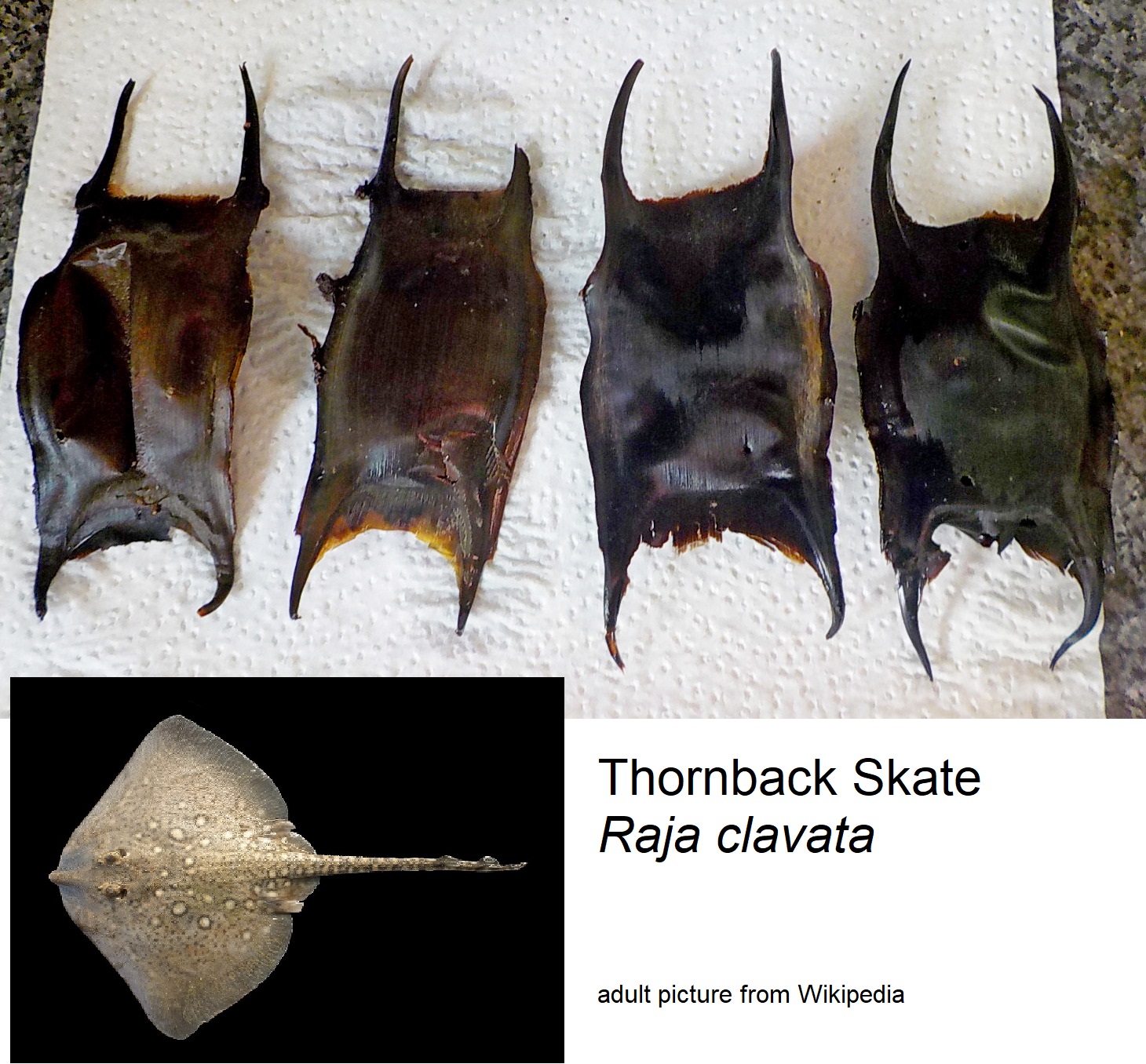


The first egg cases we found were those of the Thornback Skate. The name is confusing as the terms skate and ray are interchangeable and if you look up Thornback Skate on Wikipedia you will find it endemic to Australia. The much more widespread fish is referred to as the Thornback Ray. This is one of the reasons we use scientific names. The egg cases we found were those of Raja clavata.


A little further on, we spotted these odd structures, which I had to check out on iNaturalist, as I hadn't come across them before. Turns out, they are called egg clouds, and they belong to the Common Whelk, Buccinum undatum. Learning all the time.


After an hour or so, we came upon a cluster of shark egg cases. You can tell that they are shark egg cases as they come with noodles attached. They are actually tendrils that anchor the egg cases to structures on the sea bed. These particular ones belong to the Small Spotted Cat Shark, Scyliorhinus canicula. This used to be a staple of fish and chip shops, sold under the name of rock salmon, but it seems to have gone out of fashion these days.


Having got a crick in the neck from peering myopically at the wrack line (the line of seaweed left on shore at high tide), we wandered back along the dunes. As we sat with a coffee, looking at Scotland across the firth, the first butterfly of the year landed nearby; a Small Tortoiseshell.


We rounded off the morning with a nice bit of home made chicken and leek pie at The Lowther Arms at Mawbray. This pub nearly died, but was brought back from the brink of extinction by the villagers who, along with other shareholders, bought it, and now run it as a community pub. Cheers!


News From The Old Cornmill


Last year, a mouse used to feed at my bird feeder, where he was quite welcome. This year, however, he found a way into my cupboard under the sink where he was not so desirable. He has now been deported to the old Cockermouth railway line where I hope he'll be very happy.

Meanwhile, the antiques shop continues to ship orders worldwide. A vintage copy of John Bunyan's Pilgrims Progress flew out to Australia yesterday, and, to mark my birthday, I'm offering a 10% discount on all glassware this week, so pop in and have a browse for some preloved gifts (much more environmentally friendly than buying new, and better value too).

What with nature blogging and running a shop, I haven't had time to promote my novel, The Magic of Nature of Nature, but you can read the beginning for free on Amazon by clicking on Steve's Books below.


All the best,


Steve


Steve's Vintage Collectables.


Steve's Books


Follow me on Steve's Nature Plus

and also on Twitter Steve's Nature, Facebook Steve Daniels Naturalistsand Instagram

Steve Daniels Cumbria


Wednesday, 1 June 2022

Beautiful Barrow-in-Furness


Okay, so beautiful is not the first adjective that springs to mind when you conjure up an image of Barrow-in-Furness, but like most industrial northern towns, it is not without its charms. There is some stunning architecture to be seen, tranquil waterways, and the wildlife has, um shall we say, character. In truth, apart from the occasional “are-you-lookin'-at-me?!” stare, the seagulls gave us no problems at all. I say 'seagull' but scientifically, there is no such bird. This one, for instance, is one of the Large White-headed Gulls of the genus Larus. Probably a Herring Gull, but possibly a Lesser, or Greater, Black-backed Gull. We can't see quite enough detail to be sure and it's difficult to determine the size of a single gull.


When it comes to heavy industry, it doesn't come much heavier than building nuclear submarines and the massive BAE Systems building dominates the town. Barrow has been building and launching submarines since 1886 and a wander around The Dock Museum (the triangular building, centre) gives a fascinating insight into this little known industry. But back to those gulls. They are carnivores and scavengers, and one of the reasons they appear to be aggressive is that we delight in feeding them. Consequently, they associate humans with food, and don't really care whether you agree with them or not. However, when they're not pinching your chips, they're quite happy to find their own food such as this whelk which I picked up just round the corner from here. There's a lovely promenade walk just behind us, so let's see what else we can find.


That's a nice stand of Rosemary just there, being pollinated by a carder bee. Rosemary is the herb of remembrance and, for us British at least, forever associated with roast lamb. Personally, my favourite way of using it is in Goat Chops & Rosemary Casserole, the recipe for which you can find in Steve's Wild Kitchen. Carder Bees, (who's name derives from the trade of carding, or combing, wool), comb material into their nests to protect their developing larvae. These days, a carder is someone who steals information from your credit cards. A carder bee has never been known to do this. They are quite easy to recognise from their bright orange thorax. The only other British Bumblebee to share this feature is the Tree Bumblebee which has a white bottom.


Looking out across the water, we have a good view of Walney Island, a small sliver of land that boasts two nature reserves, which we must definitely visit at some point in the future. Meanwhile, back on this side of the water we have a Pill Woodlouse. Not an insect (far too many legs and no wings), but an Isopod. Isopods have 7 pairs of legs and 11 body segments and most of them live in the water, but woodlice are one of the few that are terrestrial. In America, children keep them as pets. They are covered on pages 66 and 67 of The Quick Guide to Creepy-Crawlies. And talking of books, here are a couple more suggestions for your nature library. 


Paperback £15.38 Kindle £13.00


Hardback £7.99 Paperback £4.50

Paperback £14.99

Build Your Own Nature Library


Next week, we're off to the Isle of Arran for a few days, so I'll tell you all about it when we get back. (I see that Mattie has got in before me with this announcement – see Mattie's Page).


All the best,


Steve


Follow me on Steve's Nature Plus

and also on


 Steve's Nature


 Steve Daniels Naturalists


 Steve Daniels Cumbria


Recent Posts