Showing posts with label Allonby Sands. Show all posts

Wednesday, 5 April 2023

Shark!


“What do you want to do on your birthday?” asked Ishbel.

“Go hunting for mermaid's purses,” I replied.

Ishbel wasn't phazed. After all, she's getting to know my eccentricities now, and she's savvy enough, natural hitory wise, to know that mermaid's purses are the egg sacs of sharks and rays. And so, on the bright sunny morning of April 3rd, we went off to Allonby on the Solway Firth to begin our hunt. This is part of a citizen science project, details of which can be found at https://www.sharktrust.org/greateggcasehunt if you want to take part.
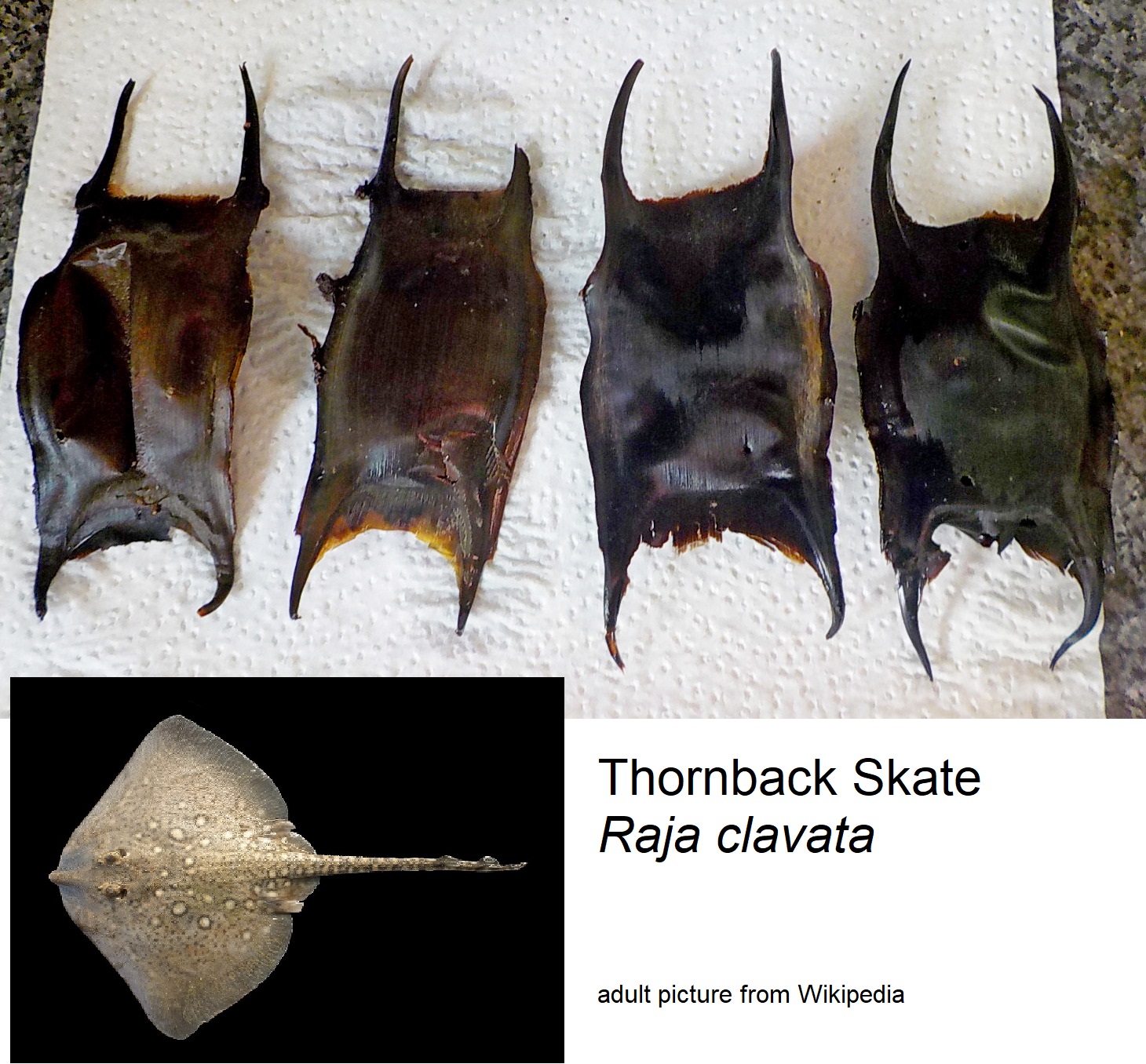


The first egg cases we found were those of the Thornback Skate. The name is confusing as the terms skate and ray are interchangeable and if you look up Thornback Skate on Wikipedia you will find it endemic to Australia. The much more widespread fish is referred to as the Thornback Ray. This is one of the reasons we use scientific names. The egg cases we found were those of Raja clavata.


A little further on, we spotted these odd structures, which I had to check out on iNaturalist, as I hadn't come across them before. Turns out, they are called egg clouds, and they belong to the Common Whelk, Buccinum undatum. Learning all the time.


After an hour or so, we came upon a cluster of shark egg cases. You can tell that they are shark egg cases as they come with noodles attached. They are actually tendrils that anchor the egg cases to structures on the sea bed. These particular ones belong to the Small Spotted Cat Shark, Scyliorhinus canicula. This used to be a staple of fish and chip shops, sold under the name of rock salmon, but it seems to have gone out of fashion these days.


Having got a crick in the neck from peering myopically at the wrack line (the line of seaweed left on shore at high tide), we wandered back along the dunes. As we sat with a coffee, looking at Scotland across the firth, the first butterfly of the year landed nearby; a Small Tortoiseshell.


We rounded off the morning with a nice bit of home made chicken and leek pie at The Lowther Arms at Mawbray. This pub nearly died, but was brought back from the brink of extinction by the villagers who, along with other shareholders, bought it, and now run it as a community pub. Cheers!


News From The Old Cornmill


Last year, a mouse used to feed at my bird feeder, where he was quite welcome. This year, however, he found a way into my cupboard under the sink where he was not so desirable. He has now been deported to the old Cockermouth railway line where I hope he'll be very happy.

Meanwhile, the antiques shop continues to ship orders worldwide. A vintage copy of John Bunyan's Pilgrims Progress flew out to Australia yesterday, and, to mark my birthday, I'm offering a 10% discount on all glassware this week, so pop in and have a browse for some preloved gifts (much more environmentally friendly than buying new, and better value too).

What with nature blogging and running a shop, I haven't had time to promote my novel, The Magic of Nature of Nature, but you can read the beginning for free on Amazon by clicking on Steve's Books below.


All the best,


Steve


Steve's Vintage Collectables.


Steve's Books


Follow me on Steve's Nature Plus

and also on Twitter Steve's Nature, Facebook Steve Daniels Naturalistsand Instagram

Steve Daniels Cumbria


Wednesday, 24 July 2019

Grand Tour 2: Cumbrian Lakes and Seashore

Crummock Water, Cumbria, UK


Let me take you back 500 million years. Crummock Water, now one of fourteen beautiful lakes in The Lake District, was on the sea bed, a bed made up of sand and black, glutinous mud. Since then, that sediment has been squeezed, scunched and uplifted (and continues to be so) to form the fells that surround the lake, in this, the oldest part of the National Park. To the south of this are the eroded outcrops of hard lavas and ashes formed as a result of catastrophic volcanic eruptions 450 million years ago. It is here that you will find the highest peaks including Scafell Pike, England's highest at 3,209 feet (978m). To the south of this lies the gentler sedimentary rocks of southern Lakeland. These mudstones, sandstones, siltstones and limestones made up of billions of crushed seashells were formed upon the sea bed around 420 million years ago. The result is an area of truly outstanding natural beauty.

Let us take a walk around the woodland at the edge of the lake. It feels primaeval with its moss covered rocks and trees where red squirrels scamper around in the canopy and warblers and finches sing from unseen branches. Rows of bracket fungi adorn fallen branches and down by the water's edge bilberries are just starting to form. Look at the mosses more closely and you can see that the moss growing on the rocks (Thuidium sp.) and the moss climbing the trees (Hypnum sp.) are entirely different, occupying, as they do, completely separate ecological niches.


We'll track north now to Allonby Sands, a long, sandy beach on the edge of the Solway Firth. It is the middle of May and the Hawthorn bushes up on the dune ridge are just coming into flower. Floating all around them, long legs trailing, are the Hawthorn flies (Bibio marci). These harmless little insects (they don't bite) have a tendency to hatch in large numbers on or about the 25th April – the males sometimes about a week earlier – which is St. Mark's Day. This gives them their alternative name of St. Mark's Fly. Having completed their mating cycle many of them finish up on the surface of lakes, rivers and streams where they provide a seasonal bounty for the fish.

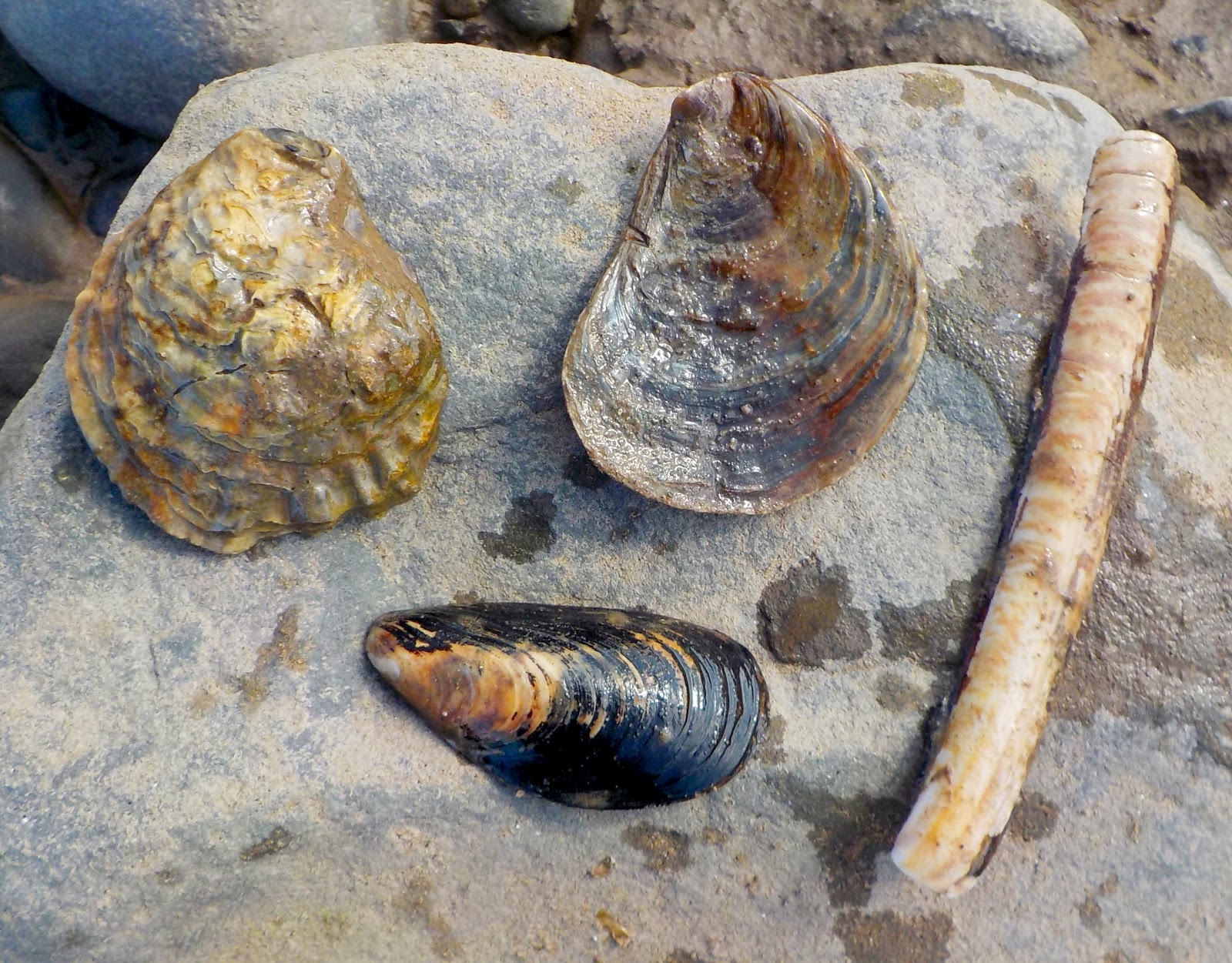
Coming down onto the shoreline and peering into the rock pools (or guddling in the local dialect) we find a treasure trove of shells of edible molluscs; oysters [top], mussels [bottom] and razor shells [right]. Unfortunately the original inhabitants of these shells are no longer present so no 'Allonby Chowder' recipe this week. It's a dish more suited to the depths of winter so, maybe on our next visit. And we must include smoked kippers! Around the turn of the 18th century, the village of Allonby was the centre of the local herring fishing industry, salting and packing the herring in barrels and kippering them in the smoke house.


From the remote geolical past, through more recent history, we come to the present. Out beyond the shoreline, where the oystercatchers, knots and dunlin probe the sands for their lunch, lies the Robin Rigg offshore wind farm. Sixty 260ft (80m) high towers with four 144ft (44m) blades apiece turning at an average 170 miles per hour produce enough electricity to power half the houses in Cumbria. There are concerns of course. You can't plant a forest of turbines in somewhere like the Solway Firth without shaking it up a little and the ecology is being carefully monitored. But, whichever way you look at it, it means a heck of a lot less fossil fuel has to be burnt to keep the lamps lit over half the county.


Crete Nature Catch-up

Steve's Books (well, just the one at the moment but 'The Quick Guide to Creepy-Crawlies' is well under way and should be available later in the year).)

Not Just For Twisted Women by Steve Daniels 
A light-hearted look at life through the eyes of the fairer sex.
Kindle Edition 1.99 pounds sterling (or equivalent).
Paperback Edition 4.99 pounds sterling (or equivalent)..
Read snippets, samples and stuff at Steve's Books


*********************************************************************
LINKS:
Share your nature thoughts, photos and comments on Naturalists (the facebook page that accompanies this blog)

Explore the region with the #CreteNature interactive Hiking and Nature Map


Recent Posts