Showing posts with label Caves. Show all posts

Tuesday, 14 June 2022

Arran Special 2 - In Search of Seals


It's a beautiful morning, so let's head up the west coast to see what we can find. First stop is the village of Blackwaterfoot where Clauchen Water flows into Drumadoon Bay. A beautiful spot for introducing Mattie to the pursuit of rock pooling and for teaching her that not everything is best investigated by trying to eat it. Like this Blue Jelly for example. The sting of this particular species is quite mild but, if you are stung by a jellyfish do not try to treat it with vinegar, alcohol or urine. It will only make it worse. Better to wash it in sea water and take an antihistamine tablet. Next we have a European Green Crab (AKA Shore Crab) which is native to the north east Atlantic and the Baltic. However, it is listed as one of the world's 100 most invasive species and can be found on coastlines almost everywhere. In New England, they have taken to eating them and have even produced a Green Crab Cook Book. Probably go nicely with a bit of pickled Knotted Wrack which we also have here. Decorate with a few boiled Periwinkles and that's lunch sorted.


Well done Mattie! That's the first of Arran's Big 5, The Common, or Harbour, Seal. There are about eight of them on and around those rocks out there. Harbour seals pretty much stick to the same haul out spots, so these are probably resident here. Now that sealing has been banned in UK waters under the Conservation of Seals Act (1970), they can live to their full term, which is 20-25 years for males and 30-35 years for females. Aren't they beautiful? We'll carry on north, have a spot of lunch somewhere, then Ishbel has spotted an interesting looking walk for this afternoon with some intriguing caves to find.


That was different. Cold jacket potato with chilled coronation chicken and salad. I wonder if it was meant to be served like that? Still, it wasn't quite as unappetising as it sounds. We're on the edge of a fir plantation with a little burn running alongside the path. Looks like a good walk for an insect safari. And that's a good start – a beautiful Golden-ringed Dragonfly. At 7-8cm long with a 10cm wingspan this is Britain's longest dragonfly. In comparison, this Large Red Damselfly, despite its name, is only about half that size. Note the wing positions: out straight = Dragonfly; folded along the back = Damselfly. Over here we have the smallest of the Satyrinids or Brown Butterflies , The Small Heath. These are grassland specialists and the caterpillars feed exclusively on grasses, whereas the adults are nectar feeders. We also have a couple of beetles. There's a Gazelle Beetle, so called because of their speed, and my favourite, the Green Tiger Beetle (another speed merchant in the beetle world – see Water, Water, Everywhere). Dragons and Damsels, Butterflies and Beetles are all covered in The Quick Guide to Creepy-Crawlies.


Ah we've reached the caves. Although the biggest one is called The King's Cave, it's doubtful that this is the one used by Robert The Bruce before the Battle of Bannockburn and I don't see any doggedly determined spiders either. I do see a determined little doggy though. What's she found now? Just time to mention a few of the flowers that I've spotted on the walk. Just outside the cave there are Marsh Orchids and Ragged-Robin as well as some English Stonecrop (seems the English are invading Scotland once again). Down by the sea there's Sea Thrift and Sea Campion, and growing in the burn, some rather tasty water mint.
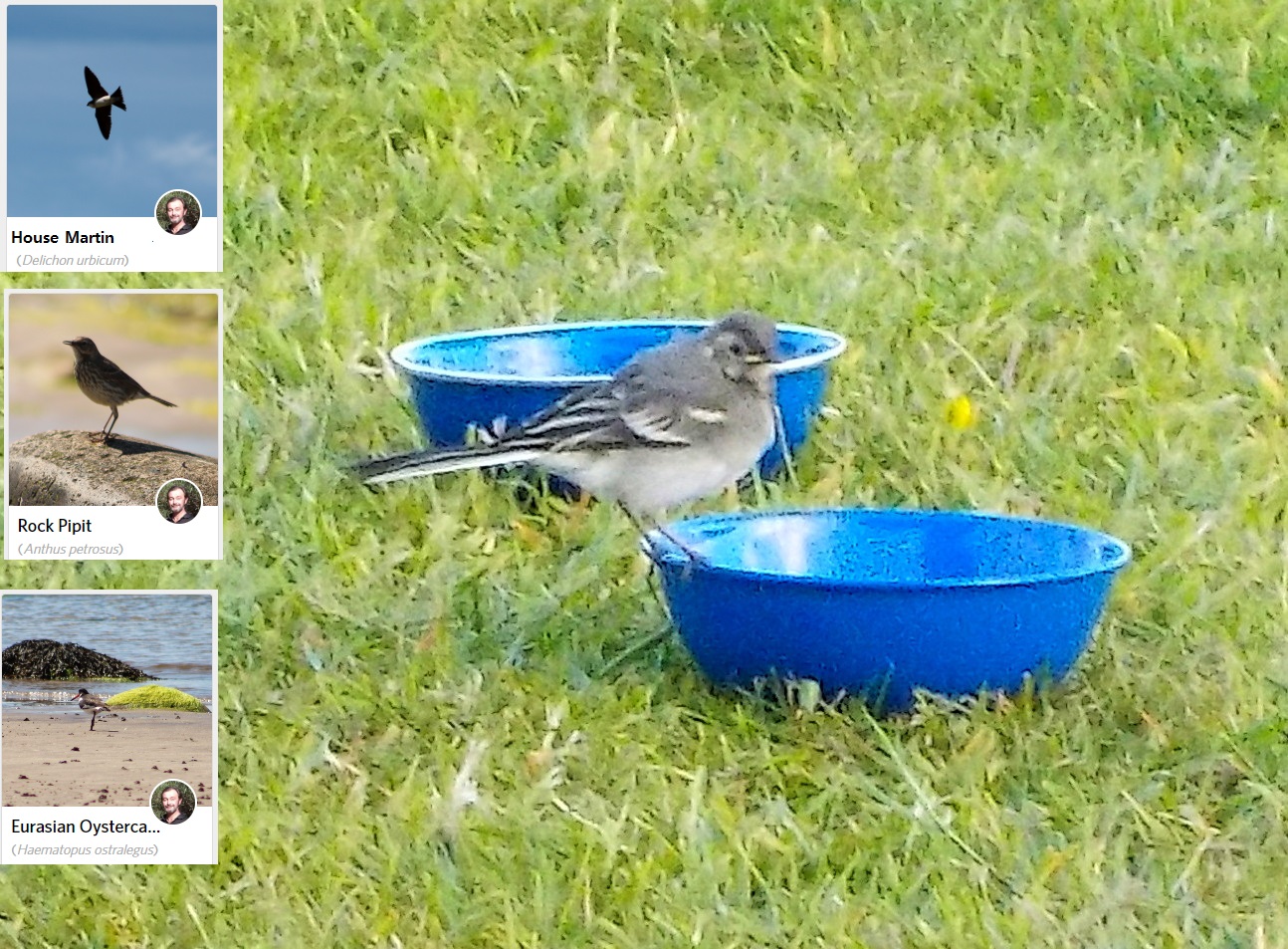


And finally, back at camp, a few more birds to add to our list from yesterday. Firstly, this young Pied Wagtail is being very brave, sipping water from Mattie's bowl, just outside the tent. There are also House Martins flying about, and down on the beach a Rock Pipit and a few Oystercatchers. Tomorrow, we're off to Broddick Castle and we'll take a look around the grounds to see what wildlife we can find there.


Hardback £24.09


Hardback £5.30 Paperback £2.56


Paperback £14.99

Build Your Own Nature Library


See you tomorrow,

Steve

Follow me on Steve's Nature Plus and also on 

Steve's Nature

 Steve Daniels Naturalists

 Steve Daniels Cumbria


Wednesday, 16 January 2019

Toplou Gorge


Welcome to the all new fortnightly Series 9 of the #CreteNature Blog with a host of new features to come.

Out & About


Winter is early and severe this year as the weather system 'Telemachos' comes marching through on the heels of weather system 'Sofia' and now we have storm Zeus. Not that that deters us naturalists of course and on January 7th I set off with amateur botanist Julia Cross and a small group of intrepid individuals to explore the Toplou Gorge on the north east coast of the island.


Flowers were few and far between but the Poppy Anemones (Anemone coronaria) were abundant and there were a fair few Mediterranean Mandrakes in flower (Mandragora officinarum) as well as a couple of Friar's Cowls (Arisarum vulgare). Pride of place however must be given to a small yellow job with a couple of black dots which Julia informed me was a Scorpion Violet (Viola scorpiuroides). This was originally a north African plant but can now be found in east and west Crete as well as on the islands of Kythera and Antikythera. Sorry about the quality of the photograph but the light shower in which we'd set off had now turned to freezing rain.


The rain turned to hail, we sheltered under a carob tree and I had an irresistible urge to cuddle up to one of the big, hairy goats nearby for warmth. These proved to be virtually the only animal life that we saw that day. I heard a few larks and a solitary raven but everything else had more sense than to be out in that weather. We waited until the hail had stopped bouncing off the goats and continued down past some caves that definitely looked worth exploring on a warmer day.


At the bottom of the gorge we came to some large pools where I found some Whirligig Beetles of the Gyrinidae family spinning around like tops which is fairly characteristic and some nice green algae of which I took a sample to look at under the microscope later. We didn't stop long at the pools as none of us had had the foresight to bring our swimming costumes but trekked back up the adjoining ravine which involved a short but somewhat steep climb of about 200m and made me realise that I was still carrying a fair few pounds of Christmas fayre. Still, thank you Julia & Co. for an interesting afternoon in good company.


Walking Notes


This would make a nice day trip from nearby Sitia (15mins by car), Makry Gialos (1 hour), Ierapetra (1 hour 30 mins) or even Agios Nilolaos (1 hour 45 mins). Use the #CreteNature interactive Hiking and Nature Map for routes. The walk starts from the north side of the main road about 200m to the west of the Toplou monastery. There is a small route map on a post. Wear trainers, be prepared for a bit of scrambling, follow the splashes of red paint on the rocks and remember to tie the gate shut behind you about 100m from the start.


Fieldcraft & Foraging


This is one of the new sections I'm building into the blog which I hope will be of interest. This tip concerns using trees as compasses. Every area of the world has a prevailing wind direction. Here in Crete the prevailing wind comes from the north west (in England it is from the south west). Trees in exposed locations, like these at the end of the Toplou Gorge walk, point in the opposite direction from the prevailing wind, i.e. south east. If the location is not so exposed as to make the trees lean in any obvious direction take a look at the roots. The strongest and longest will point in the direction of the prevailing winds as this is where the tree needs the most support.


In The Lab

And another new section. Actually, a bit of a misnomer as the lab is still in the planning stage and bits of it are strewn all over the house and garden at the moment. However, the green algae that I sampled from the Toplou Gorge pools was duly placed under the microscope and looked like this at x1600 magnification. These are desmids of the genus Mougeotia who, rather than pulling carbon dioxide from the atmosphere to get the carbon that they need for photosynthesis, extract it directly from the limestone. The little fish like organisms with the red eyes that you can see towards the top of the picture are single celled flagellates called Euglena.


*********************************************************************
LINKS:
Share your nature thoughts, photos and comments on Naturalists (the facebook page that accompanies this blog)

Explore the region with the #CreteNature interactive Hiking and Nature Map


Tuesday, 2 October 2018

The Oldest Saint


As I dropped down onto the Lasithi Plateau a Buzzard launched itself from a telegraph pole, narrowly missed my windshield and crashed into the undergrowth to my left where it had obviously spotted its unwary breakfast. That was a good omen as I was taking my little group of intrepid strollers to the heights above Agios Charalampos to look for Grifon Vultures. The saint, after whom the village is named, was reputedly 114 years old when he was martyred for his Christian preaching in the 3rd century, thus making him the oldest saint and his claim to fame was that, whilst being tortured, one of his torturers arms miraculously fell off and another had his head put on backwards. I think that I am more inclined to believe in Betty's black snake but more of that later.


As our little band negotiated the steep, narrow alleyways through the village and emerged on the hillside above the plateau we did indeed see Grifon Vultures and other high flying birds but it was the smaller passerines that really brought the day alive, particularly the flocks of Goldfinch. These birds are resident here in Crete but in the autumn they gather in flocks, their numbers swollen by birds migrating south from eastern Europe. As we exited the top of the village however, it was domestic fowl that caught the ever observant Betty's eye.


Oh, look,” she said, looking up to where a group of birds were admonishing us from their pen on top of a house “turkeys!”

Actually,' I said, not wishing to dampen her enthusiasm, “I think you'll find that they are guinea fowl.”

They're too tall for guinea fowl,” Betty challenged.

They're standing on the roof,” I pointed out.


Meanwhile, back to the chaffinch. The tall plant upon which she is perched is a Wavyleaf Mullein and the landscape was littered with them in various stages of life. Apart from providing staging posts for the goldfinches, leaf warblers, stonechats and sparrows, all of which were gaily flitting about on this fine autumn morning, I noticed that one had also attracted a tachinid fly. Not the nicest of flies; their maggots chew their way into unsuspecting caterpillars and eat them slowly from the inside, making sure to keep them alive as they do so, until they are almost ready to leave their host. At this point they feed indiscriminately, the caterpillar dies and the maggot wanders off to pupate in the ground without so much as a by-your-leave.


Caterpillars that are not devoured from within eventually become butterflies, of course, and these were dancing around at our feet, enjoying the nectar rich Sweet Scabious that grew by the side of the track. The name of the plant derives from the fact that it was used to treat scabies (an itchy rash caused by a mite infestation under the skin) in the middle ages. The Small White butterfly is a male which has only one spot on each forewing whereas the female has two. The other butterfly is the amazing Painted Lady which, although resident here, occurs in larger numbers in autumn and winter like the Goldfinches and the reason is the same: they migrate. Over six generations they make an incredible 9,000 mile round trip from Africa to the Arctic and back (see Secrets of Painted Lady migration revealed ).


Noticing a sign at the side of the road pointing the way to the Cave of Charalampos, Bert decided to go and investigate. Seeing her loving husband peering into what appeared to be a very large hole in the ground Betty thought that she had better go and join him to 'make sure he doesn't fall in' (at least, I think that she said doesn't). I trailed on behind, pausing to take a photograph of an old friend, Chorthippus bornhalmi. The 'cave' turned out to be a rather unimpressive hole in the ground. Presumably the roof had caved in since the 18th century BC when it was a seven chambered ossuary. Besides the bones, archaeologists also found clay figurines and musical rattles called sistra about which, I expect, they got very excited.


Having quickly exhausted the thrill of the cave I took to my favourite hobby; rock flipping (there used to be an annual rock flipping day but it seems to have died a death in 2009) and discovered a lovely little Green Toad.

Amphibians and reptiles are often put together,” said Bert, getting down to take a closer look, “is that because they are closely related?”

The toad and Bert looked at each other with mutual interest whist I wracked my brains to remember who evolved when.

Yes,” I replied, “Amphibians evolved from the early fish and have both lungs and gills. Reptiles are an offshoot of Amphibians and have only lungs. Mammals, such as ourselves, and later, Birds, are offshoots of reptiles.”

Talking of reptiles,” interjected Betty, “I saw a huge black snake here on Crete once and I was told that it must have escaped from a private collection. What do you think?”

How big is huge?” I asked.

About two inches in diameter,” she indicated, joining thumb and forefinger together, “and it stretched all across the road with its head disappearing into the undergrowth on one side of the road and its tail out of sight on the other side.”

Not one of the four Cretan snakes,” I ventured “but I know what it sounds like.”

What?” asked Bert, carefully replacing the stone over the now disgruntled toad.

A black plastic water pipe.”

It wasn't a water pipe,” said Betty, indignantly, “it moved”.

They can be quite lively,” I explained, “if they get an air lock.”

Betty was not convinced and I had to confess that, not being familiar with all the snakes in the world, an escapee remained a plausible alternative.


The Taverna Bit


Thanks to all at Spani's Taverna in Charalampos who hastily rearranged their restaurant furniture when we descended upon them en masse and they also provided an excellent menu. The barbecued chicken and roast potatoes were beautiful.


Diary Dates


Stroll #3
Sunday 7th October
11 am
Kroustas Forest


A mushrooming we will go (and hopefully find many more interesting things besides). Here and above are the maps. Take the Kroustas - Prina road and look for the only yellow litter bin on that road. See you on Sunday


Stroll #4
Sunday 14th October
11 am
Almyros Wetlands
(Details next week)

Not Just For Twisted Women by Steve Daniels 

A light-hearted look at life through the eyes of the fairer sex. 

Kindle Edition 1.99 pounds sterling (or equivalent).


Paperback edition will be available in time for Christmas.

Read snippets, samples and stuff at Steve's Books


*********************************************************************
LINKS:
Share your nature thoughts, photos and comments on Naturalists (the facebook page that accompanies this blog)

Explore the region with the #CreteNature interactive Hiking and Nature Map


Recent Posts