Showing posts with label crabs. Show all posts

Tuesday, 14 June 2022

Arran Special 2 - In Search of Seals


It's a beautiful morning, so let's head up the west coast to see what we can find. First stop is the village of Blackwaterfoot where Clauchen Water flows into Drumadoon Bay. A beautiful spot for introducing Mattie to the pursuit of rock pooling and for teaching her that not everything is best investigated by trying to eat it. Like this Blue Jelly for example. The sting of this particular species is quite mild but, if you are stung by a jellyfish do not try to treat it with vinegar, alcohol or urine. It will only make it worse. Better to wash it in sea water and take an antihistamine tablet. Next we have a European Green Crab (AKA Shore Crab) which is native to the north east Atlantic and the Baltic. However, it is listed as one of the world's 100 most invasive species and can be found on coastlines almost everywhere. In New England, they have taken to eating them and have even produced a Green Crab Cook Book. Probably go nicely with a bit of pickled Knotted Wrack which we also have here. Decorate with a few boiled Periwinkles and that's lunch sorted.


Well done Mattie! That's the first of Arran's Big 5, The Common, or Harbour, Seal. There are about eight of them on and around those rocks out there. Harbour seals pretty much stick to the same haul out spots, so these are probably resident here. Now that sealing has been banned in UK waters under the Conservation of Seals Act (1970), they can live to their full term, which is 20-25 years for males and 30-35 years for females. Aren't they beautiful? We'll carry on north, have a spot of lunch somewhere, then Ishbel has spotted an interesting looking walk for this afternoon with some intriguing caves to find.


That was different. Cold jacket potato with chilled coronation chicken and salad. I wonder if it was meant to be served like that? Still, it wasn't quite as unappetising as it sounds. We're on the edge of a fir plantation with a little burn running alongside the path. Looks like a good walk for an insect safari. And that's a good start – a beautiful Golden-ringed Dragonfly. At 7-8cm long with a 10cm wingspan this is Britain's longest dragonfly. In comparison, this Large Red Damselfly, despite its name, is only about half that size. Note the wing positions: out straight = Dragonfly; folded along the back = Damselfly. Over here we have the smallest of the Satyrinids or Brown Butterflies , The Small Heath. These are grassland specialists and the caterpillars feed exclusively on grasses, whereas the adults are nectar feeders. We also have a couple of beetles. There's a Gazelle Beetle, so called because of their speed, and my favourite, the Green Tiger Beetle (another speed merchant in the beetle world – see Water, Water, Everywhere). Dragons and Damsels, Butterflies and Beetles are all covered in The Quick Guide to Creepy-Crawlies.


Ah we've reached the caves. Although the biggest one is called The King's Cave, it's doubtful that this is the one used by Robert The Bruce before the Battle of Bannockburn and I don't see any doggedly determined spiders either. I do see a determined little doggy though. What's she found now? Just time to mention a few of the flowers that I've spotted on the walk. Just outside the cave there are Marsh Orchids and Ragged-Robin as well as some English Stonecrop (seems the English are invading Scotland once again). Down by the sea there's Sea Thrift and Sea Campion, and growing in the burn, some rather tasty water mint.
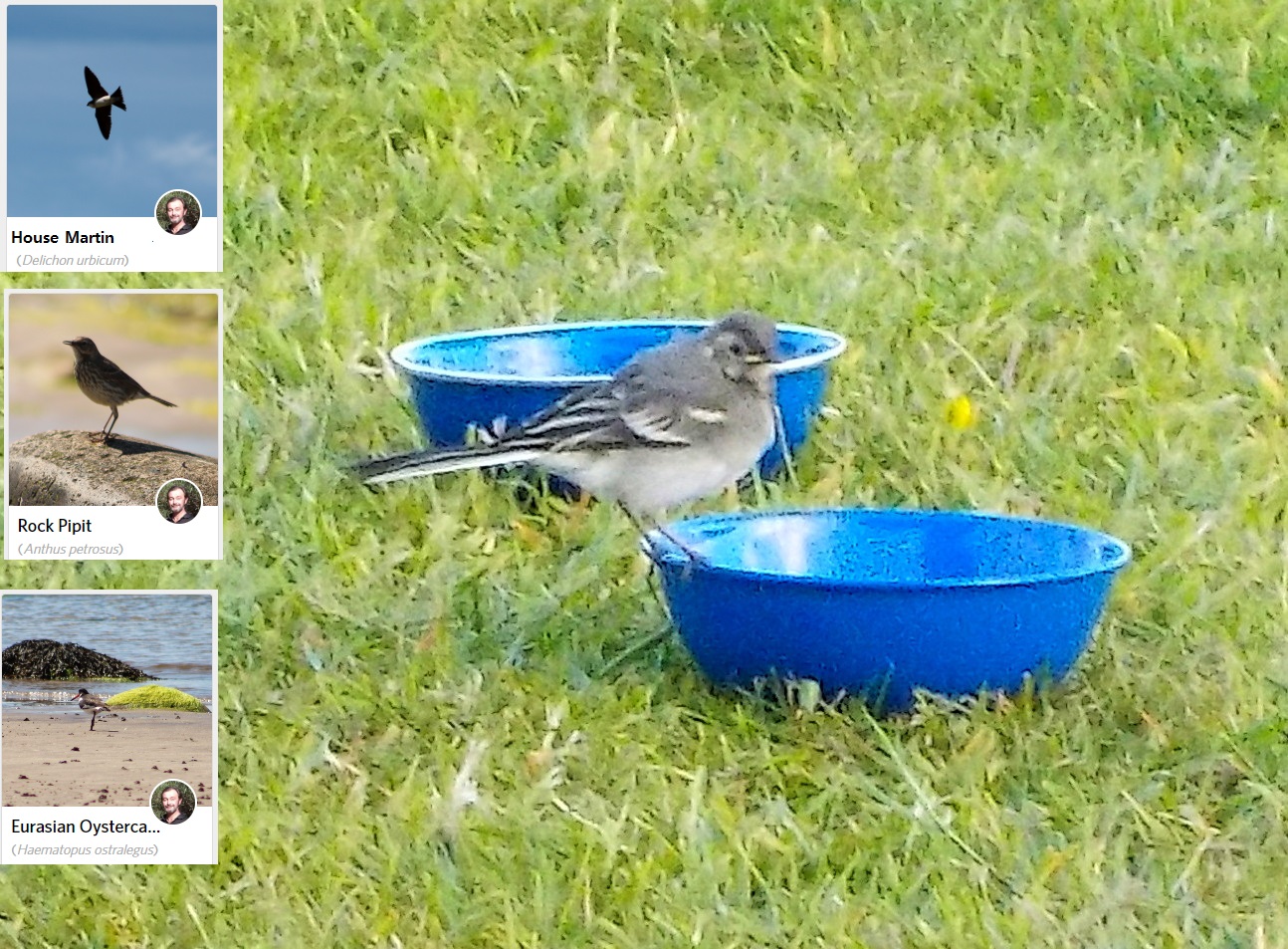


And finally, back at camp, a few more birds to add to our list from yesterday. Firstly, this young Pied Wagtail is being very brave, sipping water from Mattie's bowl, just outside the tent. There are also House Martins flying about, and down on the beach a Rock Pipit and a few Oystercatchers. Tomorrow, we're off to Broddick Castle and we'll take a look around the grounds to see what wildlife we can find there.


Hardback £24.09


Hardback £5.30 Paperback £2.56


Paperback £14.99

Build Your Own Nature Library


See you tomorrow,

Steve

Follow me on Steve's Nature Plus and also on 

Steve's Nature

 Steve Daniels Naturalists

 Steve Daniels Cumbria


Wednesday, 28 April 2021

Beside The Seaside


Those of you who know me of old, are fully aware that I'm rarely happier than when I'm beside the seaside. Particularly when there are rock pools involved. Today we're off to Lowca beach where marine molluscs and crustaceans await us, plenty of birds on the shoreline, and some interesting plants to observe and maybe eat later on.


Let's start with the molluscs. Collecting seashells is a worldwide hobby, there's even an International Seashell Collectors Club. Most of these are Gastropods, as are the slugs and snails that you find on land. The exception is the mussel which is a bivalve, as are oysters, clams and scallops. These have two half shells joined with a hinge. Besides the mussels, we have limpets who's claim to fame is their teeth (of which they have 100 rows) that are the hardest known biological substance on earth. We also have some Common Periwinkles, Atlantic Dogwhelks and even a little Top Snail.


There are quite a few crab carcases on the tide line too. Despite its deep orange colour this one is known as the European Green Shore Crab, or variations on that name. Here in the UK, for example, we refer to them simply as shore crabs. This is a very invasive species. Native to the European and North African Atlantic coasts, including the North and Baltic Seas, it has now spread as far as the Pacific coast of North America and the coasts of Australia and New Zealand.


As we've been walking along we've had a couple of Sand Martins darting about which have arrived from their overwintering grounds in southern and east Africa. Our friends the Oystercatchers are patrolling the shore line whilst, rootling about on the tide line is a Ringed Plover with his distinctive bright orange legs. There's a small stream running down ont the beach where a Common Sandpiper is investigating. You can tell that ity's a Common Sandpiper because the white breast feathers extend all the way up to the shoulder. We also have a Rock Pipit, obligingly standing on a rock, and in the hinterland behind us, a Linnet is surveying the ground from his vantage point atop a woody shrub.


Looking behind us, there is a great swathe of greenery which will be very pretty later in the year as it is all Japanese Rose. Unfortunately, this is another of those invasive species, which you may remember, we discussed up the coast at Siddick Ponds, earlier in the year. There are also some edible plants down here. There is Rock Samphire growing on the back wall (not to be confused with Marsh Samphire which is entirely different). For my thoughts on the edibility of Rock samphire see Snakeless in Sisi. We also have some Sea Kale. The blanched shoots of these were a Victorian delicacy and one of the most expensive vegetables around at the time. The leaves are also edible but they are very strong in flavour, to the point of being almost unpalatable in the case of the larger leaves. The smaller leaves can be cooked the same as you would for curly kale. Despite their names, Sea kale is more closely related to cabbage and chard than to Curly kale.


It looks like Jack has found a Sea Slater and isn't quite sure what to do with it. These are common inhabitants of the littoral zone (the beach and the hinterland behind it) and, as you can see, it looks like a woodlouse, to which it is closely related. The term louse is a misnomer as they are not lice at all (which are insects) but isopods which are a type of crustacean, the same as crabs and lobsters. (Woodlice and Sea Slaters are covered in pages 56-57 of The Quick Guide to Creepy-Crawlies)


That about wraps it up for today. Oh, I do love to be beside the seaside.


See you next week


Steve

#CumbriaNature

Steve's Books


The Quick Guide to Creepy-Crawlies

All you need to know to identify any type of insect, spider, worm or snail very simply and find out more about it.

Yvonne: This was a gift for a family so that the children can understand what they see on days out. The second was for me. Logical and easy to use. If you know anyone who likes nature you can be confident that gifting this book will give years of pleasure.

The Eggs of Saramova

A science fiction novella for those who don't like science fiction. A fast-paced thriller that is, literally, out of this world (and it starts right here in Crete).

Too new for reviews yet!


£7.50 Paperback edition

Not Just For Twisted Women by Steve Daniels 

A light-hearted look at life through the eyes of the fairer sex.

Janet: If you are short on time but enjoy reading and are maybe not into long extended novels then Not Just For... Twisted Women provides readers with concise stories that stand alone and most certainly entertain with their ultimate twists. Loved it.

Helen: A very good read! Well written and entertaining!

Margaret: Each quick tale gives a glimpse into a character's life and has an often humorous twist at the end. I would love to read more.

Yvonne: These days many people find it hard to find the time to read a novel, so this book of short stories is ideal to dip into. It is also makes a good gift.


£4.99 Paperback
edition


See sample pages of all my books and latest blogs, and keep abreast of latest publications here:

http://author.to/SteveDaniels


Crete Nature Catch-up

Series 1 - Welcome to Lasithi

Series 2 - The Rhythm Of Life

Series 3 - A Journey Begins

Series 4 - The Milonas Valley

Series 5 - This Is Ferma

Series 6 - Upland Villages

Series 7 - The Forty saints

Series 8 - Sunday Strolls

Series 9 -Stormy Weather

*********************************************************************

LINKS:

Share your nature thoughts, photos and comments on Naturalists (the facebook page that accompanies this blog)


Wednesday, 26 September 2018

Snakeless in Sisi


I had two reasons for wanting to visit Sisi on the north coast of Crete; firstly I'd never been there, despite having been living on the island for 14 years and secondly I'd been promised that I would find Dice Snakes lounging in the rock pools just waiting to have their photographs taken. What better way to start my series of Sunday Strolls with an enthusiastic band of budding amateur naturalists in tow? Sisi is only a small village but somehow Betty managed to get lost in it before we had even started but after a slight delay whilst we phoned her with directions we descended upon the rock pools. I should point out at this juncture that to avoid confusion and boredom by introducing loads of names into these stories (to say nothing of potential ostracism and/or libel actions) all of the ladies will be referred to as Betty and the gentlemen as Bert.


We found plenty of life in the rock pools; everything from Peacock's Tails (see Creature's of the Blue Lagoon if you'd like to know where you put them on your body and why), a couple of nice anemones including the Beadlet that was just coming out to feed, a few young gobies and an intense ecological battle. On one side of the battlefield there were a goodly number of small but beautifully formed, Marble Crabs, which are a native Mediterranean species and, lurking half under a rock, a much larger Sally Lightfoot which is probably the most invasive crab in the Mediterranean. First reported simultaneously off Ibiza and Italy in 1999 and off Crete in 2006 they're eating the poor Marble Crabs out of house and home. Where I live, in Ferma on the south east coast, it's not unusual to see half a dozen or more on one short snorkeling session. The main culprit? Increased shipping in the Mediterranean.


Growing around the rock pools was a fair amount of Rock Samphire, an edible plant that one can pickle in vinegar or brine or use the leaves raw on salads. I handed a few leaves round and I think that we all agreed that we'd rather not. Whereas the unrelated Marsh Samphire has a pleasant, salty taste that goes well with fish dishes, Rock Samphire has a distinctly medicinal tang and could only accompany dental mouthwash in my opinion. As we continued on our leisurely way around the inlet, where ducks and geese lazed on the shore or honked across the water impersonating fog horns' Betty came upon a bush of black berries. As she correctly observed, they looked almost, but not quite, like blackberries.

Are they a close relative?” she asked.

Not remotely”, I replied, “and what is more, the berries are poisonous.”

You can't eat them then?” added Bert, just wanting to get everything absolutely clear in his mind (which is always a top idea when contemplating the consumption of anything in the wild).

Er, no,” I confirmed.

Betty gave Bert a look which, if she'd turned it on the plant, would have had the berries withering on the stalk but left Bert totally unfazed.

The plant in question was Common Lantana, also known as the Bacon and Egg Plant as its tricolour flowers, radiating from centre, are yellow, white and raw bacon pink.


Of more use around the home were the Chaste Trees that grew alongside the road. Although used in herbal medicine as supposedly fine tuning our circadian rhythms, its efficacy has yet to be proven scientifically. Their common name derives from the fact that it was considered an anaphrodisiac in ancient times and, according to Pliny, it was used by Athenian women to cool the heat of lust in their menfolk. Personally I use it as pot pourri because, even to my anosmic snozzle, it smells pleasantly like lavender.


Insects were a bit thin on the ground this week but as we passed through the Bougainvillea bedecked arbour that leads back down to the sea I managed to capture an Egyptian Grasshopper or Locust who seemed quite happy to swap his resting place on the side of a tree for a similar position on my index finger whilst Betty and Bert admired him.


What's the difference between a locust and a grasshopper?” asked Betty.

Scientifically, none,” I informed her, “but in common parlance, locusts usually refer to the larger, strong flying grasshoppers such as this fellow, that occasionally form migratory swarms and do significant damage to crops on their way.”

Returning said Grasshopper/Locust to a nearby tree where he promptly continued his siesta, we made our way down to the spit that protects the little harbour in search of birdies.


We were instantly rewarded by a group of about fifteen large birds flying in a somewhat ragged formation out to sea which I at first took to be a phalanx of storks but on closer inspection of the photograph back in the lab, turned out to be a flight of herons, possibly a mixture of grey and purple herons but that could be a trick of the light. On the spit itself we were entertained by a couple of kingfishers chasing each other around the rocks. Autumn is the season when Kingfishers begin their courtship with the male chasing the female, calling after her almost incessantly. Later she will accept presents of fish but they will not merge their territories until the spring as each bird needs to eat 60% of its body weight each day.

So, no snakes, but plenty of other wildlife and we meandered back to one of the many seafront tavernas where we played at being kingfishers and attempted to consume 60% of our bodyweight in gyros and chips. If you'd like to join Betty, Bert and I then details of the next two Sunday strolls are below. Otherwise just click on the 'G+ Follow' icon in the top left panel to keep abreast of our adventures. Until next week, when I let Betty and Bert loose in a wildlife refuge, enjoy your autumn wherever you are.


Diary Dates


Stroll #2
Sunday 30th September
11 am
Ag. Charalampos, Lassithi Plateau


A gentle walk around the lower slopes of the Plathini-Lagkada Wildlife Refuge where I hope that we shall see some Griffon Vultures (unless they see me coming and decamp like the Dice Snakes).


Stroll #3
Sunday 7th October
11 am
Kroustas Forest
(Details next week)


Photographic Bit

Many of you have asked me what photographic equipment I use so for details of aperture settings, shutter speeds etc. my pictures will be on Flickr within a few days and that has all the geeky stuff.Pictures were edited with FastStone Image Viewer and combined with Microsoft Paint.


*********************************************************************
LINKS:


Not Just For Twisted Women by Steve Daniels 

A light-hearted look at life through the eyes of the fairer sex. 

Kindle Edition 1.99 pounds sterling (or equivalent).

Paperback edition will be available in time for Christmas.


Share your nature thoughts, photos and comments on Naturalists (the facebook page that accompanies this blog)

Explore the region with the #CreteNature interactive Hiking and Nature Map


Recent Posts