Showing posts with label books. Show all posts

Monday, 27 February 2023

Beyond Crete


For sixteen years, I lived a somewhat idyllic life on the island of Crete in the Mediterranean, and many of you know me from The Crete Nature Blog. I returned to the UK in 2020, settling in Cockermouth in Cumbria, where my life has changed, almost beyond recognition. It is now, I am glad to say, just as idyllic (albeit somehat damper) and new adventures await.


As well as having a host of new wildlife to observe, new plants to pluck from the hedgerows and cook in Steve's Wild Kitchen, I have also developed an interest in human history and begun to collect various curios to adorn my new 'bachelor pad' set in The Old Cornmill, on the banks of the River Derwent. These, I live with for a while and then sell on through my little online antiques shop, SVCwithEtsy. It makes a little beer money, but it's mainly for the joy of finding out the history behind the object.


I have also acquired a new life partner in Ishbel, who shares my love of nature and objects from a byegone age, which is presumably what she sees in me. Apart from me, she has also recently invested in a turn of the century campervan. It is in this, along with Mattie the hyperpup, that we intend to explore this beautiful country. So, join us, if you will, as we explore the countryside, take in a few antiques fairs along the way, sample as much local produce as we can, and generally appreciate Cumbria, Westmorland and beyond.


Make a note now, to subscribe to Steve's Nature Plus.


PS You may have noticed, in the second picture, a set of volumes held between two industrial book ends. This is my first full length novel, The MONOM, which is now available as a paperback and ebook on Amazon. This is the fifth book I've written since leaving Crete, and you can see them all on my author page.


All the best,


Steve


SVCwithEtsy.


Follow me on Steve's Nature Plus

and also on Twitter Steve's Nature, Facebook Steve Daniels Naturalistsand Instagram

Steve Daniels Cumbria


Wednesday, 4 January 2023

Remotest Cumbria


With all the razzmatazz of Yuletide in full swing, it's nice to take some time out and look out over the fells, in a remote spot, miles from anywhere.


The only civilisation for miles, nestled alongside a powerful beck called the Cald, is the appropriately named village of Caldbeck. Here, you can walk alongside the beck for miles in perfect peace and tranquility.


The beck is so powerful that it provided the motive force for The Howk bobbin mill, which turned coppiced wood into bobbins for the textile industry from 1857 to 1924. The beck also powered fulling, corn, flax, wool, wood, paper and smelting mills. There was also a barytes crushing works and a brewery in the village. Quite a hive of industry back in the day.


You can see and hear the force of the water in a series of falls above the bobbin mill. Not much wildlife about today, apart from a phalanx of ducks on the village green and a buzzard in the sky above. Hart's-tongue ferns and Dog's Mercury line the path, and various mosses and orange Jelly Spot fungus add a little colour to the fence posts.


In fact, most of the invertebrate life that I've seen over winter so far, has taken up residence with me in the Old Corn Mill. This moth of the Tortricidae family seems perfectly content in the bathroom.


Talking of the Old Corn Mill. Do you remember that sprouting acorn we found, back in November? (see Fine Weather For Ducks) I promised to let you know how it was getting on, and it's doing just fine on the kitchen windowsill. maybe I'll take up bonzai this year!


Meanwhile, back in Caldbeck, it's beginning to rain, so it's time to retreat to The Oddfellows Arms. This year, I thought I'd introduce you to some of the Cumbrian hostelries, for those of you who are thinking of visiting the area. We didn't eat here (too much food in the fridge at home) but the menu looks good and they also do accommodation. 


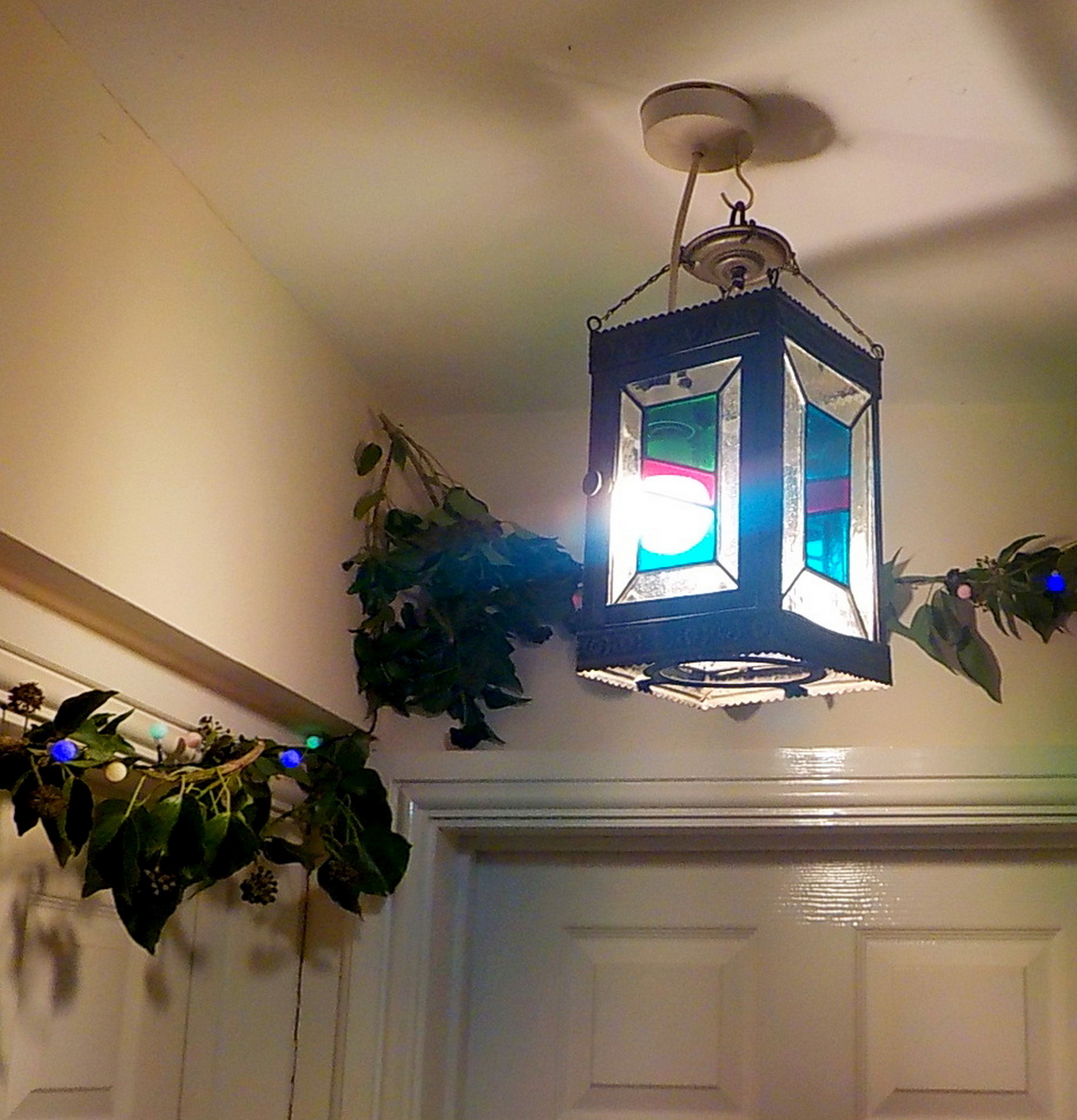
Ah well, it's twelfth night tomorrow, so the decorations will have to come down. Don't want bad luck for the rest of the year. The Victorian lantern, by the way, is one of many items on sale at my little on-line shop, SVCwithEtsy. If you enjoy my nature blogs, you may also like my history blogs. Mainly shop news at the moment, but I'm going to expand it into fascinating insights behind the products. This week I'll be covering the silver trade and tobacconalia.


One other bit of news to tell you about; my first full length novel, The MONOM (The Magic of Nature of Magic) will be published later this month. It's an intriguing tale of the natural and supernatural worlds, in which you, the reader, are one of the four main characters. I am one of the other main characters, and of course, we have a nemesis. It is one of your jobs to uncover their identity. We are all linked together by a nineteenth century naturalist named Singent Hellington-White, and the journey we undertake spans from 1858 to the present day from Crete, to London, to Haiti. 400 pages of adventure to lose yourself in.

You can keep up with all my blogs and books, and a load more besides, by subscribing to my website Steve's Nature Plus

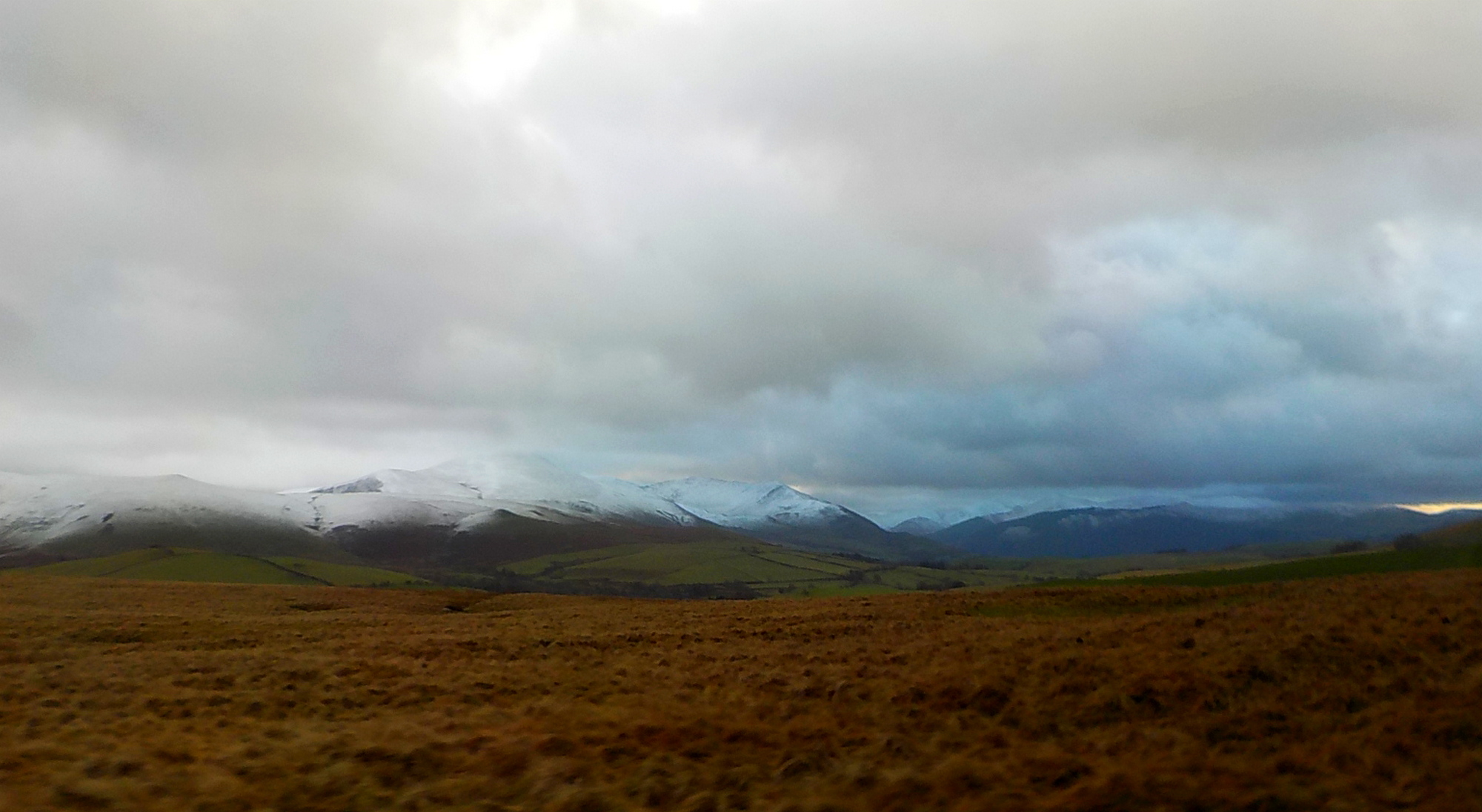
All that remains is for me to wish you all A Happy New Year, and I'll leave you with this panorama of the snow covered Cumbrian fells.

All the best,

Steve


Wednesday, 23 November 2022

China Ducks and Wooden Cats


Once again, it has been great weather for ducks. The Derwent, I am pleased to say, has been behaving itself, the goosanders are back for the winter, the mallards are doing whatever it is that mallards do, and Sally and Harry, the herons, pop by from time to time. Harry Jnr. (AKA Connick) is all grown up and moved on to pastures new.


In the meantime, Ive been spending a fair bit of time at auction houses buying stock for my on-line antiques shop, Steve's Vintage Collectables. Even there, I can't seem to get away from wildlife. Very often, I buy a box of mixed ceramics, if there's something interesting in there. One I bought recently also included this foreign made duck teapot. Not worth auctioning at Christie's, but I think he's absolutely lovely.


At other times, I spot something, tucked away at the back of the room, that just tickles my fancy. Such as this ridiculous one metre tall, hand crafted, wooden cat. He looks marvellous, peering out from behind the foliage, next to the fireplace, at The Old Corn Mill. I suupose that I'll have to sell the cat and the duck eventually, but I think I'll hang on to them for a while.


Meanwhile, as I write books, I thought I'd diversify into the antiquarian book market. I've a box of inter-war children's books to look through, which I picked up yeaterday, in Carlisle. I was also lucky enough to get a very rare, London & Melbourne 1936 edition of Mrs Beeton's Household Management, that turned out to be worth a lot more than I (or the auctioneers) realised. And on the subject of books, I have almost finished proofreading my first novel, The MONOM, (an anacronym for The Magic of Nature of Magic). I hope to get it published before Christmas, so if you get any Amazon vouchers in your Christmas stocking...


We're off to the central lakes at the weekend, to pick up a charity consignment for the homeless, so I'll take my camera, and let you know what's happening on the wet wildlife front, here in soggy Cumbria.


All the best,


Steve


P.S. In common with the rest of the world, I'm running a sale at the moment, in conjunction with Etsy's Cyber Week, so if you're interested in investing in antiques (a better bet than banks and building societies at the moment), or just looking for some Christmas gift ideas, come in and have a browse... Steve's Vintage Collectables.


Follow me on Steve's Nature Plus

and also on Twitter Steve's Nature, Facebook Steve Daniels Naturalistsand Instagram

Steve Daniels Cumbria


Friday, 23 September 2022

Hanging on to Summer


Quite a lot of people suffer from SAD, Seasonal Affected Disorder. It's 8.30 in the morning as I write, it's tipping it down outside, it barely got light an hour ago, but there's something warming and comforting about viewing the outside world from my study window, all snug inside (even if the current energy crisis makes it injudicious to put the heating on!). Astronomically speaking, it is still Summer, at least until tomorrow (Friday 23rd September). The equinox is a late one this year. The date varies because the calendar year is 365 days but the Earth actually takes 365 and a quarter days to travel around the Sun. But although the clocks go back at the end of next week, let us embrace the Autumn, season of mists and mellow fruitfulness as Keats put it, get out and about when we can and snuggle down when we can't.


Autumn is a great time for foraging. The brambles are laden with blackberries, hazelnuts are ripening nicely and the woods are full of delicious fungi. For those of you with gardens, it's harvest time, and one of my favourite places at this time of year is the kitchen. Stuffed marrow is on the menu tonight. Recipe in Steve's Wild Kitchen plus Stuffed Halloween Pumpkins.


Autumn is also a lovely time of year for bird watching. Taking Mattie for a walk, down on Parton beach earlier in the week, turned up a couple of Gull species, a Little Egret, a Redshank and a Curlew, plus a Northern Wheatear. This bird holds the record for the longest migration of any songbird at 9,000 miles each way from Alaska to sub-Saharan Africa and back.


Insects are still about too. In the past week I've seen grasshoppers, leafhoppers, beetles and butterflies and quite a number of the large, furry Fox Moth caterpillars. They are out and about looking for leaf litter in which to hibernate over winter. They will emerge in the Spring as fairly large moths, reddish brown in the case of the male and greyish brown in the female. Both sexes have two creamy lines across their wings.


Tips From Yesteryear


I try to live life simply, here at The Old Corn Mill, and often think back to how my grandparents used to do things (and I'm old enough to be a grandparent myself, so we're going back a bit). They didn't live in the throwaway age and nothing was ever wasted. Potatoes that had sprouted too much for the pot were returned to the earth where one potato produced a handful. The roots cut off spring onions were placed in a pot on the kitchen windowsill to produce another spring onion. It wasn't called recycling then, it was just what people did.


Talking of yesteryear, I'm pleased to say that my little on-line antiques shop, that I started at the beginning of the year, is doing rather well. This is in no small part due to the series of blogs I've been writing called 'Steve's History of Things', which gives some fascinating insights into the history of everyday objects. Here's a list of the series so far, and feel free to browse around the shop: Steve's Vintage Collectables


Steve's History of Things 1


Introduction

Steve's History of Things 2


5 Good Reasons to Buy EPNS


Steve's History of Things 3


Fielding's Musical Tankards

Steve's Hstory of Things 4


Jasperware

Steve's History of Things 5


Blood Pressure Monitors

Steve's History of Things 6


Chodov Porcelain

Steve's History of Things 7


The Pottery Detective


Next week:

Royal memorabilia


Happy Equinox,


Steve


Beetles and Butterflies; spiders and scorpions; woodlice and worms. How do you tell them all apart? To say nothing of crane flies, dragonflies, bee flies and yet more butterflies. Are they all flies? If not, why call them so? If you're fascinated but confused by the beautiful world of the very small, then this is the book for you.


82 pages of information on all aspects of the world of minibeasts, with over 100 photographs and illustrations, this book will help you track down and identify any arthropod, in its adult or juvenile state, anywhere in the world.


See all of my books at author.to/SteveDaniels


Follow me on Steve's Nature Plus

and also on


Steve's Nature


Steve Daniels Naturalists


Steve Daniels Cumbria


Monday, 28 March 2022

Minibeast Monday - Jumping Spiders


Walking back from town last week, I came across this little fellow, sunning himself on the parapet of Gote Bridge. It's a Zebra Spider, one of the  Jumping Spiders from the family Salticidae. It's pretty well camouflaged and I wouldn't have spotted him if he hadn't moved.


They make short, jerking runs when stalking prey, remaining absolutely motionless between runs, like someone playing grandmother's footsteps. Then, when they are in position, they pounce with amazing rapidity, and they're not afraid to take on prey much bigger than themselves.


They are easy to recognise, not just from their behaviour, but also from their eye pattern. They have two very prominent, forward facing eyes, front centre and two, fairly prominent, side facing eyes in the same plane. They also have two more pairs of eyes; one pair above and one pair below. This allows them to make their jumps with pinpoint accuracy.


It is a big family, with about 6,000 described species and distributed pretty well world wide. You can't deny, they have a certain cute charm about them and many people keep them as pets. I always let them have the run of the house out in Crete as a biological control against the small biting insects that managed to evade the mosquito nets. If you fancy keeping them yourself here are a few items that may be of use. Click on the pictures for more information. 


All of the books featured on my posts are now available to view, by category, on one page: Build Your Own Nature Library

All the best,


Steve

Follow me on Steve's Nature Plus and also on


Steve's Nature


Steve Daniels Naturalists


Steve Daniels Cumbria

Wednesday, 9 March 2022

Under Sharp Edge


Back in March of last year, I took you on a walk half way along the disused railway line from Keswick to Threlkeld. Sunday was a beautiful day, and so we decided to do the other half, fortifying ourselves with a cup of coffee at a lovely coffee shop in the village beforehand, and beginning below the awe inspiring Sharp Edge of Blencartha, neatly delineated by a line of snow. As we walked down towards the line, evidence of the recent three storms was clearly visible.


The river Greta winds its way around the old line which was closed fifty years ago this month. It is now a tarmacadam path (suitable for wheelchairs). Down below, a pair of Goosander are fishing for breakfast – note how the female is holding her head, horizontally under the water. These are fish eating sea ducks who come down from Scandinavia in the winter. If you look closely at the male, you can see the hook on the end of his beak which he uses to stab the fish.


The line passes through tunnels and deep, moss covered cuttings, where the water drips down, reflecting golden red globes of sunlight. Absolutely mesmerising. A Wolf Spider stands motionless, awaiting prey, upon a bare patch of rock. They have excellent eyesight, the top two of their eight eyes being very large. They don't spin webs but are opportunistic hunters, pouncing on their prey as it passes, and injecting them with venom. This can produce an itchy welt in us humans but isn't dangerous.


In order to make this a circular walk, we'll take this footpath up over the hill where a flock of Herdwick sheep are contentedly grazing in the warm winter sun. #LadyBeetles are the subject of the insect section of this month's European Nature Almanack and here is our first one, a 7-spot, our most common species. Birch Polypore fungi adorn the Silver Birch trees, and down on the floor, among the reddening leaves of the Geraniums and Cranesbills, Trumpet Lichens rise above the Sphagnum Moss.


Looping round, we meet up with the River Greta once more, and the banks are very inviting for our first picnic of the year. Help yourself to a sandwich. I see we are being joined by a Reed Bunting. These are resident birds, but are often mistaken for sparrows, particularly the females. They are monogamous birds and should start breeding at the beginning of next month. About a fortnight later, the female will lay four or five olive grey eggs in a nest in a low bush or grass tussock. Both mother and father will feed and care for the offspring. All say ahhh!


Jack The Navigator Hound is with us, but sad to say he has deteriorated quickly over the past fortnight. He's spent the walk cradled in the crook of Ishbel's elbow, enjoying the fresh smells of the Cumbrian countryside. I wonder if he's remembering the thousands of miles that he's walked over his sixteen plus years? 

It was a heartbreaking decision, but it would have been selfish to prolong his demise, and we took him to the vet's last night where he was quietly put to sleep and departed his long and adventurous life in Ishbel's arms. Rest In Peace, Jack, my little friend.


A sad note to end on, but a change of location next week as we're off to Bulgaria. I'll try to send some pictures on Instagram and give you a full report when I get back. Meanwhile, some more books that may be of interest: 


A small book about this fascinating family of spiders £5.16 paperback or £2.24 on Kindle

An erudite book, going into detail from someone who knows her subject well. £25.25 hardcover, £14.95 paperback £2.97 on Kindle

With the Creepy-Crawlies beginning to emerge as Spring is upon us. Now is the perfect time to get acquainted with them. £14.99 paperback only


All of the books featured on my posts are now available to view, by category, on one page: Build Your Own Nature Library


All the best,


Steve


Follow me on Steve's Nature Plus


and also on


Steve's Nature


Steve Daniels Naturalists


Steve Daniels Cumbria


Recent Posts