Showing posts with label Grasmere. Show all posts

Wednesday, 28 September 2022

Stone Arthur


A couple of years back, I introduced you to Fell Walking For Wimps, low level walks, not too taxing on the leg muscles. Today we're going to attempt something more strenuous. Stone Arthur, at 504m (1654ft) is one of 214 fells, known as The Wainwrights, after Arthur Wainwright who spent a lot of time in the early twentieth century climbing and writing about them. Ishbel, Mattie, her brother James and his dog, Corrie, are going for the summit. We, on the other hand, are going to make a more leisurely ascent, taking a look at the fauna and flora along the way, and we'll meet up with them on the way down. I am of the opinion that if God had meant us to climb Wainwrights, he wouldn't have invented Google Earth. So, starting off in the village of Grasmere, we're aiming in the general direction of that rocky outcrop up there, known as Arthuur's Seat.
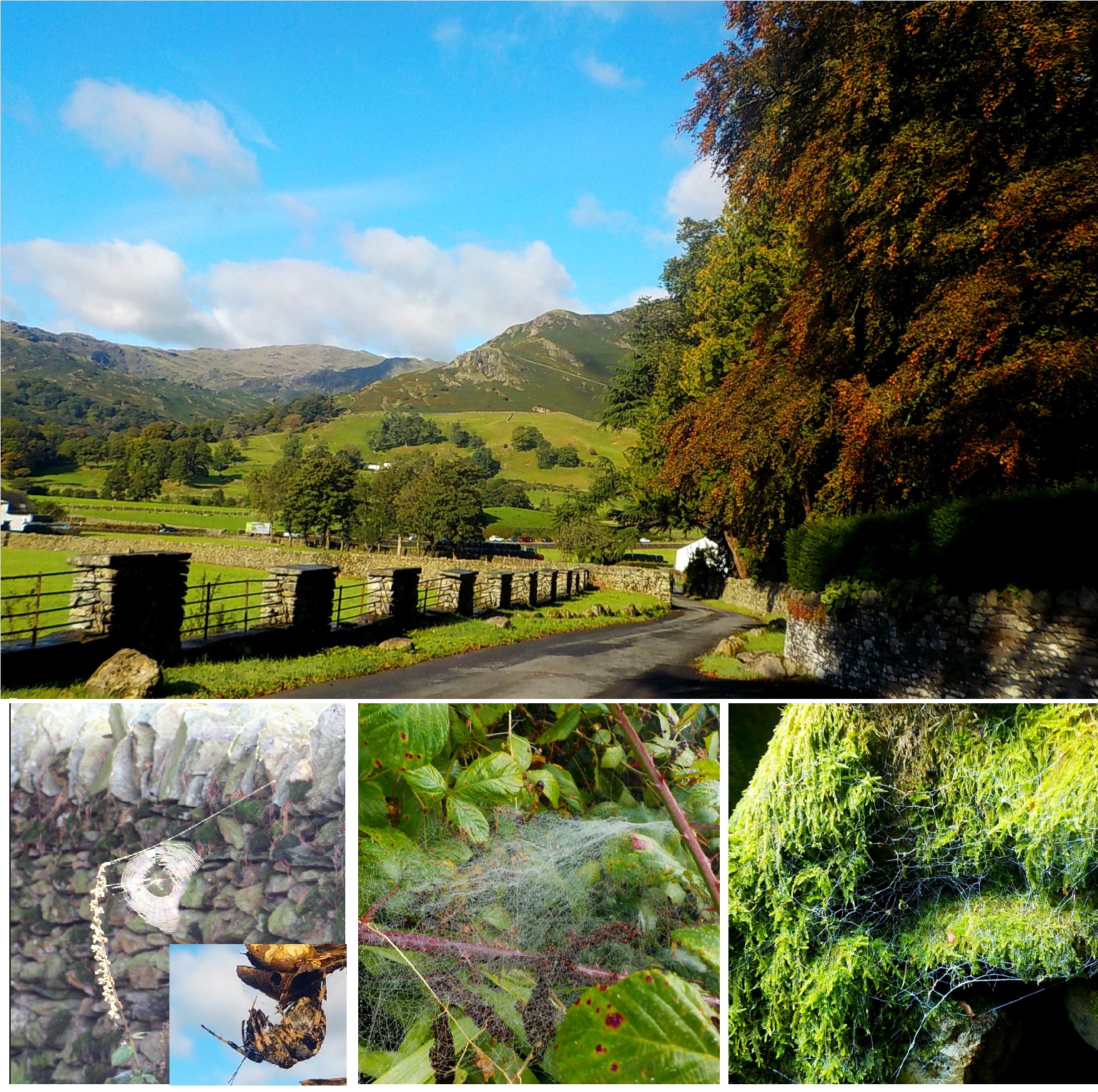


It's a beautiful autumn day, the leaves are beginning to turn, and the sun is illuminating the spiders' webs sublimely. Did you know that there are six main types of spider web? The first one here is an orb web, primarily associated with the family Araneidae. It is a sticky web, hung vertically, to trap flying insects. The spider often sits to one side, with one leg touching a thread, waiting like a fisherman, for a twitch upon the line. The second one is a sheet web. These are made by spiders of the Linyphilidae family, and catches prey on the underside. The spider simply dangles beneath the web and waits for lunch to arrive. The third one, which looks a bit of a mess, is actually cunningly constructed. These are mainly made by the Theriidae family. There are sticky threads dangling from it which are anchored to the floor. When an insect blunders into one of these, it breaks and contracts. The unfortunate insect finds itself impossibly stuck, and catapulted upwards into the web.


Turning off the road and heading up a small lane we are joined by a beck, tumbling down from the fells. There's not a lot in flower at the moment, but a few racemes of Buddleja are still clinging on. Buddleja, aka the butterfly bush, was named after Adam Buddle, a 17th century cleric and botanist from Deeping St. James, near Peterborough. It is native to central China and Japan, It was probably introduced into the UK in the 1890s and by 1922 it was designated an invasive species. A century later and it's everywhere.


We're getting on for half way up now, and I think that it's time to sit and admire the view for a bit. That's Grasmere down there, one of the smaller lakes in The Lake District. The lake, and the village beside it, share the same name. Hello, we've been joined by a small frog. They are more active than you may think. Here in the UK, they only hibernate from about late October to January. They'll burrow down into mud, leaves, or even at the bottom of ponds or streams, where oxygen absorption through the skin is sufficient to keep them alive.


We're in sight of the summit now, and I can hear Mattie, barking joyously nearby, so I guess that they're on their way down. We have a few 'shrooms up here to have a look at while they oil their way down to us. Unusually, I don't have a paper bag on me, in which to collect samples for spore analysis, so I can't positively identify them. However, the first one looks to be a Greenfoot Fibrecap, an inedible (some sources say poisonous) specimen. The second one, I think, is a Deceiver. It's called The Deceiver because it has a very variable appearance. Although it is considered edible, it can easily be confused with other, poisonous, species. It's best left alone. Finally, we have a small, slender stemmed item, quite typical of members of the Omphalotacae family. The name is more of a mouthful than the mushroom is.


And here comes Mattie, ears akimbo, bouncing down the fellside like an errant snowball. Time to head back down for a well earned pint in The Traveller's Rest.


Until next week, all the best,


Steve

Follow me on Steve's Nature Plus


See all of my books at author.to/SteveDaniels

Beetles and Butterflies; spiders and scorpions; woodlice and worms. How do you tell them all apart? To say nothing of crane flies, dragonflies, bee flies and yet more butterflies. Are they all flies? If not, why call them so? If you're fascinated but confused by the beautiful world of the very small, then this is the book for you.

82 pages of information on all aspects of the world of minibeasts, with over 100 photographs and illustrations, this book will help you track down and identify any arthropod, in its adult or juvenile state, anywhere in the world.


Steve's History of Things


Introduction


5 Good Reasons to Buy EPNS


Fielding's Musical Tankards


Jasperware


Blood Pressure Monitors


Chodov Porcelain


The Pottery Detective


Royal Memorabilia


Wednesday, 7 April 2021

Grasmere & Rydal Water: The most loveliest spot than man hath found

Welcome to 'The most loveliest spot than man hath found’ as Wordsworth described Grasmere whilst staying at Dove Cottage just outside the village. Our walk today will take us down the west side of the lake, along the River Rothay then on to Steps End Wood via the south side of Rydal Water to the village of Rydal.


There are cormorant, heron, ducks and geese upon the water but the most prominent wildlife as we walk along would appear to be these marvellous midges. Granted, they are a bit of a nuisance, but at least they're not bloodsuckers. These are Chronomid, or Non-biting Midges, and we can tell this, firstly by the feathery antennae of the males, and secondly by the fact that they are not biting us. This is a male mating swarm that we are walking through, all out looking for partners. Most of their lives are spent as aquatic juveniles, quite often feeding on detritus, generally keeping ponds and streams clean, and providing a banquet for their local community.


At the end of the lake we enter Deerbolt Wood along the banks of the Rothay, full of Chaffinches, Robins, Great Tits and this little fellow which I've not come across before. This is a Marsh Tit, Poecile palustris, which looks very similar to a Willow Tit and pretty much like a Coal Tit. Luckily, he's just sneezed at us, which is a bit of a giveaway. Marsh Tits begin their song with a 'Pi-tchoo' which is very distinctive.


We also have little pools of water to investigate. No frog or toad spawn as yet but we do have an adult common toad lurking in the shadows. I reckon that this is a female. She appears to have a couple of reddish warts on her hind leg, which females are prone to, whereas males are not.


The same set of waterfowl on Rydal Water as on Grasmere, but here at the swampy end, apart from a pair of apparently house-hunting Mallards, we also have a patch of very showy, yellow flowers. You may well have these in your garden pond. They are American Skunk Cabbages, brought over from The States after the second world war and are very popular. The problem is, that they spread and totally take over, and have to be ruthlessly controlled. Sometimes, unwanted plants are dumped in the wild, but their seeds are also quite capable of finding their own way to nearby wetlands. As they out-compete native plants this is rather worrying. They are already considered an invasive species, just over the border in Scotland. If you are looking for an alternative, non-invasive, addition to your bog garden, the Asian Skunk Cabbage with its elegant white flowers, is a good bet.


And finally, as we cross the footbridge over the Rothay and into Rydal we are joined by, of all things, a bat. He's flying very fast, swooping low over the water, even flying beneath the footbridge, and pretty obviously feeding on the plethora of midges. This may explain why he is out so early in the afternoon, as I'm pretty sure he's one of the Vespertilionidae, the so-called Evening Bats. The flight seems too rapid for a Pipistrelle and, given that he is feeding in this manner and we are in woodland, I would hazard a guess that he's a Daubenton's Bat.


So, here we are in Rydal village and there's a regular bus service to take us back to Grasmere. I have to agree with Wordsworth, it is certainly one of the most loveliest spots than man (and midges) hath found.


Until next week, we'll enjoy our new found freedom as lockdown begins to ease, here in the UK.


Steve


Steve's Books


The Quick Guide to Creepy-Crawlies

All you need to know to identify any type of insect, spider, worm or snail very simply and find out more about it.

Yvonne: This was a gift for a family so that the children can understand what they see on days out. The second was for me. Logical and easy to use. If you know anyone who likes nature you can be confident that gifting this book will give years of pleasure.

The Eggs of Saramova

A science fiction novella for those who don't like science fiction. A fast-paced thriller that is, literally, out of this world.

Now available for free on The Author Reads podcast.

https://anchor.fm/author-reads 

£7.50 Paperback edition

Not Just For Twisted Women by Steve Daniels 

A light-hearted look at life through the eyes of the fairer sex.

Janet: If you are short on time but enjoy reading and are maybe not into long extended novels then Not Just For... Twisted Women provides readers with concise stories that stand alone and most certainly entertain with their ultimate twists. Loved it.

Helen: A very good read! Well written and entertaining!

Margaret: Each quick tale gives a glimpse into a character's life and has an often humorous twist at the end. I would love to read more.

Yvonne: These days many people find it hard to find the time to read a novel, so this book of short stories is ideal to dip into. It is also makes a good gift.


£4.99 Paperback edition


LINKS:

Share your nature thoughts, photos and comments on Naturalists (the facebook page that accompanies this blog) or join me throughout the week at Steve's Nature Plus.


Recent Posts