Showing posts with label buddleja. Show all posts

Wednesday, 28 September 2022

Stone Arthur


A couple of years back, I introduced you to Fell Walking For Wimps, low level walks, not too taxing on the leg muscles. Today we're going to attempt something more strenuous. Stone Arthur, at 504m (1654ft) is one of 214 fells, known as The Wainwrights, after Arthur Wainwright who spent a lot of time in the early twentieth century climbing and writing about them. Ishbel, Mattie, her brother James and his dog, Corrie, are going for the summit. We, on the other hand, are going to make a more leisurely ascent, taking a look at the fauna and flora along the way, and we'll meet up with them on the way down. I am of the opinion that if God had meant us to climb Wainwrights, he wouldn't have invented Google Earth. So, starting off in the village of Grasmere, we're aiming in the general direction of that rocky outcrop up there, known as Arthuur's Seat.
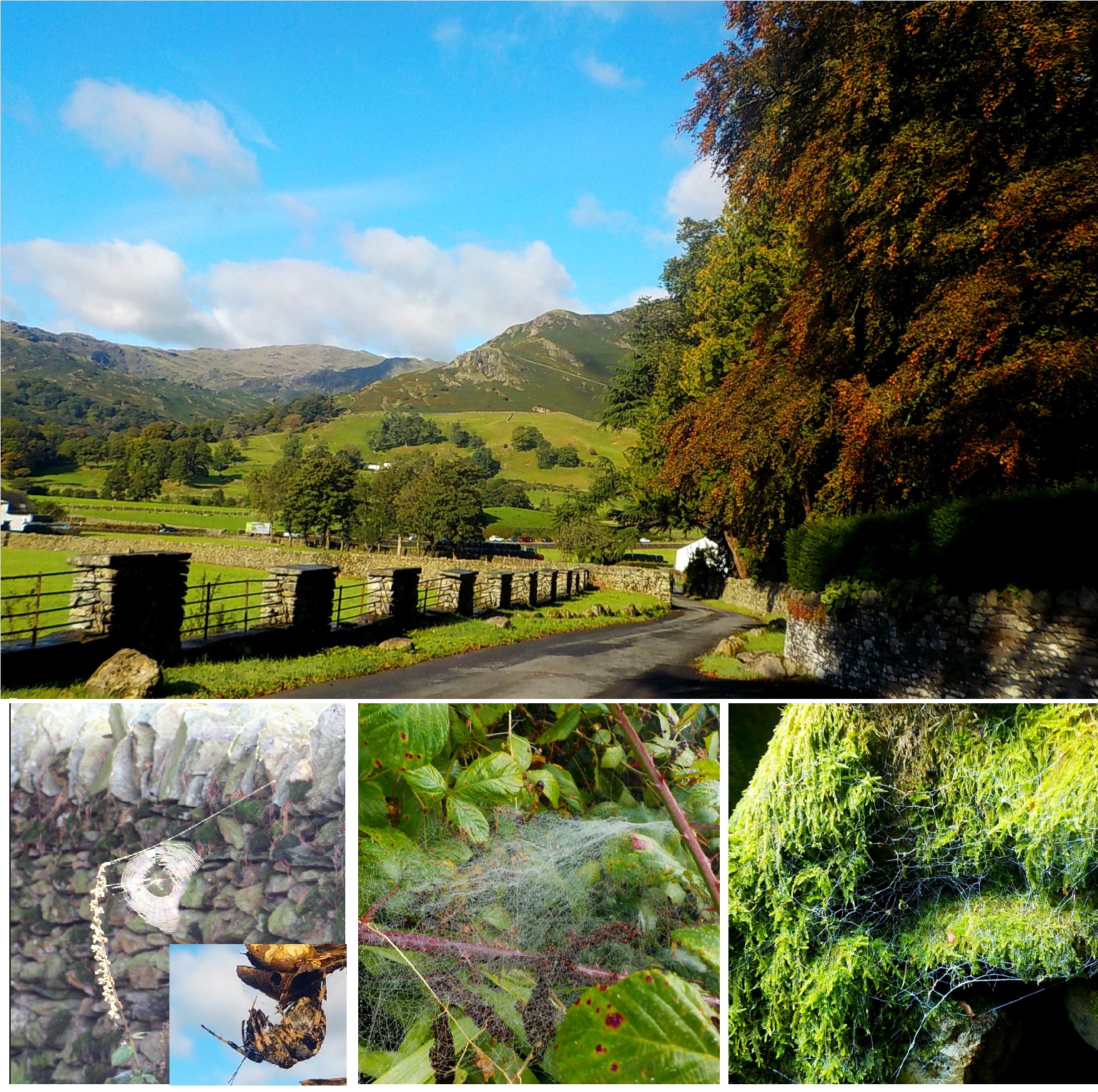


It's a beautiful autumn day, the leaves are beginning to turn, and the sun is illuminating the spiders' webs sublimely. Did you know that there are six main types of spider web? The first one here is an orb web, primarily associated with the family Araneidae. It is a sticky web, hung vertically, to trap flying insects. The spider often sits to one side, with one leg touching a thread, waiting like a fisherman, for a twitch upon the line. The second one is a sheet web. These are made by spiders of the Linyphilidae family, and catches prey on the underside. The spider simply dangles beneath the web and waits for lunch to arrive. The third one, which looks a bit of a mess, is actually cunningly constructed. These are mainly made by the Theriidae family. There are sticky threads dangling from it which are anchored to the floor. When an insect blunders into one of these, it breaks and contracts. The unfortunate insect finds itself impossibly stuck, and catapulted upwards into the web.


Turning off the road and heading up a small lane we are joined by a beck, tumbling down from the fells. There's not a lot in flower at the moment, but a few racemes of Buddleja are still clinging on. Buddleja, aka the butterfly bush, was named after Adam Buddle, a 17th century cleric and botanist from Deeping St. James, near Peterborough. It is native to central China and Japan, It was probably introduced into the UK in the 1890s and by 1922 it was designated an invasive species. A century later and it's everywhere.


We're getting on for half way up now, and I think that it's time to sit and admire the view for a bit. That's Grasmere down there, one of the smaller lakes in The Lake District. The lake, and the village beside it, share the same name. Hello, we've been joined by a small frog. They are more active than you may think. Here in the UK, they only hibernate from about late October to January. They'll burrow down into mud, leaves, or even at the bottom of ponds or streams, where oxygen absorption through the skin is sufficient to keep them alive.


We're in sight of the summit now, and I can hear Mattie, barking joyously nearby, so I guess that they're on their way down. We have a few 'shrooms up here to have a look at while they oil their way down to us. Unusually, I don't have a paper bag on me, in which to collect samples for spore analysis, so I can't positively identify them. However, the first one looks to be a Greenfoot Fibrecap, an inedible (some sources say poisonous) specimen. The second one, I think, is a Deceiver. It's called The Deceiver because it has a very variable appearance. Although it is considered edible, it can easily be confused with other, poisonous, species. It's best left alone. Finally, we have a small, slender stemmed item, quite typical of members of the Omphalotacae family. The name is more of a mouthful than the mushroom is.


And here comes Mattie, ears akimbo, bouncing down the fellside like an errant snowball. Time to head back down for a well earned pint in The Traveller's Rest.


Until next week, all the best,


Steve

Follow me on Steve's Nature Plus


See all of my books at author.to/SteveDaniels

Beetles and Butterflies; spiders and scorpions; woodlice and worms. How do you tell them all apart? To say nothing of crane flies, dragonflies, bee flies and yet more butterflies. Are they all flies? If not, why call them so? If you're fascinated but confused by the beautiful world of the very small, then this is the book for you.

82 pages of information on all aspects of the world of minibeasts, with over 100 photographs and illustrations, this book will help you track down and identify any arthropod, in its adult or juvenile state, anywhere in the world.


Steve's History of Things


Introduction


5 Good Reasons to Buy EPNS


Fielding's Musical Tankards


Jasperware


Blood Pressure Monitors


Chodov Porcelain


The Pottery Detective


Royal Memorabilia


Wednesday, 10 February 2021

Wonderful Wintery Whitehaven


We're not walking far today, just around Whitehaven Harbour, as Jack the Navigator Hound is recovering from a minor op..

  “You wouldn't call it a minor op. If you'd had one of your boll..”

OK, so maybe not such a minor op. from your point of view but the point is, Jack, your fans will want to know why you're not bounding round the fells as usual.”

Which is why we're wandering around Whitehaven, hoping to see the odd dolphin or porpoise. The sea is dead calm, which would be good for spotting if there were anything out there... but there isn't. We do have plenty of birds though, Gulls, Oystercatchers, Swans, Geese, Jackdaws and even a Cormorant. And here on the quayside, rooting around in the debris, a Rock Pipit, Anthus petrosus. These are predominantly coastal birds, related to the wagtails in the family Motacilladae.


One of the problems with bird identification is that they don't come out of the egg looking like the pictures in the bird book. Take these Herring Gulls, Larus argentatus, for example. In their first winter, they are mainly brown and heavily streaked. This one is in his second winter: his head and underparts are beginning to whiten and he's starting to turn grey. Next year he'll look almost adult but he'll still have a few brown feathers in his wings and dark markings on his bill rather than the red spot of the adult. Swans are similar. We all know the song about the ugly duckling with his feathers all stubby and brown, who turns out not to be a duckling at all, but a cygnet who turns into a beautiful swan. The reason, of course, is protective camouflage. It doesn't pay to advertise when you're young.


The last time Britain was invaded was in 1778. I bring this up because it happened right here where we're standing. It was an American invasion, but not a particularly successful one. Led by one Commander John Paul Jones, he was after the 400 British merchant ships which were anchored here, but totally misjudging the currents, a one hour lighting raid in two rowing boats turned into a six hour marathon and one of the boats turned back when the sailors 'heard a noise'. Jones did manage to set fire to the southern fort and the subsequent conflagration engulfed the entire town.


More recently, in the mid 1800s, this castle-like structure was built, along with that tall chimney-looking object, affectionately known as The Candlestick. The 'castle' was the entrance lodge to Wellington coal pit and 'The Candlestick' was a ventilation shaft. There was a major mining disaster here in 1910 when methane ignited and 132 lives were lost, a consequence of which was the invention, by Humphrey Davey, of the safety lamp, which was tested here.

Back to natural history and I see that the Feral Pigeon still holds sway in Whitehaven, repulsing the invasion of the Collared Dove with true Cumbrian grit. Down on the harbour wall, however, an invader from the far east has claimed a roothold. This is Buddleja davidii, the well know butterfly bush, which is now classified as an invasive species in the UK.


News From The Old Cornmill


Just a few miles downriver from the Cornmill another river, The Marron, joins The Derwent. I went out there at first light yesterday and found a scene of absolute peace and tranquility. Just me, the river, a robin and a blue tit. You can keep up with all my sporadic wanderings and more by visiting my website at Steve's Nature Plus.


Steve's Books


The Quick Guide to Creepy-Crawlies

All you need to know to identify any type of insect, spider, worm or snail very simply and find out more about it.

Yvonne: This was a gift for a family so that the children can understand what they see on days out. The second was for me. Logical and easy to use. If you know anyone who likes nature you can be confident that gifting this book will give years of pleasure.


The Eggs of Saramova

A science fiction novella for those who don't like science fiction. A fast-paced thriller that is, literally, out of this world (and it starts right here in Crete).

Now available in paperback priced £7.50


Not Just For Twisted Women by Steve Daniels 

A light-hearted look at life through the eyes of the fairer sex.

Janet: If you are short on time but enjoy reading and are maybe not into long extended novels then Not Just For... Twisted Women provides readers with concise stories that stand alone and most certainly entertain with their ultimate twists. Loved it.

Helen: A very good read! Well written and entertaining!

Margaret: Each quick tale gives a glimpse into a character's life and has an often humorous twist at the end. I would love to read more.

Yvonne: These days many people find it hard to find the time to read a novel, so this book of short stories is ideal to dip into. It is also makes a good gift.


Paperback £4.99


Recent Posts