Showing posts with label Frog. Show all posts

Wednesday, 28 September 2022

Stone Arthur


A couple of years back, I introduced you to Fell Walking For Wimps, low level walks, not too taxing on the leg muscles. Today we're going to attempt something more strenuous. Stone Arthur, at 504m (1654ft) is one of 214 fells, known as The Wainwrights, after Arthur Wainwright who spent a lot of time in the early twentieth century climbing and writing about them. Ishbel, Mattie, her brother James and his dog, Corrie, are going for the summit. We, on the other hand, are going to make a more leisurely ascent, taking a look at the fauna and flora along the way, and we'll meet up with them on the way down. I am of the opinion that if God had meant us to climb Wainwrights, he wouldn't have invented Google Earth. So, starting off in the village of Grasmere, we're aiming in the general direction of that rocky outcrop up there, known as Arthuur's Seat.
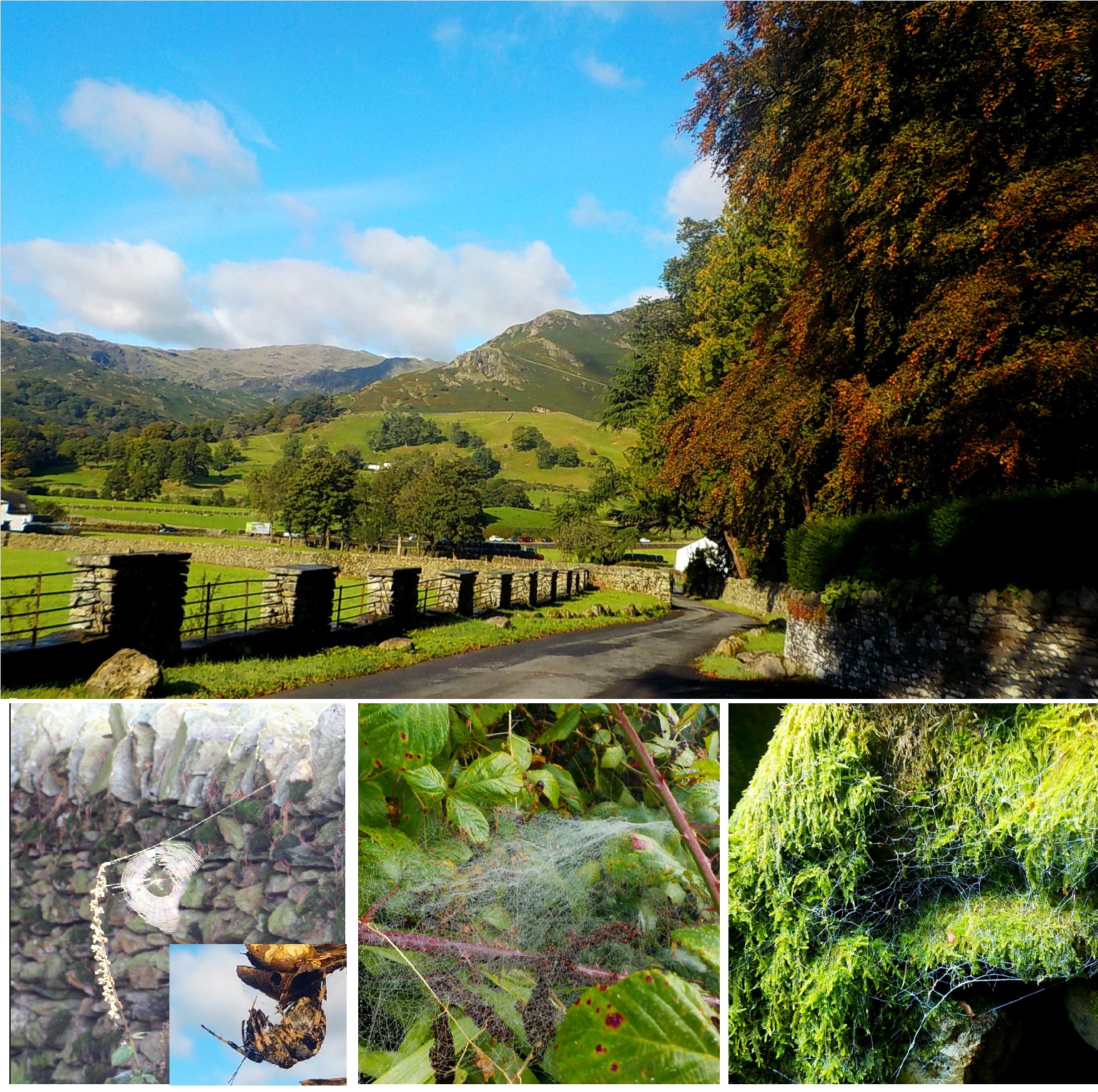


It's a beautiful autumn day, the leaves are beginning to turn, and the sun is illuminating the spiders' webs sublimely. Did you know that there are six main types of spider web? The first one here is an orb web, primarily associated with the family Araneidae. It is a sticky web, hung vertically, to trap flying insects. The spider often sits to one side, with one leg touching a thread, waiting like a fisherman, for a twitch upon the line. The second one is a sheet web. These are made by spiders of the Linyphilidae family, and catches prey on the underside. The spider simply dangles beneath the web and waits for lunch to arrive. The third one, which looks a bit of a mess, is actually cunningly constructed. These are mainly made by the Theriidae family. There are sticky threads dangling from it which are anchored to the floor. When an insect blunders into one of these, it breaks and contracts. The unfortunate insect finds itself impossibly stuck, and catapulted upwards into the web.


Turning off the road and heading up a small lane we are joined by a beck, tumbling down from the fells. There's not a lot in flower at the moment, but a few racemes of Buddleja are still clinging on. Buddleja, aka the butterfly bush, was named after Adam Buddle, a 17th century cleric and botanist from Deeping St. James, near Peterborough. It is native to central China and Japan, It was probably introduced into the UK in the 1890s and by 1922 it was designated an invasive species. A century later and it's everywhere.


We're getting on for half way up now, and I think that it's time to sit and admire the view for a bit. That's Grasmere down there, one of the smaller lakes in The Lake District. The lake, and the village beside it, share the same name. Hello, we've been joined by a small frog. They are more active than you may think. Here in the UK, they only hibernate from about late October to January. They'll burrow down into mud, leaves, or even at the bottom of ponds or streams, where oxygen absorption through the skin is sufficient to keep them alive.


We're in sight of the summit now, and I can hear Mattie, barking joyously nearby, so I guess that they're on their way down. We have a few 'shrooms up here to have a look at while they oil their way down to us. Unusually, I don't have a paper bag on me, in which to collect samples for spore analysis, so I can't positively identify them. However, the first one looks to be a Greenfoot Fibrecap, an inedible (some sources say poisonous) specimen. The second one, I think, is a Deceiver. It's called The Deceiver because it has a very variable appearance. Although it is considered edible, it can easily be confused with other, poisonous, species. It's best left alone. Finally, we have a small, slender stemmed item, quite typical of members of the Omphalotacae family. The name is more of a mouthful than the mushroom is.


And here comes Mattie, ears akimbo, bouncing down the fellside like an errant snowball. Time to head back down for a well earned pint in The Traveller's Rest.


Until next week, all the best,


Steve

Follow me on Steve's Nature Plus


See all of my books at author.to/SteveDaniels

Beetles and Butterflies; spiders and scorpions; woodlice and worms. How do you tell them all apart? To say nothing of crane flies, dragonflies, bee flies and yet more butterflies. Are they all flies? If not, why call them so? If you're fascinated but confused by the beautiful world of the very small, then this is the book for you.

82 pages of information on all aspects of the world of minibeasts, with over 100 photographs and illustrations, this book will help you track down and identify any arthropod, in its adult or juvenile state, anywhere in the world.


Steve's History of Things


Introduction


5 Good Reasons to Buy EPNS


Fielding's Musical Tankards


Jasperware


Blood Pressure Monitors


Chodov Porcelain


The Pottery Detective


Royal Memorabilia


Wednesday, 19 September 2018

Crete Nature Almanack 2018 Autumn


Autumn is nearly upon us and the birds are already flying south from northern Europe and either staying or passing through Crete on their way to sub-Saharan Africa. Find any stretch of water and you are likely to see birds such as Ruddy Turnstones, Arenaria interpres (top left); Common Sandpipers, Actitis hypoleucos (top right); and possibly even a Spotted Redshank, Tringa erythropus (bottom right). Look out also for the first appearance of the Black Redstart, Phoenicurus ochruros (bottom left), which usually arrives down here on the south east coast somewhere between late October and the end of November.


The flowers will start to appear after the first autumnal rains which have been getting gradually later over the past five years; from September 16th in 2013 to September 29th in 2017. I have chosen just three of them, but can you spot the connection? The first one is the Autumn Buttercup, Ranunculus bullatus, which grows throughout the Mediterranean, including north Africa. The second is the Autumn Squill, Prospero autumnale, which although it can be found throughout southern Europe and the Middle East, for some reason can also be found in Great Britain according to Kew Garden's world checklist. The third one is Crocus laevigatus, which is endemic to Crete and is one of a number of crocuses sometimes known as the Autumn Crocus as, like the others, it flowers at this time of year.


The rains also bring forth the snails, of course, and the familiar Garden Snail, Cornu aspersum, starts to appear in considerable numbers in gardens and supermarkets across the island. Apart from being edible did you know that its yucky, slimy secretions are used in American skin creams? The second one is the Chocolate-band Snail, Eobania vermiculata, which also appears in gardens but not so often in supermarkets. They are edible but considered inferior to Garden Snails by the Greeks so we export them to France (mind you, that little nugget of information is 37 years old, so don't quote me on it). Finally, the Green Garden Snail, Cantareus apertus, which has a shell that can vary from creamy yellow, through olive green, to almost black but is easily recognisable if you pick it up. It will blow bubbles all over your hand which reeks of slightly off garlic and lasts for days. Incidentally Wikipedia notes that In Crete this species is active for 3–4 months after the first rainfalls in October.” Rubbish; I've found them out and about at the end of March.


As the seasonal rivers and streams start to fill, listen out for the a capella amphibian assembly after dark. The frogs and toads become very vocal in the autumn. The main singers being the Green Toad, Bufotes viridis, (left) which I think is a very dull name for such a beautiful animal, the endemic Cretan Frog, Pelophylax cretensis (middle). This is a particularly vivid specimen, they are usually much duller, and the diminutive European Tree Frog, Hyla arborea, which, although small, certainly holds his own in the croaking stakes.


Autumn also sees the opening of the mushroom season and lets hope we have a better one than last year when they were very few and far between. In fact, the only ones I found were these Mica Caps, Coprinellus micaceus, a nice, edible mushroom but you have to get them in the pan within the hour and, given the other caveats (see Voila - Turkish Delight ) one wonders whether they're worth collecting at all. Hopefully, this year we'll find a few more species.

That's it for the almanack; next week sees the start of Steve's Sunday Strolls and for those of you who are on the island during the next fortnight here is where you can join me:

Sunday 23rd September
11 am
Sisi
(see last week's post for details).


Sunday 30th September
11 am
Ag. Charalampos, Lassithi Plateau


A gentle stroll around one corner of the Plathini-Lagkada Wildlife Refuge and a handy village taverna where we can chat about what we have seen afterwards.


The Extra Bit

A big thank you to all who have taken the time to investigate my book of short stories and an even bigger thank you to those of you who have actually bought a copy (Amazon Kindle £1.99 or currency equivalent).


Photographic Bit

Many of you have asked me what photographic equipment I use so for details of aperture settings, shutter speeds etc. my pictures will be on Flickr within a few days and that has all the geeky stuff.Pictures were edited with FastStone Image Viewer and combined with Microsoft Paint.


*********************************************************************
LINKS:
Share your nature thoughts, photos and comments on Naturalists (the facebook page that accompanies this blog)

Explore the region with the #CreteNature interactive Hiking and Nature Map


Wednesday, 29 April 2015

Nature Is Winning


On the way back from our expedition into The Arms of Giants last week my attention was drawn to a piece of ground that we last visited together in January of last year. This was part of a hillside that had been levelled for development back in 2005 and then, for some reason best known to the Cretan mind but totally unfathomable to the English, the project was abandoned. The subsequent development of a whole new ecosystem we documented in Nature Fights Back

Lizards scurry through the Oat Grass
In the past fifteen months the only human intervention has been from my neighbour, who occasionally tethers a few goats up there, so I think it’s time to take another look. The foreground is now covered with a lush, green covering of Wild Oats on the dry side to our left whilst to our right the reed bed around the little spring is tall and vibrant. Plenty of insects buzzing around today and whoops! I nearly trod on a small lizard right under my feet. Unfortunately he’s plunged into deep cover but it’s good to see that we now have reptiles in our new ecosystem. 


A Hooded Crow harries a Buzzarrd over the Tamarisk trees
In the centre the tamarisk trees haven’t grown much taller but they have certainly grown thicker and there are various finches and a blackbird regaling us with song. But look up to the skies: the Hooded Crows are mobbing our poor local Buzzard again. They do this with monotonous regularity and I’m surprised that the beleaguered bird puts up with it. It has nothing to do with protecting the nest or the young as it happens at all times of the year. It could be territorial but I think that the crows, who certainly have an air of devilment in their make-up, just do it for fun. Just showing off to their mates as it were.


Arthropods abound in the dry areas
Now, if we can just force a passage through these Tamarisks (says he, trying to disentangle the sweep net from a host of flowering branches and getting covered in fluffy seeds in the process) we’ll see what arthropods we can find. Arthropods? – mostly little animals with their skeletons on the outside containing the soft squishy bits -as opposed to Chordates like ourselves who hang our squishy bits from an internal skeleton and keep the lot together in a bag of skin. We seem to have quite a haul so  let’s see what we have here. Firstly, a Great Green Bush-cricket (notice the long whip-like antennae); then the nymph of one of the short-horned grasshoppers (you can tell it’s a nymph as the wings have not developed). They usually come in green or brown but pink forms like this, although not common, are far from rare. Over on the far wall we have a lovely powder blue Southern Skimmer dragonfly taking in the sun and finally a beautifully marked little Orb Web Weaver spider. A delightful little crew.


A pool full of microscopic life
Listen. Did you hear that soft croaking? Not only do we have reptiles in residence up here now, we also have amphibians. Let’s plunge into the pools and see if we can find the owner of the croak. There he goes! Coming your way. My but he moved quickly. No, don’t chase him any further, just let him be. Come and have a look at these black, squiggly things in this puddle instead. Remember last week we were discussing complete and incomplete metamorphosis in the insect world? All the two winged insects in the world (flies, midges, gnats, mosquitoes and so forth) belong to the insect order Diptera – from the Greek meaning (unsurprisingly) two winged. The Diptera is one of those orders that undergo complete metamorphosis (egg-larva-pupa-adult) and here you can see both larvae and pupae. Here in the puddle it’s difficult to tell what they are exactly but if we take some home with us, let a couple hatch and then put them under the microscope we should be able to find out what they are. 


A mosquito wing under the microscope
You can tell a lot about an insect from its wing venation (the pattern formed by the veins on the wing) and this particular pattern is that of a mosquito. “What use are mosquitoes?” you ask. Well, they’re very good at producing more mosquitoes which is the whole point of life surely? Oh, I see, what use are they to us? Do they have to be? As it happens, without them and their other dipteran relatives we’d probably starve to death. Not all of those squiggly blobs will make it to adulthood. The greater majority will finish up on the dinner plate of other insects or higher animals such as that frog that skipped off nimbly into the reeds. Those that do survive, and many of the insects for which they provide essential nutrition, will go on to pollinate the plants that we and our livestock eat. Life on Earth is a series of large interconnected processes of which we are but a small, if somewhat destructive, part. Unfortunately that may be our legacy in the great panoply of existence. Evolution thrives on periodic mass extinctions and there have been five already in the planet’s history. We are currently engineering the sixth. That’s a rather sobering thought. Come on, let’s go down to the Carrot Club. There’s an orgy going on and we’re invited. 


Welcome to The Carrot Club
Welcome to the Carrot Club. The beautiful purple flower centrepiece is one of the ways in which you can distinguish a wild carrot from similar looking plants such as the deadly poisonous Hemlock (for total security look for three-forked or pinnate lower bracts). We’ll grab ourselves a carrot juice and have a look to see who’s in today. Over in the top left corner I see we have a wasp, finely turned out in glossy black with a white shoulder wrap (one of the Scoliid wasps I think). Moving round we have a Flower Chafer Beetle, also decked out in shiny black with fetching white blotches. The tall, thin guy in black (seems to be the ‘in’ colour this week) and the iridescent, silvery wing cloak is one of the sawflies – a close relative of the wasps and the couple in reds and browns over there in the corner, defying the dress code and exhibiting the sort of behaviour that certainly wouldn’t be tolerated in the better London clubs, are Soldier Beetles. In fact, looking around, there seem to be a lot of soldiers in today. Well, it IS the Carrot Club; nature’s own and totally uninhibited. Cheers everyone!


Until next week – happy hunting.

***********************************************************************************
LINKS:
Naturalists (the facebook page that accompanies this blog)


Recent Posts