Showing posts with label Spiders. Show all posts

Wednesday, 28 September 2022

Stone Arthur


A couple of years back, I introduced you to Fell Walking For Wimps, low level walks, not too taxing on the leg muscles. Today we're going to attempt something more strenuous. Stone Arthur, at 504m (1654ft) is one of 214 fells, known as The Wainwrights, after Arthur Wainwright who spent a lot of time in the early twentieth century climbing and writing about them. Ishbel, Mattie, her brother James and his dog, Corrie, are going for the summit. We, on the other hand, are going to make a more leisurely ascent, taking a look at the fauna and flora along the way, and we'll meet up with them on the way down. I am of the opinion that if God had meant us to climb Wainwrights, he wouldn't have invented Google Earth. So, starting off in the village of Grasmere, we're aiming in the general direction of that rocky outcrop up there, known as Arthuur's Seat.
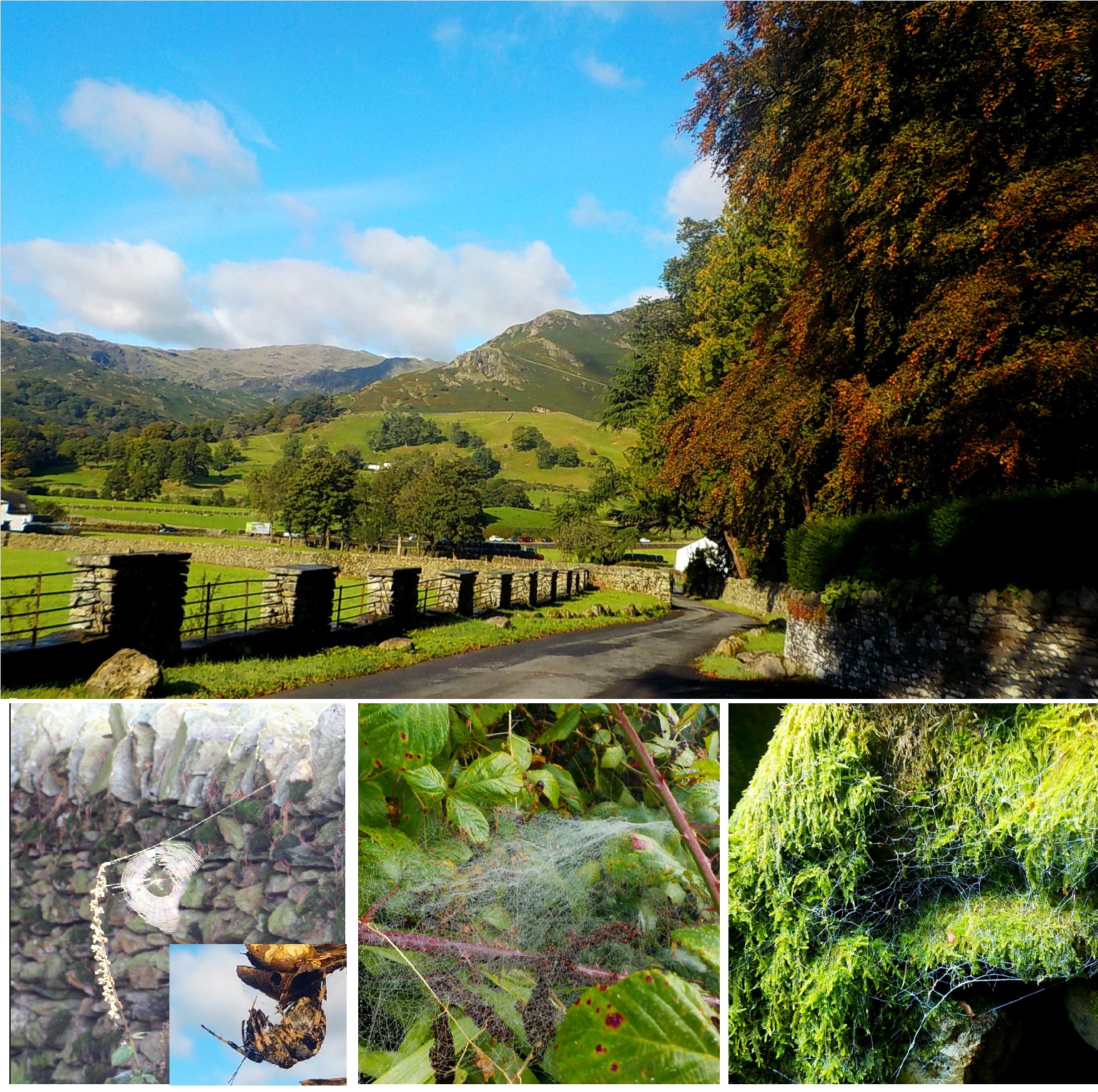


It's a beautiful autumn day, the leaves are beginning to turn, and the sun is illuminating the spiders' webs sublimely. Did you know that there are six main types of spider web? The first one here is an orb web, primarily associated with the family Araneidae. It is a sticky web, hung vertically, to trap flying insects. The spider often sits to one side, with one leg touching a thread, waiting like a fisherman, for a twitch upon the line. The second one is a sheet web. These are made by spiders of the Linyphilidae family, and catches prey on the underside. The spider simply dangles beneath the web and waits for lunch to arrive. The third one, which looks a bit of a mess, is actually cunningly constructed. These are mainly made by the Theriidae family. There are sticky threads dangling from it which are anchored to the floor. When an insect blunders into one of these, it breaks and contracts. The unfortunate insect finds itself impossibly stuck, and catapulted upwards into the web.


Turning off the road and heading up a small lane we are joined by a beck, tumbling down from the fells. There's not a lot in flower at the moment, but a few racemes of Buddleja are still clinging on. Buddleja, aka the butterfly bush, was named after Adam Buddle, a 17th century cleric and botanist from Deeping St. James, near Peterborough. It is native to central China and Japan, It was probably introduced into the UK in the 1890s and by 1922 it was designated an invasive species. A century later and it's everywhere.


We're getting on for half way up now, and I think that it's time to sit and admire the view for a bit. That's Grasmere down there, one of the smaller lakes in The Lake District. The lake, and the village beside it, share the same name. Hello, we've been joined by a small frog. They are more active than you may think. Here in the UK, they only hibernate from about late October to January. They'll burrow down into mud, leaves, or even at the bottom of ponds or streams, where oxygen absorption through the skin is sufficient to keep them alive.


We're in sight of the summit now, and I can hear Mattie, barking joyously nearby, so I guess that they're on their way down. We have a few 'shrooms up here to have a look at while they oil their way down to us. Unusually, I don't have a paper bag on me, in which to collect samples for spore analysis, so I can't positively identify them. However, the first one looks to be a Greenfoot Fibrecap, an inedible (some sources say poisonous) specimen. The second one, I think, is a Deceiver. It's called The Deceiver because it has a very variable appearance. Although it is considered edible, it can easily be confused with other, poisonous, species. It's best left alone. Finally, we have a small, slender stemmed item, quite typical of members of the Omphalotacae family. The name is more of a mouthful than the mushroom is.


And here comes Mattie, ears akimbo, bouncing down the fellside like an errant snowball. Time to head back down for a well earned pint in The Traveller's Rest.


Until next week, all the best,


Steve

Follow me on Steve's Nature Plus


See all of my books at author.to/SteveDaniels

Beetles and Butterflies; spiders and scorpions; woodlice and worms. How do you tell them all apart? To say nothing of crane flies, dragonflies, bee flies and yet more butterflies. Are they all flies? If not, why call them so? If you're fascinated but confused by the beautiful world of the very small, then this is the book for you.

82 pages of information on all aspects of the world of minibeasts, with over 100 photographs and illustrations, this book will help you track down and identify any arthropod, in its adult or juvenile state, anywhere in the world.


Steve's History of Things


Introduction


5 Good Reasons to Buy EPNS


Fielding's Musical Tankards


Jasperware


Blood Pressure Monitors


Chodov Porcelain


The Pottery Detective


Royal Memorabilia


Tuesday, 29 March 2022

The European Nature Almanack - April 2022


April is the bonanza month for naturalists in Europe. Everything really starts to happen this month in the northern latitudes, whilst down south, Spring is in full swing. It's impossible to pick out any one item on which to focus, so this month we're going to zoom in on relationships.


As the flowers start to bloom, so the insects emerge. 88% of flowering plant species are pollinated by insects, which includes three quarters of our food crop species. So, this month's first photographic theme is #InsectPollination. Here, a Marmalade Hoverfly is busy pollinating an ox-eye daisy.


Flies are major pollinators, coming second only to bees, a fact that this Pink Crab Spider is taking full advantage of. Pink? That's its neutral colour. Crab spiders have the ability to change colour to match their backgrounds. It takes a while but it's very effective. This one has matched the yellow of the crown daisy perfectly and nabbed itself an unsuspecting Parasite Fly. #Predation, in all its forms, is the second photographic theme for the month.


With food in such abundance, it is the perfect time to start the mating game. Courtship rituals are fascinating to watch, so take the time to stop and observe the species that you are photographing this month. Your time will be well rewarded. Photographic (and video) theme number 3 is #Courtship.

After courtship comes copulation. I caught these two Tiger Beetles mating in Crete, and used it as the cover for my book, The Quick Guide to Creepy-Crawlies (if you haven't got yours yet, then you'll find it at its most useful this month, when there's so much going on). #Copulation is our fourth and final theme for the month. Send your photos and videos, with hashtag and location, to any of the following:


Steve's Wild Kitchen 


With so much to forage this month, I thought I'd look into a question that's been puzzling me for some time. What's the difference between oregano and marjoram?

The store bought Oregano in your kitchen is Origanum vulgare. This is also known as Wild Marjoram, not to be confused with Sweet Marjoram which is Origanum majorana which is also known as Knotted Marjoram or Pot Marjoram.

Pot Marjoram is also the name given to Cretan Oregano which is a different species, Origanum onites. Hardy Marjoram AKA French/Italian/Sicilian Marjoram is a cross between O. vulgare and O.majorana.

Spanish Oregano, Thymbra capitata and Mexican Oregano, Poliomintha spp. are from the same family but not in the same genus, so they are not true oregano. The famous Cretan Dittany is however, despite not having oregano in its name. It is Origanum dictamus.

Hope that clears up the confusion!


Steve's Books


Chubby's Crematorium & Burger Bar

A book of humorous poems to cheer, amuse and entertain your friends with.


The Quick Guide to Creepy-Crawlies

All you need to know to identify any type of insect, spider, worm or snail very simply and find out more about it.


The Eggs of Saramova

A science fiction novella for those who don't like science fiction. A fast-paced thriller that is, literally, out of this world (and it starts right here in Crete).


Not Just For Twisted Women

A light-hearted look at life through the eyes of the fairer sex.


See sample pages of all my books and keep abreast of latest publications here:

http://author.to/SteveDaniels


All of the nature books featured on my posts are now available to view, by category, on one page: Build Your Own Nature Library

Build Your Own Nature Library


Enjoy the Spring

All the best,


Steve


Wednesday, 10 June 2020

Life on the Littoral


One of the major ecotourist attractions on the south east coast of Crete is Red Butterfly Gorge which we visited back in February 2014. Much less visited, but still worthy of our attention, is the narrow strip of land opposite the gorge entrance, between the road and the sea. The sea shore, the cliffs and the cliff tops constitute a habitat called the littoral zone and today we are going to look for life on the littoral.

This is one of the hottest and driest areas on the island, the ground is stony and the vegetation is sparse; hardy pines, mastic bushes and thyme predominate but, here and there, sunshine yellow Fumana flowers burst through. It is also a favourite haunt of grasshoppers, such as this Calliptamus (he of the rear end pincers for use in mating) which we met in the Uplands in October 2016.


That isolated beach down there is where we want to get to next, and there would appear to be no obvious route. We did, however, cross a tiny gully a little while back, which would seem to be a good place to start. If you want to get to the sea; follow the water course. Some very spiny and scratchy plants on the way through but, not to worry, the blood will wash off in the sea and we have loads of rock pools to explore.

OK, so we burnt our feet on the sand, the rock pools were alternately razor sharp then smooth and slippery, and we only found a few Sea Slaters. Life’s like that sometimes. Thalassotherapy time - we’ll sit and watch the waves crashing in for a bit and then try further down the coast.

What a difference a few hundred yards makes. That, and the fact that the stream which flows through Butterfly Gorge reaches the sea at this point, means that there is a lot more going on here. We have some beautiful Silverleaf Nightshade, Solanum elaeagnifolium, and exploring the leaves, a Blister Beetle, Mylarbis kodymi. Interestingly, both the plant and the beetle can be poisonous to horses. I wonder if there’s a connection?


Moving on, and we have a marvellous spread of Globe Thistles, Echinops spinosissimus. These are really attracting the Hymenopterans this morning, in particular, Honey Bees, Apis melifera, and Mammoth Wasps Megascolia maculata. These are well named; worker bees are 10-15mm long, Mammoth Wasps are 4 to 6 times bigger at 60mm! I have read that they have a sting to match, but like most animals; ‘you leave them be and they’ll leave you be’, as my grandmother taught me.

Note: If you do get stung, the Hymenoptera page of The Quick Guide To Creepy-Crawlies has a medical treatment section. What do you mean, you haven’t bought a copy yet? Come along, come along, what else are you going to do with all that money you’ve saved over the last three months?


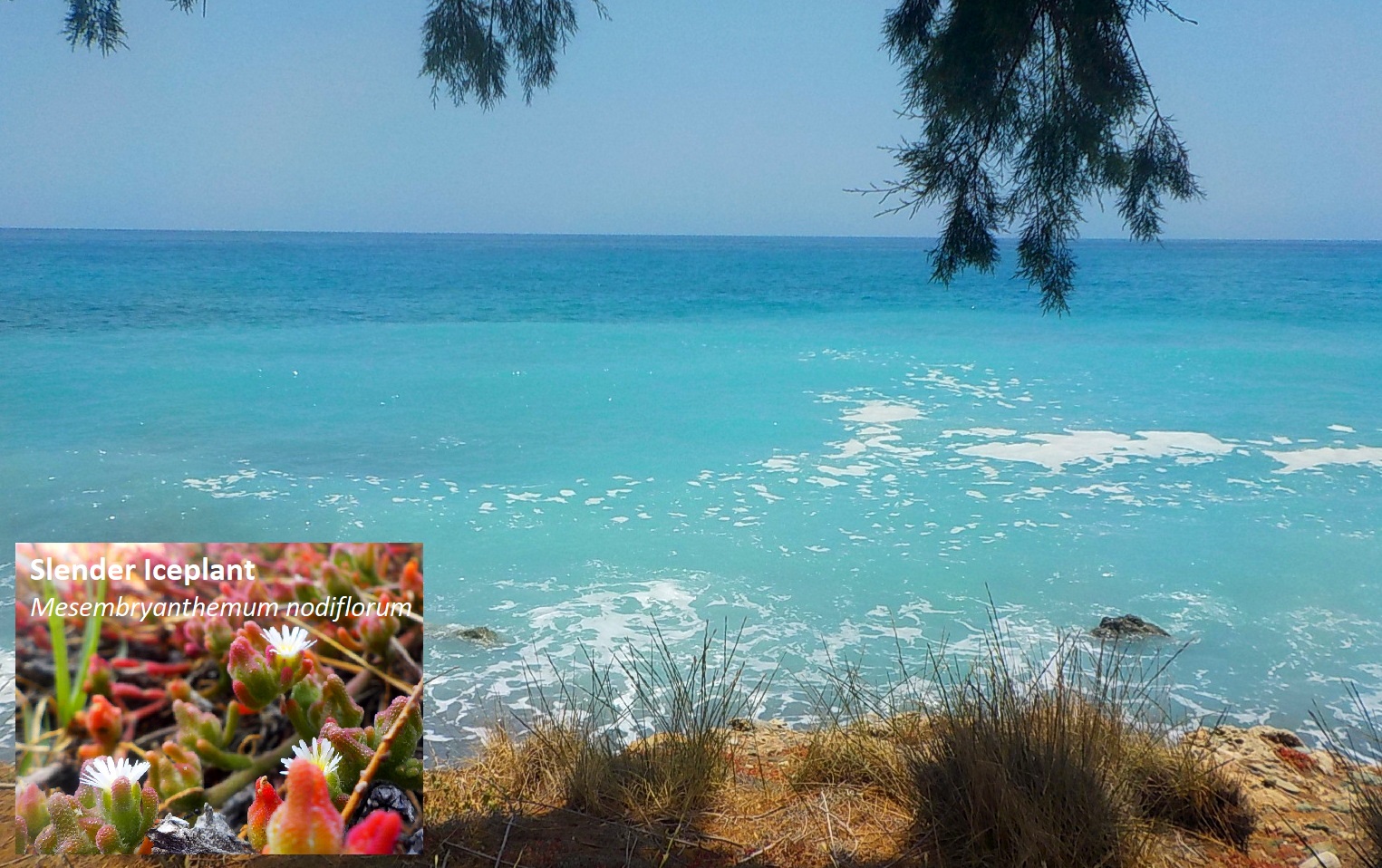
As it is now getting extremely hot, I suggest that we sit in the shade of this Tamarisk tree and explore the world at our feet. The most obvious thing is this mat of red foliage, giving the landscape a somewhat Martian appearance. It is the Slender Iceplant, Mesambryanthemum nodiflorum. Wikipedia declares this to be “native to Israel, Palestine, and Jordan, as also endemic to southern Africa.” This confuses me a bit because, to the best of my knowledge, a native plant exists naturally in the named areas (e.g. Israel, Palestine and Jordan) whereas, an endemic plant exists naturally only in the named area (e.g. southern Africa). By my logic a plant cannot be both endemic and native to different areas. Thoughts and clarification from any etymologically inclined botanists please. 

And on that little puzzler we’ll make our way back to the car as we have a lunchtime get together to attend in order to celebrate the re-opening of tavernas, post lockdown. Do not confuse the little bottles of hand sanitizer with the little bottles of raki.

And finally… I’ve had a lot of correspondence recently from people discovering giant spiders in their houses. I too, have had one as a house guest recently. They are Huntsman spiders, Eusparassus walckenaeri. Firstly, they are totally harmless to us humans so don’t throw your slipper at them. They are useful in the house because they eat insects and are particularly partial to the odd cockroach. If you have an inherent abhorrence of spiders this is a good one to get to know. It likes to live high up on walls and on the ceiling (so you always know where it is and it is not going to surprise you by suddenly appearing from under a cushion, or running across your feet). It is also large enough to be regarded as a small pet, like a mouse. Say hello and then leave it be, it will leave you be, in return.


See sample pages of all my books and latest blogs, and keep abreast of latest publications here:


All you need to know to identify any type of insect, spider, worm or snail very simply and find out more about it.
Yvonne: This was a gift for a family so that the children can understand what they see on days out. The second was for me. Logical and easy to use. If you know anyone who likes nature you can be confident that gifting this book will give years of pleasure.


The Eggs of Saramova
A science fiction novella for those who don't like science fiction. A fast-paced thriller that is, literally, out of this world (and it starts right here in Crete).
Too new for reviews yet!


A light-hearted look at life through the eyes of the fairer sex.
Janet: If you are short on time but enjoy reading and are maybe not into long extended novels then Not Just For... Twisted Women provides readers with concise stories that stand alone and most certainly entertain with their ultimate twists. Loved it.
Helen: A very good read! Well written and entertaining!
Margaret: Each quick tale gives a glimpse into a character's life and has an often humorous twist at the end. I would love to read more.
Yvonne: These days many people find it hard to find the time to read a novel, so this book of short stories is ideal to dip into. It is also makes a good gift.


Crete Nature Catch-up
*********************************************************************
LINKS:
Share your nature thoughts, photos and comments on Naturalists (the facebook page that accompanies this blog)

Explore the region with the #CreteNature interactive Hiking and Nature Map


Recent Posts