Showing posts with label Hawthorn. Show all posts

Wednesday, 27 April 2022

The European Nature Almanack - May 2022

One of Ishbel's Honey Bees, Apis mellifera, pollinating May Blossom on Lowca cliffs


Where better to start this month's almanack than with a picture of a honey bee collecting nectar from May Blossom? May Blossom, Crataegus monogyna, is Britain's native Hawthorn and is associated with the pagan custom of 'Bringing in the May'. On April 31st evening, people would go out to the woods to celebrate through the night, returning in the morning with branches decorated with flowers and foliage. It seems reasonable to suppose that the largest of these would have been erected on the village green to provide a focal point for the May celebrations, but the actual origin of the Maypole is somewhat obscure.


Photo from Wikipedia

May Day celebrations are not peculiar to Britain. Walpurgis Night, April 31st, is celebrated throughout northern and central Europe, when bonfires are lit to ward off witches. Saint Walpurgis was an English Christian missionary born in Devon, England in 710, particularly associated with warding off witchcraft. Bonfires are also a major part of the Celtic festival of Beltane (= bright fire), again, to ward off witches, particularly in respect of protecting their cattle.

Balkan Whip Snake, Hierophis gemonensis, from Crete


Generally, May is seen as the month of rebirth. May Day marks the mid point of Spring, the cold, dark days of winter have gone, and the long, warm summer days lay before us. Crops are growing in the fields and animals, both wild and domestic, are raising their young. Insects are buzzing in the fields, unwittingly providing the majority of a growing chick's diet, and the amphibians and reptiles are becoming more active.


Steve's Wild Kitchen


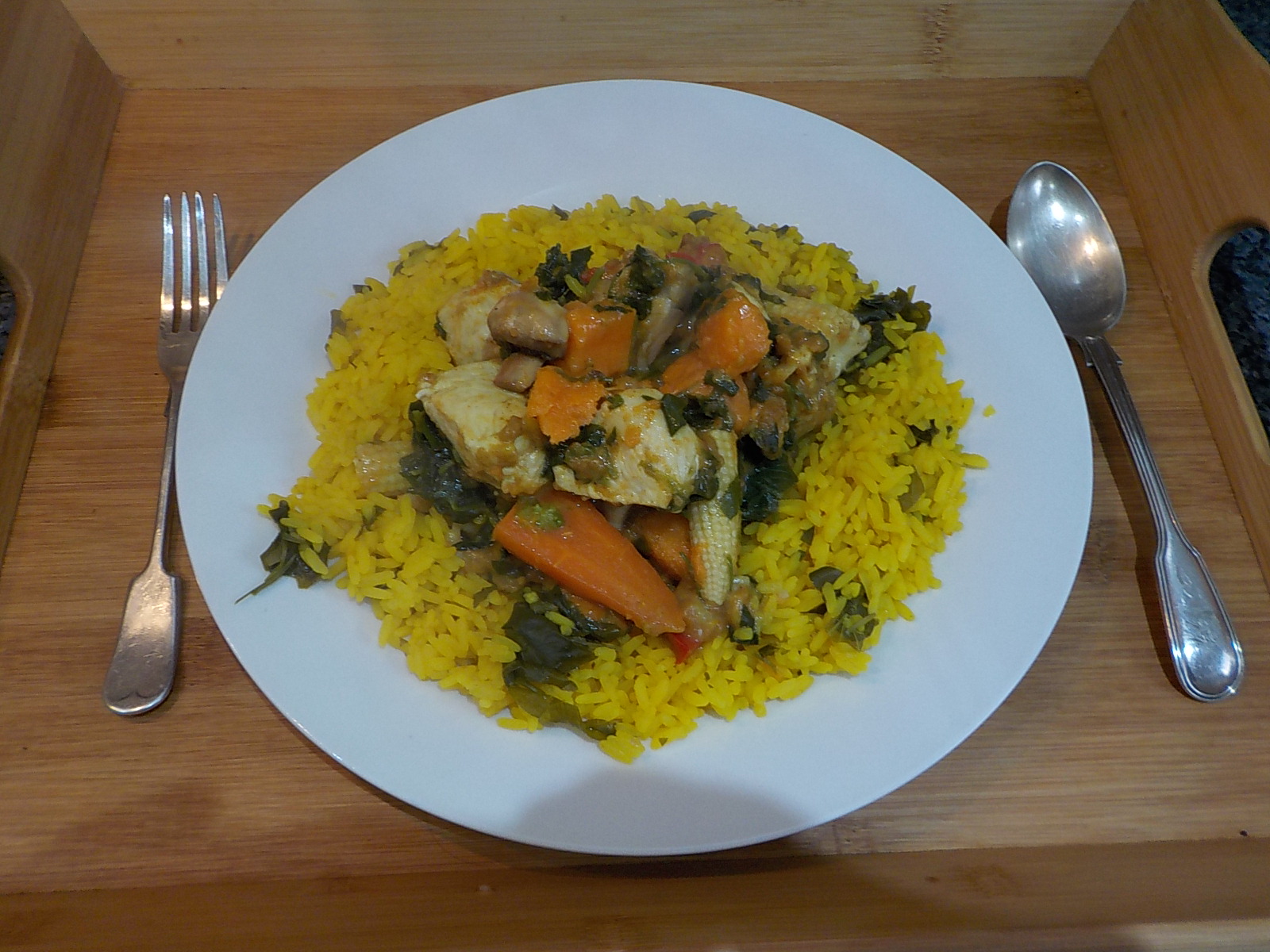
With over sixty wild plants to choose from in May, it's difficult to choose which ones to favour. A lot of them, including hawthorn flowers, can be added to salads but if you're in the mood for something hot, here's a recipe for a Green Curry (not Thai) that I made with two of my favourite hedgerow plants: Lesser Celandine and Garlic Mustard.

This month's wine will be Red Campion flower.


Steve's Books


Chubby's Crematorium & Burger Bar

A book of humorous poems to cheer, amuse and entertain your friends with.

The Quick Guide to Creepy-Crawlies

All you need to know to identify any type of insect, spider, worm or snail very simply and find out more about it.


The Eggs of Saramova

A science fiction novella for those who don't like science fiction. A fast-paced thriller that is, literally, out of this world (and it starts right here in Crete).


Not Just For Twisted Women

A light-hearted look at life through the eyes of the fairer sex.


See sample pages of all my books and keep abreast of latest publications here:

http://author.to/SteveDaniels


All the best,


Steve


Wednesday, 6 October 2021

Berries, Birds, Bugs and Us


Last week, we were chugging down the Lancaster Canal and this week we're taking to the railways. To be more precise, the old Lowca Light Railway line which closed in 1973 and is now a lovely footpath. As you come out of the village you are greeted by a beautiful stand of White Poplars. These trees, with their distinctive two-tone leaves were sacred to Hercules in Roman mythology. Apparently he bound his arrows with a branch of White Poplar after he defeated Cacus, the fire breathing giant, son of Vulcan. Who knew?


The Good, The Bad and The Edible


Further along the track, there are trees and bushes bearing a profusion of red berries, all of which look very similar. The trick in telling them apart is to look at the surrounding leaves. The slightly elongated ones, top left, are Rose Hips. Top right are Hawthorn and bottom left are Rowan. Bottom right has me slightly foxed. It's part of the rose family of plants, quite possibly a Whitebeam, but I'm still checking it out. So, are they good, bad or edible? Medicinally, the Rose Hip is under investigation for its effects in reducing the pain of arthritis, whilst the Hawthorn has proved to be effective in reducing cardiovascular disease. The folk in the white coats are just working out the dosages. This also puts Hawthorn in the 'bad' category as an overdose can cause cardiac arrhythmia and seriously low blood pressure. All three are edible, mainly in the form of condiments – syrups and jams and so forth, as well as being used in wine making. The young leaves and buds of hawthorn (known as 'bread and cheese' in some parts), can be added to salads but are probably best avoided if you have a heart condition.


The berries are not only edible for us, but also for many birds, like this Starling. These beautiful, but often overlooked, birds generally prefer a diet of insects and other invertebrates, but as the insect life declines with the turning of the seasons, they are not averse to switching to these high energy berries. In return, the trees rely on the birds for expanding their range. The seeds within the berries, pass through the birds unharmed, to be dropped with a little package of fertilizer, far from the parent plant.


The seeds have to be fertile in the first place of course, which is where the insects come in. Before the tree can produce a fertile seed, its flowers need to be pollinated. I'm not sure if this Ruby Tiger Moth caterpillar will do any pollinating when it grows up, as many moths do not feed in the adult stage and hence, have no need to visit flowers. You'll often see these caterpillars, moving quite quickly across the path at this time of year, as well as the similarly hairy, black and red, Fox Moth caterpillars (see Fell Walking For Wimps 3).

Without the birds, the seeds don't get distributed; without the bugs, the flowers don't get pollinated. Berries, and other foodstuffs like fruit, veg and cereals don't grow and we starve. Which is why people like me are always honking on about protecting biodiversity. Self interest, when you think about it!


News From The Old Corn Mill


I haven't mentioned the river lately: it has been very low over the summer (quite easily fordable in places), but now that the autumn rains have started it is filling quite quickly. We still have our usual multitude of Mallards and Harry and Sally, the Grey Herons have produced a youngster whom we've named Connick (as in Harry Jnr.). There was a new member to the cast this morning; as I was eating my breakfast a Red Squirrel scampered past the iron railings in the foreground. By the time I got out there with my camera (less than a minute) he'd disappeared. Also, my bacon and eggs had gone cold by the time I came back.


Just a quick reminder, with Christmas looming, there is a selection of books below that make great presents. My latest, Chubby's Crematorium & Burger Bar, would be perfect for a Secret Santa gift. 23 laugh-your-socks-off ditties covering all stages of life from childhood to old age.


Until next week,


All the best


Steve


Steve's Books


Chubby's Crematorium & Burger Bar

A book of humorous poems to cheer, amuse and entertain your friends with.


£4.99 Paperback

The Quick Guide to Creepy-Crawlies

All you need to know to identify any type of insect, spider, worm or snail very simply and find out more about it.

Yvonne: This was a gift for a family so that the children can understand what they see on days out. The second was for me. Logical and easy to use. If you know anyone who likes nature you can be confident that gifting this book will give years of pleasure.


£14.99 Paperback

The Eggs of Saramova

A science fiction novella for those who don't like science fiction. A fast-paced thriller that is, literally, out of this world (and it starts right here in Crete).


£7.50 Paperback

£1.99 Kindle

Not Just For Twisted Women by Steve Daniels 

A light-hearted look at life through the eyes of the fairer sex.

Janet: If you are short on time but enjoy reading and are maybe not into long extended novels then Not Just For... Twisted Women provides readers with concise stories that stand alone and most certainly entertain with their ultimate twists. Loved it.

Helen: A very good read! Well written and entertaining!

Margaret: Each quick tale gives a glimpse into a character's life and has an often humorous twist at the end. I would love to read more.

Yvonne: These days many people find it hard to find the time to read a novel, so this book of short stories is ideal to dip into. It is also makes a good gift.


£4.99 Paperback

£1.99 Kindle


See sample pages of all my books and latest blogs, and keep abreast of latest publications here:

http://author.to/SteveDaniels


Wednesday, 24 July 2019

Grand Tour 2: Cumbrian Lakes and Seashore

Crummock Water, Cumbria, UK


Let me take you back 500 million years. Crummock Water, now one of fourteen beautiful lakes in The Lake District, was on the sea bed, a bed made up of sand and black, glutinous mud. Since then, that sediment has been squeezed, scunched and uplifted (and continues to be so) to form the fells that surround the lake, in this, the oldest part of the National Park. To the south of this are the eroded outcrops of hard lavas and ashes formed as a result of catastrophic volcanic eruptions 450 million years ago. It is here that you will find the highest peaks including Scafell Pike, England's highest at 3,209 feet (978m). To the south of this lies the gentler sedimentary rocks of southern Lakeland. These mudstones, sandstones, siltstones and limestones made up of billions of crushed seashells were formed upon the sea bed around 420 million years ago. The result is an area of truly outstanding natural beauty.

Let us take a walk around the woodland at the edge of the lake. It feels primaeval with its moss covered rocks and trees where red squirrels scamper around in the canopy and warblers and finches sing from unseen branches. Rows of bracket fungi adorn fallen branches and down by the water's edge bilberries are just starting to form. Look at the mosses more closely and you can see that the moss growing on the rocks (Thuidium sp.) and the moss climbing the trees (Hypnum sp.) are entirely different, occupying, as they do, completely separate ecological niches.


We'll track north now to Allonby Sands, a long, sandy beach on the edge of the Solway Firth. It is the middle of May and the Hawthorn bushes up on the dune ridge are just coming into flower. Floating all around them, long legs trailing, are the Hawthorn flies (Bibio marci). These harmless little insects (they don't bite) have a tendency to hatch in large numbers on or about the 25th April – the males sometimes about a week earlier – which is St. Mark's Day. This gives them their alternative name of St. Mark's Fly. Having completed their mating cycle many of them finish up on the surface of lakes, rivers and streams where they provide a seasonal bounty for the fish.

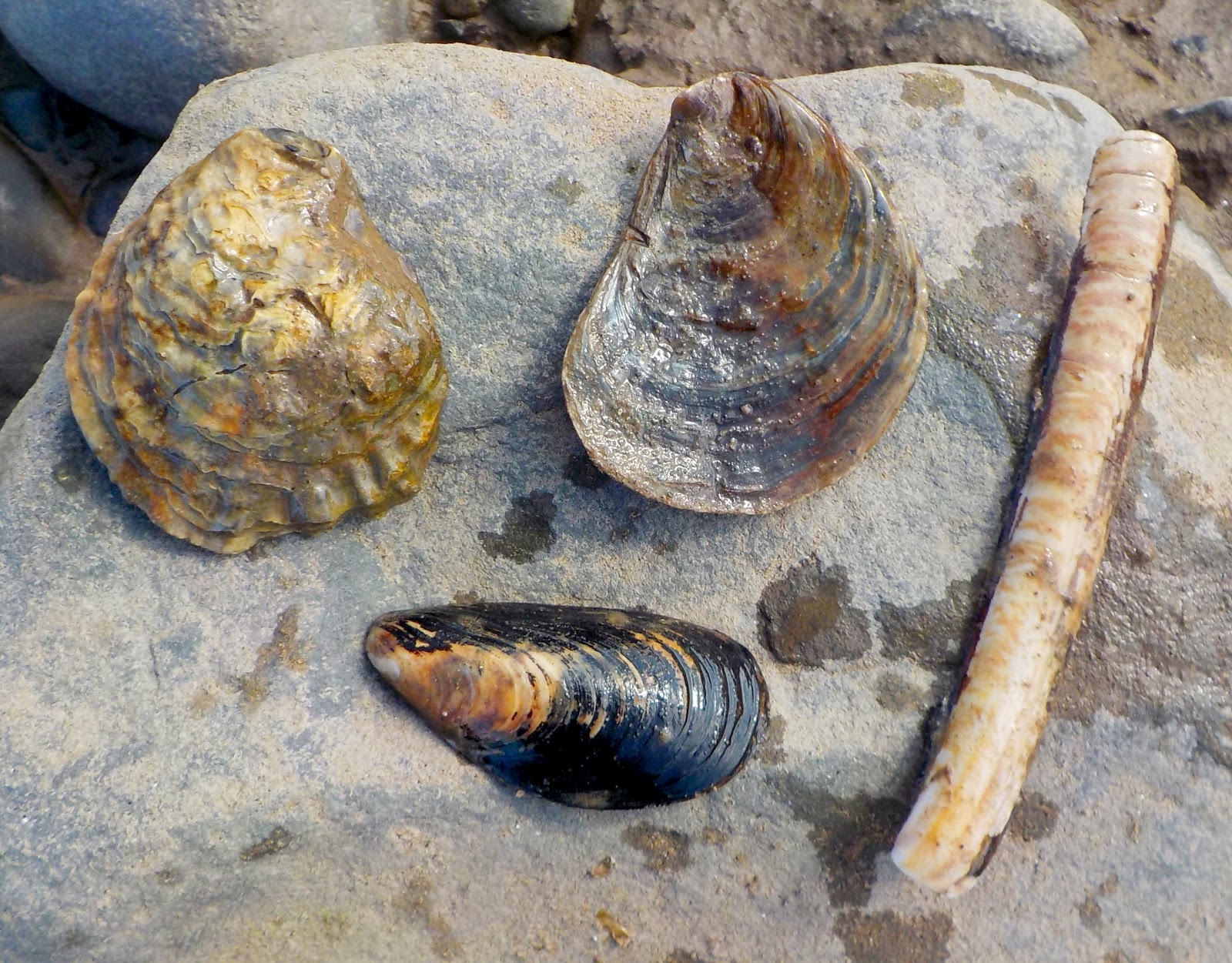
Coming down onto the shoreline and peering into the rock pools (or guddling in the local dialect) we find a treasure trove of shells of edible molluscs; oysters [top], mussels [bottom] and razor shells [right]. Unfortunately the original inhabitants of these shells are no longer present so no 'Allonby Chowder' recipe this week. It's a dish more suited to the depths of winter so, maybe on our next visit. And we must include smoked kippers! Around the turn of the 18th century, the village of Allonby was the centre of the local herring fishing industry, salting and packing the herring in barrels and kippering them in the smoke house.


From the remote geolical past, through more recent history, we come to the present. Out beyond the shoreline, where the oystercatchers, knots and dunlin probe the sands for their lunch, lies the Robin Rigg offshore wind farm. Sixty 260ft (80m) high towers with four 144ft (44m) blades apiece turning at an average 170 miles per hour produce enough electricity to power half the houses in Cumbria. There are concerns of course. You can't plant a forest of turbines in somewhere like the Solway Firth without shaking it up a little and the ecology is being carefully monitored. But, whichever way you look at it, it means a heck of a lot less fossil fuel has to be burnt to keep the lamps lit over half the county.


Crete Nature Catch-up

Steve's Books (well, just the one at the moment but 'The Quick Guide to Creepy-Crawlies' is well under way and should be available later in the year).)

Not Just For Twisted Women by Steve Daniels 
A light-hearted look at life through the eyes of the fairer sex.
Kindle Edition 1.99 pounds sterling (or equivalent).
Paperback Edition 4.99 pounds sterling (or equivalent)..
Read snippets, samples and stuff at Steve's Books


*********************************************************************
LINKS:
Share your nature thoughts, photos and comments on Naturalists (the facebook page that accompanies this blog)

Explore the region with the #CreteNature interactive Hiking and Nature Map


Recent Posts