Showing posts with label flies. Show all posts

Friday, 31 March 2023

Long Meg and her daughters


A few miles to the east of Penrith in Cumbria, lies England's third widest stone circle. Constructed in Neolithic times, it consists of 69 rhyolite glacial erratics (the daughters) and a huge block of local red sandstone, Long Meg, who stands to one side watching over them. This was to be our destination for a night of wild campervanning. Elvis had had his leisure battery replaced and the electrics were now working, and so we set off, without a care in the world. It was a beautiful sunny day, Long Meg was looking her best, and a buzzard wheeled overhead. Perfect.


We parked up, less than half a mile away, and there were plenty of hedgerows to explore en route. Apart from the daffodils, which were attracting a host of Muscoid flies, the Red Deadnettles were providing a splash of pink in the undergrowth. Elvis did his bit by attracting a Green Lacewing as well. In the meadow, a rabbit came out for his evening meal, but refused to be photographed. Dusk decended, we turned on the lights... and the electrics failed again. We'd packed emergency lights, so we could at least see what we were doing, but it was a bit chilly when we got up in the morning.


We decided to go into Penrith for breakfast, and this is when the fun began. In the middle lane of Penrith's busiest roundabout, just at the onset of rush hour, Elvis decided to blow his head gasket. The police had to be summoned to prevent a pile up, recovery vehicles had to be organised, and seven hours of alternate waiting around and hectic activity later, we finally collapsed onto the settee at home, surrounded by bin liners full of campervanning paraphenalia.


Two days later, after we had recovered somewhat, it was Ishbel's birthday, so we went out to the courtyard brasserie at Armathwaite Hall for lunch. A lovely stately old pile that stands on the north shore of Bassenthwaite lake. We took Mattie for a walk in the grounds beforehand and I found a more photogenic rabbit. It's my birthday on Monday, and I'm looking forward to a quiet walk along the shoreline looking for mermaid's purses.

All the best,

Steve

Steve's Vintage Collectables.


Steve's Books


Follow me on Steve's Nature Plus

and also on Twitter Steve's Nature, Facebook Steve Daniels Naturalistsand Instagram

Steve Daniels Cumbria


Wednesday, 12 May 2021

Route 66


America's famous Route 66 runs east-west between Chicago and Santa Monica, a distance of 2,448 miles. Our, slightly less famous (some would say infamous) A66 also runs east-west, covering the 115 miles between Redcar and Workington but, to get one up on my American friends, ours does traverse the whole country from coast to coast. The main reason for bringing you this week's blog from a lay-by on the A66, is that our Intrepid Local Guide and I have been out buying a bee hive and visiting a garden centre in an attempt to make her garden a bee's paradise. The other reason is simply to chat about roadside verges as a habitat in their own right. Britain's roadside verges cover a land area about the same as the whole of The Lake District National Park. There are over 300,000 miles of them which is more than twelve times the circumference of the Earth. They provide corridors for small mammals such as mice and voles, which is why you often see kestrels like this one hovering over our trunk roads.


This particular verge has a small area of woodland adjoining it, containing a couple of ponds, so let's go and investigate. No frogspawn or tadpoles which is a bit surprising as they seem ideal (apart from their proximity to the road). We do have some Whirligig Beetles which are fascinating insects as they have two pairs of eyes: one pair on top for seeing through air and one pair below for seeing through water. We also have quite a colony of Amber Snails on the Flag Iris leaves and a fair bit of Duckweed on the surface of the water. This is an important plant for waterfowl (such as that Mallard which Jack the Navigator Hound has just flushed) and is also perfectly edible for us humans with more protein than soybeans.


There are a couple of plants in flower around the edges of the ponds. We have some Marsh Marigolds, Caltha palustris, which is poisonous when raw but can be eaten cooked, and some Cowslips, Primula veris, an old, country favourite for making cowslip wine.


Returning to the roadside we have some more winemakers' favourites in a host of golden Dandelions. They are also attracting a lot of pollinators. There's a Ladder-backed Hoverfly to the rear, possibly a Fungus gnat diving into the flower in front of it, and down here at my feet, a Drone Fly of some description. Roadside verges are now the go to places for flowers and their pollinators, as we lost about 97% of our traditional grasslands during the 20th century. Nowadays 45% of UK wildflower species can be found on roadside verges. 


And finally, a tiny mushroom has pushed its way up through the grasses and leaflitter and even that has attracted a minute insect. So small, in fact, that I didn't even notice it until I looked at the photograph, and it's not in focus enough to be able to tell you what it is (even with my handy copy of The Quick Guide to Creepy-Crawlies) If you haven't got a copy yet, I do urge you to buy one. It makes such a difference to your nature rambles when you know what you're looking at, and at £14.99 it won't break the bank. Go on, treat yourself!

As usual, theres more stuff throughout the week on my website, Steve's Nature Plus,


All the best


Steve


Steve's Gallery


I have put selected pictures up for sale as digital downloads or prints, for both private and commercial use. I shall be concentrating on the pictures which show relationships between organisms (including ourselves) and their environment and interspecies relationships. Gallery.


Steve's Books


The Quick Guide to Creepy-Crawlies

All you need to know to identify any type of insect, spider, worm or snail very simply and find out more about it.

Yvonne: This was a gift for a family so that the children can understand what they see on days out. The second was for me. Logical and easy to use. If you know anyone who likes nature you can be confident that gifting this book will give years of pleasure.

The Eggs of Saramova

You can listen to this book for FREE as it is being serialized on the podcast The Author Reads


£7.50 Paperback edition

Not Just For Twisted Women by Steve Daniels 

A light-hearted look at life through the eyes of the fairer sex.

Janet: If you are short on time but enjoy reading and are maybe not into long extended novels then Not Just For... Twisted Women provides readers with concise stories that stand alone and most certainly entertain with their ultimate twists. Loved it.

Helen: A very good read! Well written and entertaining!

Margaret: Each quick tale gives a glimpse into a character's life and has an often humorous twist at the end. I would love to read more.

Yvonne: These days many people find it hard to find the time to read a novel, so this book of short stories is ideal to dip into. It is also makes a good gift.


£4.99 Paperback
edition


Crete Nature Catch-up

Series 1 - Welcome to Lasithi

Series 2 - The Rhythm Of Life

Series 3 - A Journey Begins

Series 4 - The Milonas Valley

Series 5 - This Is Ferma

Series 6 - Upland Villages

Series 7 - The Forty saints

Series 8 - Sunday Strolls

Series 9 -Stormy Weather

*********************************************************************

LINKS:

Share your nature thoughts, photos and comments on Naturalists (the facebook page that accompanies this blog)


Wednesday, 21 April 2021

The Cocker Line


 A few weeks back, I took you on a local walk which I referred to as The Circle Line, alluding to the London Underground. Continuing this theme, were off on the Cocker Line today, following the river out of town and into the farmlands to the south.

Even in the town, as we walk along Rubbybanks Road there is plenty of life on the river. I've often seen wagtails and dippers along here and today there's a grey heron perched on an overhanging branch on the Kirkbank.


Leaving Rubbybanks, we'll circle up onto the Greenway (once the old Cockermouth to Penrith railway line which we visited at Keswick-Threlkeld), cross the river, dive through some woodland and emerge into the fields. Along the banks, as you can see, the Speedwell, Wood Anemone and Saxifrage are coming into flower.


As we continue to follow the river bank, small rills flow down from the hills on the far side, and fungi, too tantalisingly distant to identify, adorn the fallen branches.


The dandelions are out too, providing food for various small flies. These are very difficult to put a name to. All true flies are in the order Diptera and most of them are in the suborder Brachycera. These are the flies that look like flies, so to speak, as opposed to mosquitoes, midges and crane flies that are in other suborders. Within the Brachycera are Calyptrate flies (which include the familiar house flies as well as the dung flies, flesh flies and blow flies) and the superfamily Syrphoidea which encompasses the big-headed, hover and drone flies such as that Eristalis down there. There are well over a hundred different fly families, and if you want to see how they all relate to each other here's a mind-boggling diagram.


There's a farmhouse here with a track called Simonscales which will take us back into town, or we could carry on all the way to the village of Low Lorton, some miles away. However, we have an appointment to meet some friends, that we haven't seen since before Christmas, in a pub garden in town. Low Lorton will have to wait for another day, but meanwhile we have some Muscovy Ducks on the opposite bank (where all birds live). Despite their name these ducks have no more relationship with Moscow than turkeys have with Turkey. They are native to Mexico, Central and South America.


I can never look at a duck without feeling hungry (see Crispy Duck in Steve's Wild Kitchen). I wonder if they do food in this pub? Let's go and find out.


Steve's Books


The Quick Guide to Creepy-Crawlies

All you need to know to identify any type of insect, spider, worm or snail very simply and find out more about it.

Yvonne: This was a gift for a family so that the children can understand what they see on days out. The second was for me. Logical and easy to use. If you know anyone who likes nature you can be confident that gifting this book will give years of pleasure.

The Eggs of Saramova

A science fiction novella for those who don't like science fiction. A fast-paced thriller that is, literally, out of this world (and it starts right here in Crete).

Too new for reviews yet!

£7.50 Paperback edition


Not Just For Twisted Women by Steve Daniels 

A light-hearted look at life through the eyes of the fairer sex.

Janet: If you are short on time but enjoy reading and are maybe not into long extended novels then Not Just For... Twisted Women provides readers with concise stories that stand alone and most certainly entertain with their ultimate twists. Loved it.

Helen: A very good read! Well written and entertaining!

Margaret: Each quick tale gives a glimpse into a character's life and has an often humorous twist at the end. I would love to read more.

Yvonne: These days many people find it hard to find the time to read a novel, so this book of short stories is ideal to dip into. It is also makes a good gift.


£4.99 Paperback edition


See sample pages of all my books and latest blogs, and keep abreast of latest publications here:

http://author.to/SteveDaniels


Crete Nature Catch-up

Series 1 - Welcome to Lasithi

Series 2 - The Rhythm Of Life

Series 3 - A Journey Begins

Series 4 - The Milonas Valley

Series 5 - This Is Ferma

Series 6 - Upland Villages

Series 7 - The Forty saints

Series 8 - Sunday Strolls

Series 9 -Stormy Weather

*********************************************************************

LINKS:

Share your nature thoughts, photos and comments on Naturalists (the facebook page that accompanies this blog)


Wednesday, 24 July 2019

Grand Tour 2: Cumbrian Lakes and Seashore

Crummock Water, Cumbria, UK


Let me take you back 500 million years. Crummock Water, now one of fourteen beautiful lakes in The Lake District, was on the sea bed, a bed made up of sand and black, glutinous mud. Since then, that sediment has been squeezed, scunched and uplifted (and continues to be so) to form the fells that surround the lake, in this, the oldest part of the National Park. To the south of this are the eroded outcrops of hard lavas and ashes formed as a result of catastrophic volcanic eruptions 450 million years ago. It is here that you will find the highest peaks including Scafell Pike, England's highest at 3,209 feet (978m). To the south of this lies the gentler sedimentary rocks of southern Lakeland. These mudstones, sandstones, siltstones and limestones made up of billions of crushed seashells were formed upon the sea bed around 420 million years ago. The result is an area of truly outstanding natural beauty.

Let us take a walk around the woodland at the edge of the lake. It feels primaeval with its moss covered rocks and trees where red squirrels scamper around in the canopy and warblers and finches sing from unseen branches. Rows of bracket fungi adorn fallen branches and down by the water's edge bilberries are just starting to form. Look at the mosses more closely and you can see that the moss growing on the rocks (Thuidium sp.) and the moss climbing the trees (Hypnum sp.) are entirely different, occupying, as they do, completely separate ecological niches.


We'll track north now to Allonby Sands, a long, sandy beach on the edge of the Solway Firth. It is the middle of May and the Hawthorn bushes up on the dune ridge are just coming into flower. Floating all around them, long legs trailing, are the Hawthorn flies (Bibio marci). These harmless little insects (they don't bite) have a tendency to hatch in large numbers on or about the 25th April – the males sometimes about a week earlier – which is St. Mark's Day. This gives them their alternative name of St. Mark's Fly. Having completed their mating cycle many of them finish up on the surface of lakes, rivers and streams where they provide a seasonal bounty for the fish.

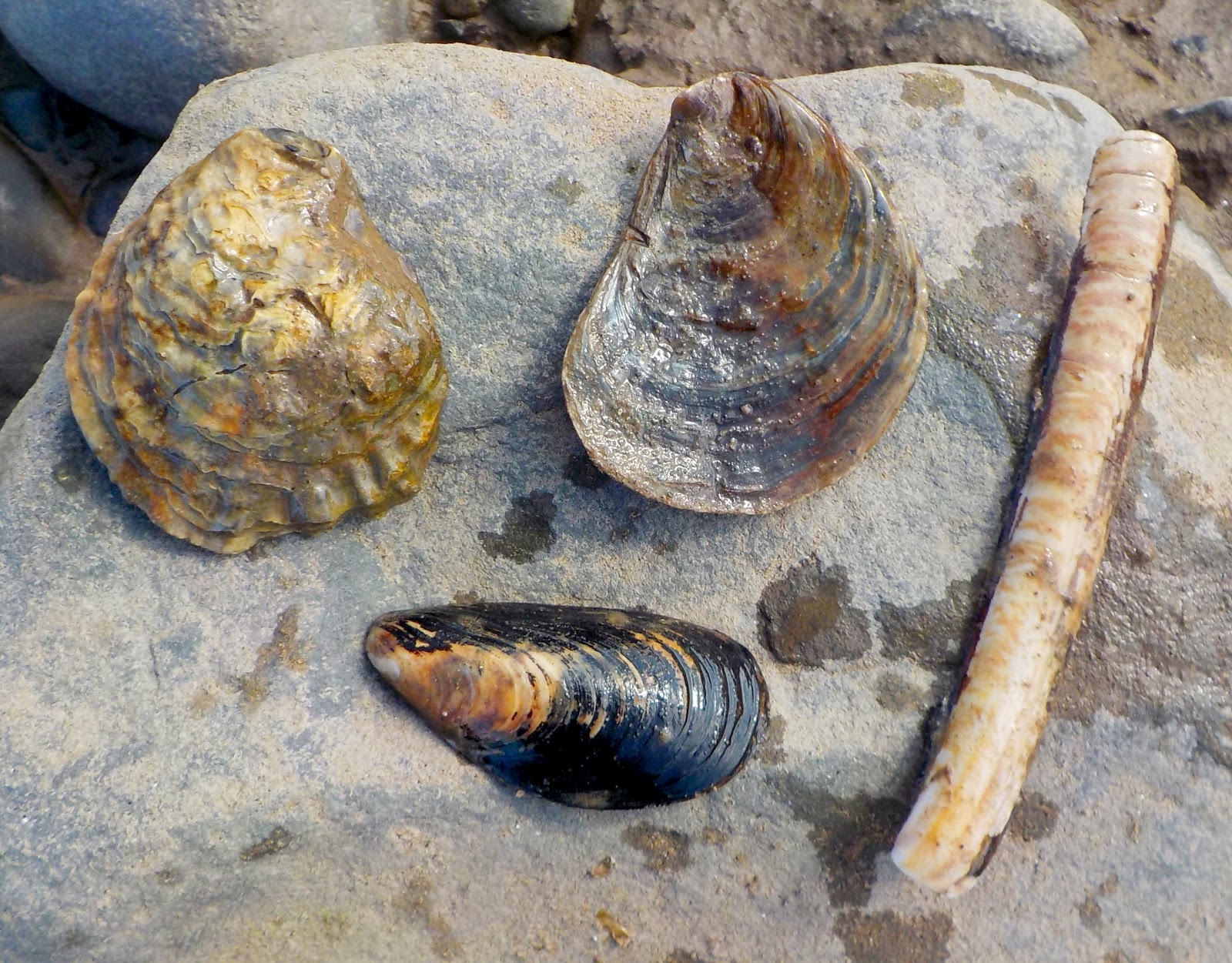
Coming down onto the shoreline and peering into the rock pools (or guddling in the local dialect) we find a treasure trove of shells of edible molluscs; oysters [top], mussels [bottom] and razor shells [right]. Unfortunately the original inhabitants of these shells are no longer present so no 'Allonby Chowder' recipe this week. It's a dish more suited to the depths of winter so, maybe on our next visit. And we must include smoked kippers! Around the turn of the 18th century, the village of Allonby was the centre of the local herring fishing industry, salting and packing the herring in barrels and kippering them in the smoke house.


From the remote geolical past, through more recent history, we come to the present. Out beyond the shoreline, where the oystercatchers, knots and dunlin probe the sands for their lunch, lies the Robin Rigg offshore wind farm. Sixty 260ft (80m) high towers with four 144ft (44m) blades apiece turning at an average 170 miles per hour produce enough electricity to power half the houses in Cumbria. There are concerns of course. You can't plant a forest of turbines in somewhere like the Solway Firth without shaking it up a little and the ecology is being carefully monitored. But, whichever way you look at it, it means a heck of a lot less fossil fuel has to be burnt to keep the lamps lit over half the county.


Crete Nature Catch-up

Steve's Books (well, just the one at the moment but 'The Quick Guide to Creepy-Crawlies' is well under way and should be available later in the year).)

Not Just For Twisted Women by Steve Daniels 
A light-hearted look at life through the eyes of the fairer sex.
Kindle Edition 1.99 pounds sterling (or equivalent).
Paperback Edition 4.99 pounds sterling (or equivalent)..
Read snippets, samples and stuff at Steve's Books


*********************************************************************
LINKS:
Share your nature thoughts, photos and comments on Naturalists (the facebook page that accompanies this blog)

Explore the region with the #CreteNature interactive Hiking and Nature Map


Wednesday, 24 January 2018

Pefki - Top of the Gorge

Last week we were walking down by the White River at Makry Gialos. If we had continued up the gorge this is the village at which we would have arrived. It is called Pefki (or Pefkoi) which means Pine Trees in Greek. The Pines to which the name relates are these, the Turkish Pine, Pinus brutia. Although native to the Eastern Mediterranean, particularly Turkey, you will also find them in Australia and New Zealand and the reason for this goes back a little over 100 years to the 25th April 1915. Aussies and Kiwis will recognise this immediately as Anzac day which commemorates the Gallipoli campaign where many Australian and New Zealand lives were lost. 

One of the major landmarks of the Gallipoli landings was a lone pine tree and in the aftermath of the campaign soldiers took cones from the battlefield and planted the seeds back home as living memorials to the fallen. Which is why you have Turkish Pines half a world away in Australia and New Zealand.


But to pleasanter thoughts – this is the track down into the gorge and immediately we have an old friend waiting for us on the path. This is the Red Admiral, Vanessa atalanta and it is one of two Vanessid butterflies that often accompany us on our walks in the winter. The other is the Painted Lady, Vanessa cardui and if you remember back to last year when we were coming down the Milonas Valley both species were flitting about all over the place. This winter I haven't seen a single Painted Lady. They are a migratory species that come over on the African winds but this year, not a sign of one as yet. Keep your eyes peeled.


I mentioned the Mandrake in passing last week and here, under this Carob tree is one of the most magnificent I've ever seen. Mandrakes are part of the Nightshade family, a somewhat diverse group of plants containing such poisonous personalities as Deadly Nightshade, Henbane and Thorn Apple as well as the table friendly Potato, Tomato, Aubergine (Eggplant) and Bell Pepper. Which begs the question; how can such diverse plants be grouped together in one family? Nowadays we are using genome sequencing to see who is related to whom but since the 19th century we have been using floral formulae and the formula for the Solanaceae family is this:


This tells us that they have bracts, are actinomorphic, hermaphrodite and more than anyone other than a dedicated botanist would want to know about the number and position of their sexual organs. Fundamentally, plants are grouped together on the basis of similarities in their anatomies which have evolved over time rather than on the basis of how they affect us. In practical terms it means that you can take any flower, determine its floral formula and work out to which family it belongs.


Whilst we're on the subject of flowers come and take a look at this Mediterranean Spurge a moment. Not the most pleasant smelling plant to us but irresistible to flies as you can see. We've long known that colour and smell attracts insects to plants and when the insect goes in for the nectar it gets coated in pollen grains. These are then transferred to the next plant it visits and thus it becomes pollinated. But not all plants are pollinated by insects, some are pollinated by birds, so how do you attract a bird and repel an insect (or vice versa)? Here's the trick. Plants have a gene that controls a protein which determines the shape of the cells on the petal surface. Turned on it produces conical cells which an insect can get a grip on, even in windy conditions; turned off and it produces flat cells that insects just slide off. This Spurge has gone one better. See how the surface is covered in tiny hairs which the flies are using to anchor themselves into position? Perfect target audience marketing – attract them in with the correct fragrance and make it simple to obtain the product. We could learn a thing or two here. After all, flowers have been in the selling game a lot longer than we have.

That's enough science for one day I think, let's just mosey on down the track awhile and enjoy the rural landscape. Most people, I suspect, miss this part of the gorge. They're either hurrying down to get to the spectacular rock walls below or thankful to have nearly reached the top if they're coming the other way. But this is really quite an idyllic rural stroll in itself with the gourds out drying in the sun and the chickens ambling about in the winter warmth. Crete, there's nowhere quite like it really.


The Extra Bit


We had rather a lot of plants this week but I've just one more to share with you as it's a type of Stonecrop (Sedum sediforme) which hasn't been recorded in this location before. 


*********************************************************************
LINKS:
Share your nature thoughts, photos and comments on Naturalists (the facebook page that accompanies this blog)

Explore the region with the #CreteNature interactive Hiking and Nature Map


Recent Posts