Showing posts with label geology. Show all posts

Thursday, 16 June 2022

Arran Special 4 - Up North


We're off up 't north today. Arran isn't a big island, only 20 miles by 9, but it is definitely an island of two halves. The highland boundary fault which separates mainland Scotland's highlands from its lowlands cracked Arran in two as well. It was a huge tectonic event called the Arcadian Orogeny that started about 375 million years ago and lasted for about 50 million years. This is a good point to introduce you to James Hutton, an 18th century Scottish geologist who worked out that the earth could not be 6,000 years old as The Bible suggests. Brilliant geologist but a hopeless writer, only about half a dozen people understood what he was on about when he published his theory of Uniformitarianism in 1788. For those of you Creationists out there, it is important to remember that God did not write The Bible, scholars did, and whilst God may be infallible and ineffable, scholars aren't.


Hutton spent some time here, developing his ideas, particularly at this point where we're stopping off. This is Glen Sannox and it's stunningly beautiful.


Here's a little fellow that's a bit of a late spring/early summer specialist, the common garden chafer. These beetles only live for about eight weeks. Live fast and die young is their motto.


Ey oop, what have we got flying above us? (Northern dialects have begun to creep in to me, but apparently haven't settled in Cumbria yet). Is it the second of Arran's Big 5, a Golden Eagle? Nah, wrong wing outline. It's a buzzard. Morning, Mr. Buzzard.


Here's a pretty little thing, it's a little geometer moth, a Common Heath. Their caterpillars feed on heather and clover so he's in the perfect spot here. You generally see them in May and June here in the UK but further south in Europe they have a second brood and you can find them as late as September.


Sorry, but this is short and sweet this morning. I'm still battling against covid but a bit of positive mental attitude should sort it. See you tomorrow.


Steve


Arran 1 – Arrival


Arran 2 – In Search of Seals


Arran 3 – The Queen's Secret Bolt Hole

Monday, 13 June 2022

Arran Special - 1. Arrival


The Isle of Arran lies off Scotland's west coast, nestling securely in the Firth of Clyde, and it's to be our home for the next six days. Described as 'Scotland in Miniature', it boasts a wealth of wildlife including Arran's big 5: Red Deer, Seals, Golden Eagles, Red Squirrels and Eurasian Otter. So, join Ishbel, Mattie and me as we pitch up on the island's south coast, at the encouragingly named Seal Shore Campsite, and we'll see how many of the big 5 we can find.


The ferry from Ardrossan on the mainland takes an hour and there are plenty of opportunities for a spot of bird watching from the top deck. As our sister ship steams past, with the islands of Padda and Ailsa Craig in the background, we have a couple of Greats: Black-backed Gull and Cormorant; Guillemots, both Common and Black as well as Common Gulls and Common Eider. And look! There's a Porpoise – he was there, honest.


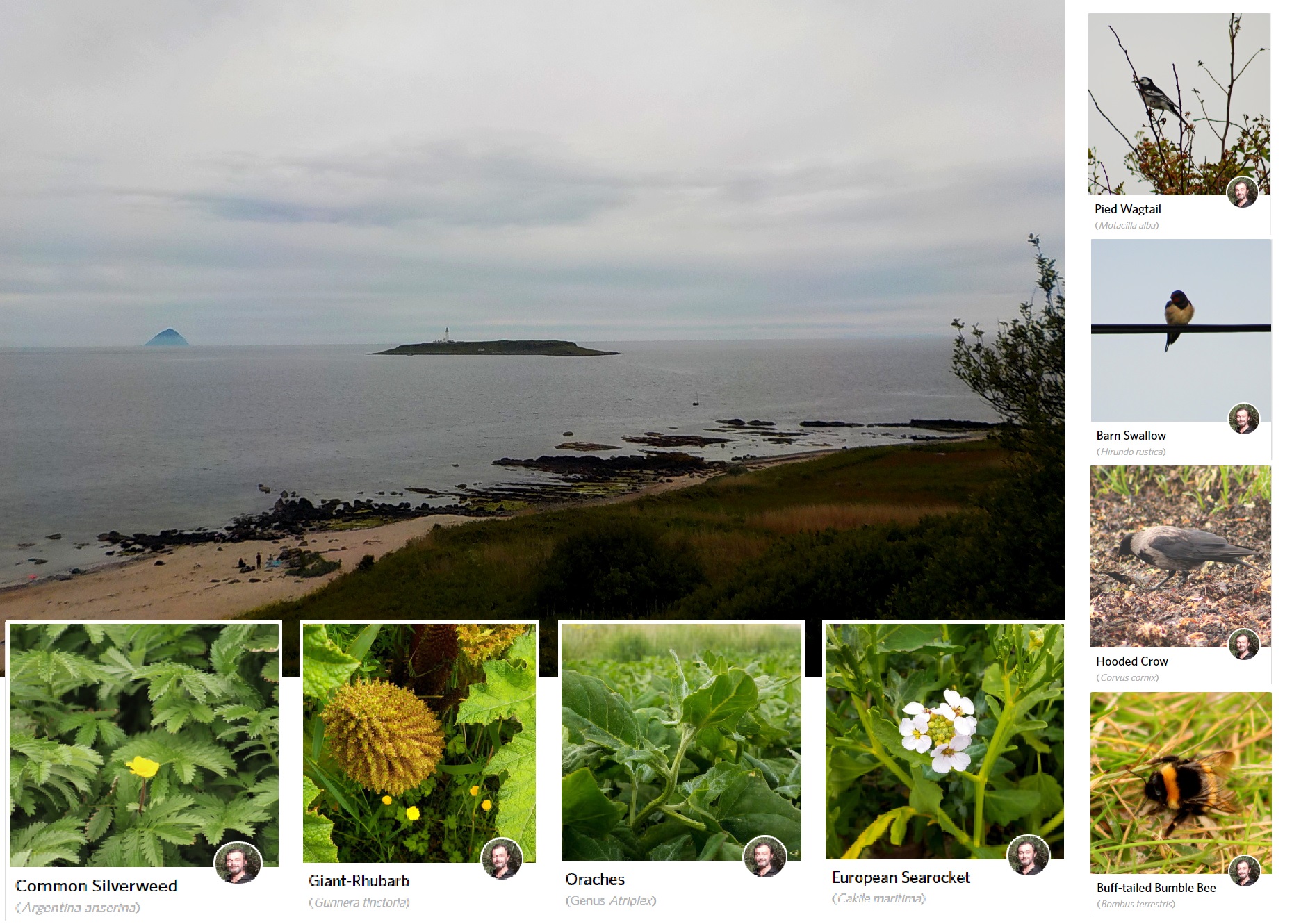
Here we are at the campsite and what a glorious view. There's a story behind those black rocks out there. Once upon a time, a very long time ago, about 200 million years ago in fact, the supercontinent of Pangea began to break apart. As the continental plate was stretched ever thinner, cracks began to appear, and boiling hot magma erupted, flaming, through the surface. These black rocks are the remains of that monumental event. The continents of North America and Eurasia were born here. That's a pretty awesome way to start a holiday. Maybe someone should put up a blue plaque or something.


The other good thing about this site is that it's on the Arran Coastal Way which encircles the island in a 65 mile (105km) loop. I don't propose that we attempt the whole lot tonight, but we could all do with stretching our legs after the long journey, so let's explore a bit of it. I make no claims to be a coastal botanist, but most of the shoreline seems to be bounded by Common Silverweed and some sort of Orache, interspersed with Giant Rhubarb (with stalks and leaves above head height) and Sea Rocket. There are a fair number of Bumble Bees about, doing the pollinating. Buff-tailed, by the looks of it, and the evening birds include Pied Wagtails, some Hooded Crows prodding about in the seaweed and a few Swallows pretending that it's summer. In truth, it's getting a bit chilly, so let us repair to the local hostelry, conveniently situated next door, and see what's on the menu.


If you're into camping this summer, here are a few things on offer that you may like:

Pair of Padded Chairs


Fire Pit and Gloves

Was £21.99 Now £15.79


Solar Charger

Was £19.99 Now £18.99


Pair of Padded Chairs

Was £79.99 Now £67.99


Until tomorrow,


All the best,


Steve


Arran Special 2 – In Search of Seals https://bit.ly/snb17-1-2

#nature #wildlife #birds #flora #insects #mammals #rockpooling


Follow me on Steve's Nature Plus


and also on


Steve's Nature


Steve Daniels Naturalists


Steve Daniels Cumbria


Wednesday, 11 May 2022

Here Be Volcanoes! - Eycott Hill

Eycott Hill Nature Reserve, Cumbria, UK


Here be volcanoes! OK, Cumbria may not be the first place that comes to mind when considering the volcanic hotspots of the world, but some 460 million years ago this place was on fire. This was the bed of The Iapetus Sea, which was being squished as continents drifted into one another, setting off volcanoes and lava flows all over the place. Between then and now, this has been land, sea and ice at one time or another and pretty well tilted as you can see from the information board provided by the Cumbria Wildlife Trust. These rocky hummocks are the bits of volcanic lava, still visible after all these years. And how do they know all this? Those neat holes in the rocks are not made by incredibly strong boring beetles, as you may imagine, but by the lesser spotted geologists, who have been taking, and studying, samples of the ancient lava.


The flora up here is pretty special too. There are twenty species of sedge and eighteen species of Sphagnum moss up here (I think I've identified these correctly, but please feel free to put me right). There are marsh violets and mountain pansies and the beautifully lace-like Parsley Fern.


As I said in this month's European Nature Almanack, May is a good month to look out for reptiles and amphibians becoming more active after months of hibernation. This little fellow is a newt. We have three species here in the UK: the Smooth, or Common Newt, the Palmate Newt and the Great Crested Newt. This one has a shallow crest running from neck to tail, and there is no webbing on the back feet, so I think that it's a Smooth Newt. To be absolutely certain I'd have to check that he has black spots on his throat, but I don't want to disturb him.


We have owls and small mammals too. We haven't actually seen any (these are two owls I made earlier, so to speak), but we do have evidence in the form of a regurgitated owl pellet. After half an hours prodding about, I've managed to extract 22 small mammal bones including leg, shoulder, vertebrae and occasional pieces of skull.


Now, it wouldn't be me if I didn't find a couple of insects to play with, and what a pair they are. The first beauty is an Emperor Moth, a grand name for a grand insect. This is one of about 2,300 species of large Saturnid moths, but the only one you'll find in the UK. They only live for about a fortnight as adults, because their only purpose is to mate. They cannot even eat, and have to rely on the food resources they built up as a caterpillar. The other fellow is a Dor Beetle. These are earth boring dung beetles who dig tunnels (up to 2 metres long in some species) beneath a pile of dung. This particular species is coprophagous, that is, it eats dung and provisions its nest with the same, but many Dor Beetles live on a diet of mouldy leaf litter. Can't say that either appeal to me particularly.


And now, a Special Offer for all you budding bug spotters out there. I have 25 signed, limited edition copies of The Quick Guide To Creepy-Crawlies to send out on a first come – first served basis. The standard version is £14.99 on Amazon + p&p but I'm offering you these signed, limited edition copies for only £12.00 + p&p.


Amazon price £14.99 plus p&p

Signed, Limited Edition Offer:

£12 + £1.50 p&p = £13.50

$14.75 + $4.25 p&p = $19.00


14 + €4.00 p&p = €18.00


Remember, there are only 25 and it's first come, first served!

All the best,


Steve


Follow me on Steve's Nature Plus and also on


 Steve's Nature


 Steve Daniels Naturalists


 Steve Daniels Cumbria


Wednesday, 24 July 2019

Grand Tour 2: Cumbrian Lakes and Seashore

Crummock Water, Cumbria, UK


Let me take you back 500 million years. Crummock Water, now one of fourteen beautiful lakes in The Lake District, was on the sea bed, a bed made up of sand and black, glutinous mud. Since then, that sediment has been squeezed, scunched and uplifted (and continues to be so) to form the fells that surround the lake, in this, the oldest part of the National Park. To the south of this are the eroded outcrops of hard lavas and ashes formed as a result of catastrophic volcanic eruptions 450 million years ago. It is here that you will find the highest peaks including Scafell Pike, England's highest at 3,209 feet (978m). To the south of this lies the gentler sedimentary rocks of southern Lakeland. These mudstones, sandstones, siltstones and limestones made up of billions of crushed seashells were formed upon the sea bed around 420 million years ago. The result is an area of truly outstanding natural beauty.

Let us take a walk around the woodland at the edge of the lake. It feels primaeval with its moss covered rocks and trees where red squirrels scamper around in the canopy and warblers and finches sing from unseen branches. Rows of bracket fungi adorn fallen branches and down by the water's edge bilberries are just starting to form. Look at the mosses more closely and you can see that the moss growing on the rocks (Thuidium sp.) and the moss climbing the trees (Hypnum sp.) are entirely different, occupying, as they do, completely separate ecological niches.


We'll track north now to Allonby Sands, a long, sandy beach on the edge of the Solway Firth. It is the middle of May and the Hawthorn bushes up on the dune ridge are just coming into flower. Floating all around them, long legs trailing, are the Hawthorn flies (Bibio marci). These harmless little insects (they don't bite) have a tendency to hatch in large numbers on or about the 25th April – the males sometimes about a week earlier – which is St. Mark's Day. This gives them their alternative name of St. Mark's Fly. Having completed their mating cycle many of them finish up on the surface of lakes, rivers and streams where they provide a seasonal bounty for the fish.

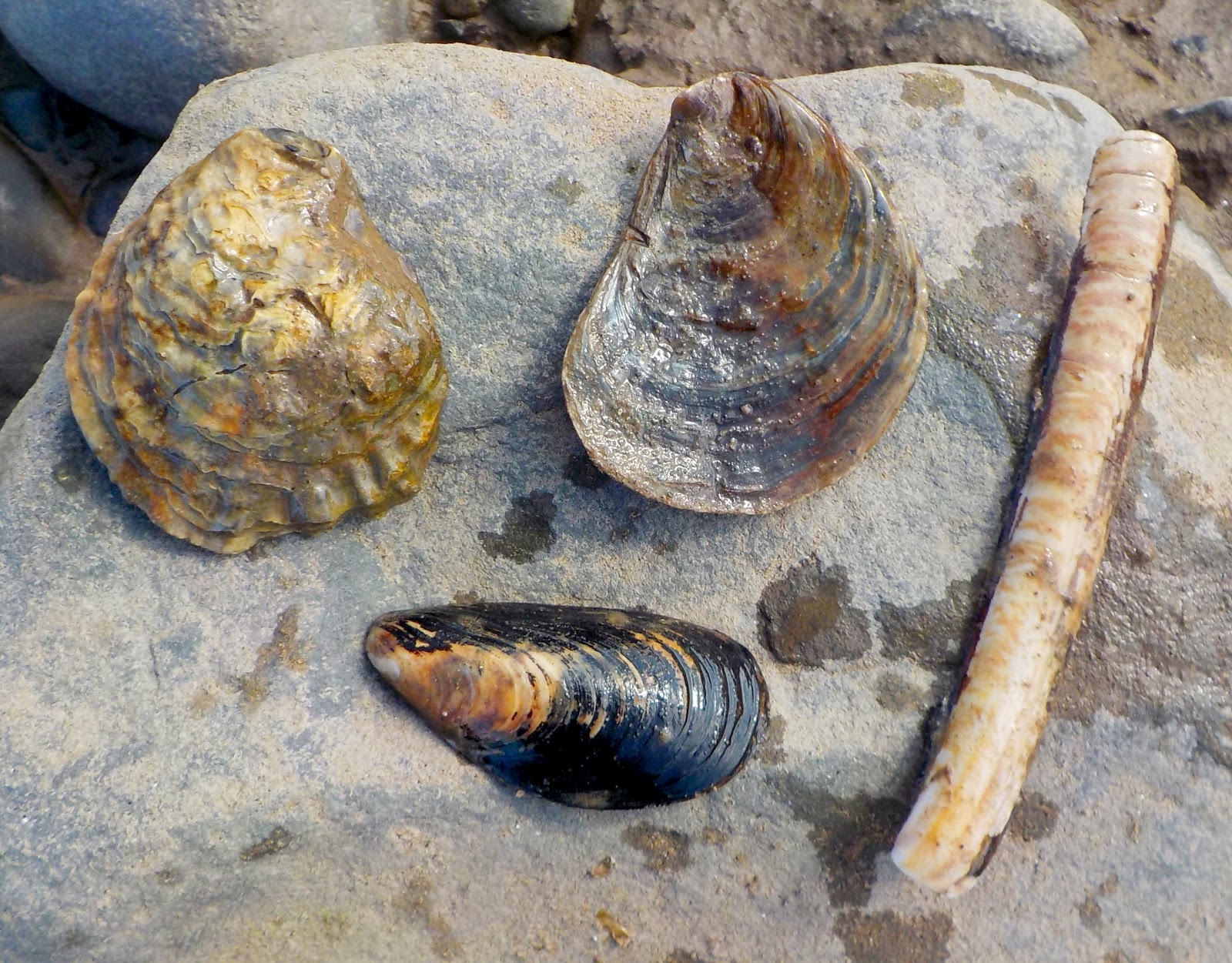
Coming down onto the shoreline and peering into the rock pools (or guddling in the local dialect) we find a treasure trove of shells of edible molluscs; oysters [top], mussels [bottom] and razor shells [right]. Unfortunately the original inhabitants of these shells are no longer present so no 'Allonby Chowder' recipe this week. It's a dish more suited to the depths of winter so, maybe on our next visit. And we must include smoked kippers! Around the turn of the 18th century, the village of Allonby was the centre of the local herring fishing industry, salting and packing the herring in barrels and kippering them in the smoke house.


From the remote geolical past, through more recent history, we come to the present. Out beyond the shoreline, where the oystercatchers, knots and dunlin probe the sands for their lunch, lies the Robin Rigg offshore wind farm. Sixty 260ft (80m) high towers with four 144ft (44m) blades apiece turning at an average 170 miles per hour produce enough electricity to power half the houses in Cumbria. There are concerns of course. You can't plant a forest of turbines in somewhere like the Solway Firth without shaking it up a little and the ecology is being carefully monitored. But, whichever way you look at it, it means a heck of a lot less fossil fuel has to be burnt to keep the lamps lit over half the county.


Crete Nature Catch-up

Steve's Books (well, just the one at the moment but 'The Quick Guide to Creepy-Crawlies' is well under way and should be available later in the year).)

Not Just For Twisted Women by Steve Daniels 
A light-hearted look at life through the eyes of the fairer sex.
Kindle Edition 1.99 pounds sterling (or equivalent).
Paperback Edition 4.99 pounds sterling (or equivalent)..
Read snippets, samples and stuff at Steve's Books


*********************************************************************
LINKS:
Share your nature thoughts, photos and comments on Naturalists (the facebook page that accompanies this blog)

Explore the region with the #CreteNature interactive Hiking and Nature Map


Sunday, 22 October 2017

Steve's Nature Quiz #21

Nature isn't just about flowers and animals, it's about the soil and rocks and everything else that allows them to exist. This week we met up with Gypsum but which city is most associated with this rock?

a) Beijing
b) Sao Paolo
c) Paris

Gypsum, Chrysopigi. east Crete
Gypsum is used to make plaster, as used in artistic molds, construction and most famously for plaster casts when setting broken bones. Although plaster was probably first made by the Egyptians for architectural purposes and then taken up by the Greeks (gypsum is Greek for plaster) a large deposit was discovered near Montmartre, Paris in the 1600s and calcined gypsum (which involves heating it to a very high temperature and then grinding it to a fine white powder) has been known as Plaster-of-Paris ever since.

For more fascinating insights into the natural world follow the #CreteNature blog 

Wednesday, 18 October 2017

Chrysopigi – Source of Gold

There's gold in them thar hills! (or so the saying goes) and the name of the next village on our route means just that. I can't promise you gold but there are plenty of blues and whites, the colours of Greece; from the light fluffy clouds in a forget-me-not sky to the small white and common blue butterflies that dance along the roadside verges. The former preferring the smelly Henbane whilst the latter opt for the more delicate European Heliotrope. But let us delve down between these two rock pillars and see what we can find in the hidden depths.


In a month or two's time there will be torrents of water rushing through here but now there are treasures to be found in the sylvan gloom (if you'll just stop looking for gold nuggets under the rocks a moment). These magnificent berries ripening from green to gold (found some!) to brilliant red are the fruits of Black Bryony (Dioscorea communis). Definitely not on the menu though as they are highly poisonous. It is a climbing plant and always entwines itself clockwise, following the sun. It's eerily quiet and still isn't it, but I just caught a movement out of the corner of my eye.


There look, it's just landed beside you. Despite its name, the Common Winter Damselfly (Sympecma fusca), I think it's a lovely little insect. They are unusual in that they are the only dragon/damselflies that overwinter as adults, according to the literature at any rate. Here in Crete I've seen Red-veined Darters in January but maybe they don't read the right field guides. I think that we've exhausted the possibilities of this habitat for the moment so let's continue on to the village which nestles at the base of the Ornos Mountains. As Ornos means mountain this is a bit of a tautology, much like naming a river Avon. Funny old thing, language.


I see that the swallows are still flying above the cliffs, way up in the sky and there are a couple of distant ravens about but what do you make of these white crumbly rocks amid the limestone greys? You can scratch them with your thumbnail. A look at the geological map shows a black square representing gypsum just about where we are standing and this is it. This is the stuff that plaster casts are made from and if you were to scramble up there – not wise as it's very crumbly – you'd very likely fall and break a leg. With a decent pen-knife and a bottle of water you could set your own fracture. An interesting example of nature providing the problem and solution in the same place.

If you look at the Google map you can clearly see the gypsum deposit but look at the wider picture of Mt. Ornos, it seems to be made up of concentric rings. I only know of two ways in which rings like this are formed; volcanoes and meteors. As far as I am aware Crete has never had a volcano of its own but I have found a reference to a significant meteor strike1 around 333AD and I wonder if this is the result? I'm no geologist so I could be wide of the mark but if anyone can shed some light on this I'm really intrigued.


Calliptamus barbarus
We haven't looked at grasshoppers yet this series, despite the fact that they've been bounding around our feet every time we move, so lets remedy that by getting up close and personal to old Tithonus here. You don't know Tithonus? Well, a very long time ago he was a mortal in love with Eos, the goddess of the dawn. The feeling being mutual Eos asked Zeus to make him immortal which he did... and Tithonus got older and older and older. Not exactly what Eos had planned but as Zeus pointed out to her “You never actually asked for the eternal youth bit, did you?” Eos left with a “Humph!' whilst Zeus chuckled away to himself for several hundred years and Tithonus withered away until little was left of him but his voice. Eos cared for him all this time but felt so sorry for him that she changed him into the insect that we now know as a grasshopper and he's been chirruping away, welcoming the dawn, ever since.

OK, so not biologically accurate but a nice little story to finish up with after all that geology.


The Extra Bit

1 The reference to the meteor strike can be found in the following paper https://www.knowledgeminer.eu/climate/pdf/hc6.pdf

Photographic Bit

Many of you have asked me what photographic equipment I use so here's a quick rundown on the cameras used for each picture. For details of aperture settings, shutter speeds etc. my pictures will be on Flickr within a few days and that has all the geeky stuff.

Picture 1 Nikon Coolpix S33
Insets Canon EOS 1300D
Picture 2 Nikon Coolpix S33
Insets Nikon Coolpix S33
Picture 3 Canon EOS 1300D
Insets
Picture 4 Nikon Coolpix S33
Insets 1. Map from Rackham, O. and Moody, J., The Making of the Cretan Landscape 2. Nikon Coolpix S33 3. Brunel SP-20 Light microscope 4. Google maps
Picture 5 Canon EOS 1300D
Insets
Extra Bit pictures

Pictures were edited with FastStone Image Viewer and combined with Microsoft Paint.

Wednesday, 25 February 2015

Over The Ridge

Route to the ridge


The sun is shining, the thermometer is reading twenty degrees Centigrade and there’s hardly a cloud in the sky. Down here in the south east of Crete we do have winter, complete with biting north winds and flurries of sleet and snow, but it usually only lasts for about a fortnight and that fortnight has now passed. If you look out from the terrace here you’ll see a faint track above the pink house. I’ve walked this many times but I’ve never gone ‘off road’ as it were and attempted to scale the ridge above it so, as we’re all feeling revitalised by the sun, I thought we’d take advantage of this Spring-like day and see what’s up there. We’ll drive up to the track (I’m not feeling that energetic) and hike off into the wilderness together.

(Clockwise) Storksbill, Groundsel, Henbit, Small White

This is a promising start. Not ten yards from the car and already we have a profusion of small flowers growing amid the grass and Wood-sorrel at the edge of the track. There’s Mallow-leaved Storksbill, Common Groundsel and Greater Henbit in this little patch alone and they’re all being fussed over by a Small White butterfly. Not having a good eye for size, I used to get confused by Small and Large Whites. Here’s the trick: Small Whites only have a black smudge at the corner of the wing; in the Large White that smudge extends at least half way down the edge of the wing. Females of both species have two black dots on the topside of the wing, the Small White Male has one dot and the Large White male has none. They all have two dots on the underside of the wing and this sometimes shows through as a faint smudge on the top side just to confuse the issue but this fellow here is most definitely a Small White male.
 
Phrygana
As we start our climb we are passing through a habitat known as phrygana, a limestone scrubland where the plants are well adapted to the ferocious summer sun. Many of them are dense, low growing and have spiny leaves so watch your legs. The stiff, twiggy branches also make great anchor plants for the Orb Weaver Spiders. These are the familiar spiral webs that trap insects which we discussed in The Incredible Shrinking Safari  last May. I said then that not all of the web is sticky but there was one thing I neglected to mention: the spider has a special third claw designed specifically for walking on the non sticky parts of the web so he doesn’t get caught in his own trap. Neat huh? Incidentally similar habitats around the world have different names such as garrigue and maquis and those of you of a certain age may have unwittingly come across another, chaparral, as immortalised in the 1960’s American TV series The High Chaparral.

A walk through the firs

Ah, the ground has levelled out a bit as we enter a stretch of pine woodland so let’s stop for a breather and listen to the birds. I can hear chaffinch (with his descending trill at the end), the rattling song of a Sardinian Warbler and the liquid warblings of blackbirds. How absolutely delightful. No, I won’t sit down thank you. To tell the truth when I was photographing the last orb weaver the loose stones slipped beneath me and I found myself reversing at some speed into a bush whose leaves must have been the original template for the hypodermic needle. Consequently my rear end now has more perforations than a Tetley tea bag. Such are the delights of wildlife photography. Oh look, a Speckled Wood butterfly making his way purposefully along the path. I think he must be a patroller. Male Speckled Woods mate as often as they can in their adult lives and have two distinctive mating techniques. Some, the territorials, will find an appealing sunny spot and defend it throughout the day, waiting for a female to fly by. Others, the patrollers, will fly through the trees actively searching out a female. The female, who only mates once, has the final choice of the type of male they prefer. Sounds familiar. OK, once more unto the ridge dear friends. What an amazing number of grasshoppers up here, mainly Red-winged but that was definitely a big Egyptian that just went whirring by like a clockwork flying machine. 

Summit Approach

Out of the trees and it looks as though we have a bit of a climb ahead of us. The plants are beginning to thin out now but here’s one on the phenology list. Just starting to come into flower: it’s Cretan Ebony. Between 2004 and 2010 I observed this flowering locally between February and April.  Since then I’ve seen it between March and June. True, it is late in the month and it’s hardly in full flower but a noteworthy sighting all the same.
“Are there any geologists in the group?” Correct me if I’m wrong but this grey lump, wedged in amongst the conglomerate, looks suspiciously like volcanic lava.  This is interesting because, as far as I know, Crete has never been a volcanic island. However, as I mentioned last week as we were following our nature trail around The National Archeological Museum in Athens, there was a massive volcanic eruption on the island of Thira (Santorini) about three and a half thousand years ago which had a devastating effect here on Crete. Could this have flown a hundred miles through the air all those years ago? [Answers in the comment box below please. SD].

View from the summit

Well, here we are at the summit and just look at that view. If you look at the horizon you can actually see the curvature of the Earth from up here. If you’re wondering what those white eyesores are dotted among the olive groves down there, they’re greenhouses covered in plastic sheeting. However, of late I’ve noticed that some of the newer greenhouses like those down there in the middle have utilised a far more harmonious green covering. I do hope this trend continues. We may as well have a poke about while we’re up here. Some lovely foliose lichen over there and my first rhinoceros beetle of the year, hello little fellow, one of the Pentadon species I believe. And here’s a bird to round the expedition off nicely, a Blue Rock Thrush. I only ever see them down here at this time of year and then, not often. Usually they’re much higher up but the winter must have driven him down. Talking of ‘down’, that is the direction in which we must now go. Watch out for loose stones and prickly bushes on the way back, certain tender portions of my anatomy are still smarting from my earlier encounter.

Until next week – happy hunting.

***********************************************************************************
LINKS:
Naturalists (the facebook page that accompanies this blog)


Recent Posts