Showing posts with label arachnids. Show all posts

Wednesday, 7 June 2023

England Coast Path - Flimby to Workington


Last week we walked the King Charles III England Coast Path from Maryport to Flimby. This week, I thought we'd continue along the path from Flimby to Workington. It's a beautiful sunny day for strolling by the Solway and everything is bursting into bloom. Eight new flowers this week including a few of my old favourites from my time in Crete, the Yellow-horned Poppy, Kidney Vetch and European Searocket.


The butterflies and moths are taking full advantage of nature's largesse. Look for the little yellow/green packets attached to grass stalks. These are the chrysalises of the Burnet Moth, a black day flying moth with red spots (not to be confused with the Cinnabar Moth which is a black day flying moth with red spots and stripes, like this one here). There's a Small Tortoiseshell over there. Their caterpillars feed on nettles but I haven't seen any this year, have you? We saw some Common Blues last week and today there are quite a few Small Blues about. They're unmistakably smaller and grey/black with white borders. Finally some Large Skippers. Skippers have a family all to themselves, the Hesperiidae.


The Lepidoptera are not the only ones taking advantage of the flowers, so are the bees. However the bee over there on the Bloody Cranesbill is an imposter. It's actually a hover fly doing a very good impression of a bumble bee. Flies only have one pair of wings, whereas all other winged insects have two pairs. This is not always easy to see, neither is the fact that flies have compound eyes and bees don't. I find that the easiest way to tell a bee from a fly mimic is to look at the antennae. All flies have very short antennae, whereas a bee's antennae are much more robust.


The path dips down onto the shore here, so let's see who's about in the bird world. A nice flight of Sanderlings for a start, and further out, a flight of Black-headed Gulls. Last week I introduced you to the Passerines, perching birds, including the Stonechats, Linnets and Starlings that we've just left behind us. This week, I'll introduce you to the Charadriiformes, or shorebirds. This group includes nearly all of the small to medium/large birds that you see around our coasts, including the Sanderlings and Gulls as well as the Ringed Plover and Dunlin that are pootling about in the shallows here.


One of the great bonuses of the Cumbrian section of the England Coast Path, is that the west coast railway line follows the same course. This means that we don't have to walk all the way back. We can hop on the train at Workington and admire the scenery from a different vantage point on our way back to Flimby. Meanwhile, there's a nice pile of rocks ahead where we can sit and rest awhile. We'll be sharing them with a number of mobile red dots, which, on closer inspection, are a group of mites (I think these are Whirligig mites). Although mites have eight legs, they are not spiders. On the whole, these are harmless little arachnids, although the Varroa Mite is the curse of beekeepers, and the Itch Mite (Sarcoptes scabiei var. hominis) is the little devil that transmits scabies. Rest assured, these are neither of them.


And so we reach Workington, where the River Derwent flows serenely down to the port. I must confess, being a southern softie, that the name 'Workington' always conjured up images of a gritty, industrial, northern town. Nothing could be further from the truth. The 'working' in Workington has nothing to do with labour. The name is mediaeval and means simply the town or settlement of Weorc or Wirc's people. As you can see, it's actually quite a beautiful place and there are even fish in the river. Some quite good sized Mullet down there, if you fancy a spot of fishing.

Steve's Vintage Collectables. (click to visit)

We've been busy on a buying spree this last week so look out for an eclectic collection of quirky items from vintage electric bed warmers, to novelty tea pots and a WW2 Aldis lamp. SVCwithEtsy is rapidly becoming one of Britain's best loved, on line, pre-loved gift shops, with over 100 items always in stock for every occasion. (And don't forget, it's Father's day a week on Sunday, so now is a good time to start looking).


Steve's Books (click to visit)


Or if you're looking for a book for Father's Day..


Follow me on Steve's Nature Plus and also on Twitter (@Steve's Nature), Facebook (Steve Daniels),and Instagram (Steve Daniels Cumbria)

Or why not join the 2.5k members of our Naturalists group?


All the best,


Steve


Wednesday, 10 June 2020

Life on the Littoral


One of the major ecotourist attractions on the south east coast of Crete is Red Butterfly Gorge which we visited back in February 2014. Much less visited, but still worthy of our attention, is the narrow strip of land opposite the gorge entrance, between the road and the sea. The sea shore, the cliffs and the cliff tops constitute a habitat called the littoral zone and today we are going to look for life on the littoral.

This is one of the hottest and driest areas on the island, the ground is stony and the vegetation is sparse; hardy pines, mastic bushes and thyme predominate but, here and there, sunshine yellow Fumana flowers burst through. It is also a favourite haunt of grasshoppers, such as this Calliptamus (he of the rear end pincers for use in mating) which we met in the Uplands in October 2016.


That isolated beach down there is where we want to get to next, and there would appear to be no obvious route. We did, however, cross a tiny gully a little while back, which would seem to be a good place to start. If you want to get to the sea; follow the water course. Some very spiny and scratchy plants on the way through but, not to worry, the blood will wash off in the sea and we have loads of rock pools to explore.

OK, so we burnt our feet on the sand, the rock pools were alternately razor sharp then smooth and slippery, and we only found a few Sea Slaters. Life’s like that sometimes. Thalassotherapy time - we’ll sit and watch the waves crashing in for a bit and then try further down the coast.

What a difference a few hundred yards makes. That, and the fact that the stream which flows through Butterfly Gorge reaches the sea at this point, means that there is a lot more going on here. We have some beautiful Silverleaf Nightshade, Solanum elaeagnifolium, and exploring the leaves, a Blister Beetle, Mylarbis kodymi. Interestingly, both the plant and the beetle can be poisonous to horses. I wonder if there’s a connection?


Moving on, and we have a marvellous spread of Globe Thistles, Echinops spinosissimus. These are really attracting the Hymenopterans this morning, in particular, Honey Bees, Apis melifera, and Mammoth Wasps Megascolia maculata. These are well named; worker bees are 10-15mm long, Mammoth Wasps are 4 to 6 times bigger at 60mm! I have read that they have a sting to match, but like most animals; ‘you leave them be and they’ll leave you be’, as my grandmother taught me.

Note: If you do get stung, the Hymenoptera page of The Quick Guide To Creepy-Crawlies has a medical treatment section. What do you mean, you haven’t bought a copy yet? Come along, come along, what else are you going to do with all that money you’ve saved over the last three months?


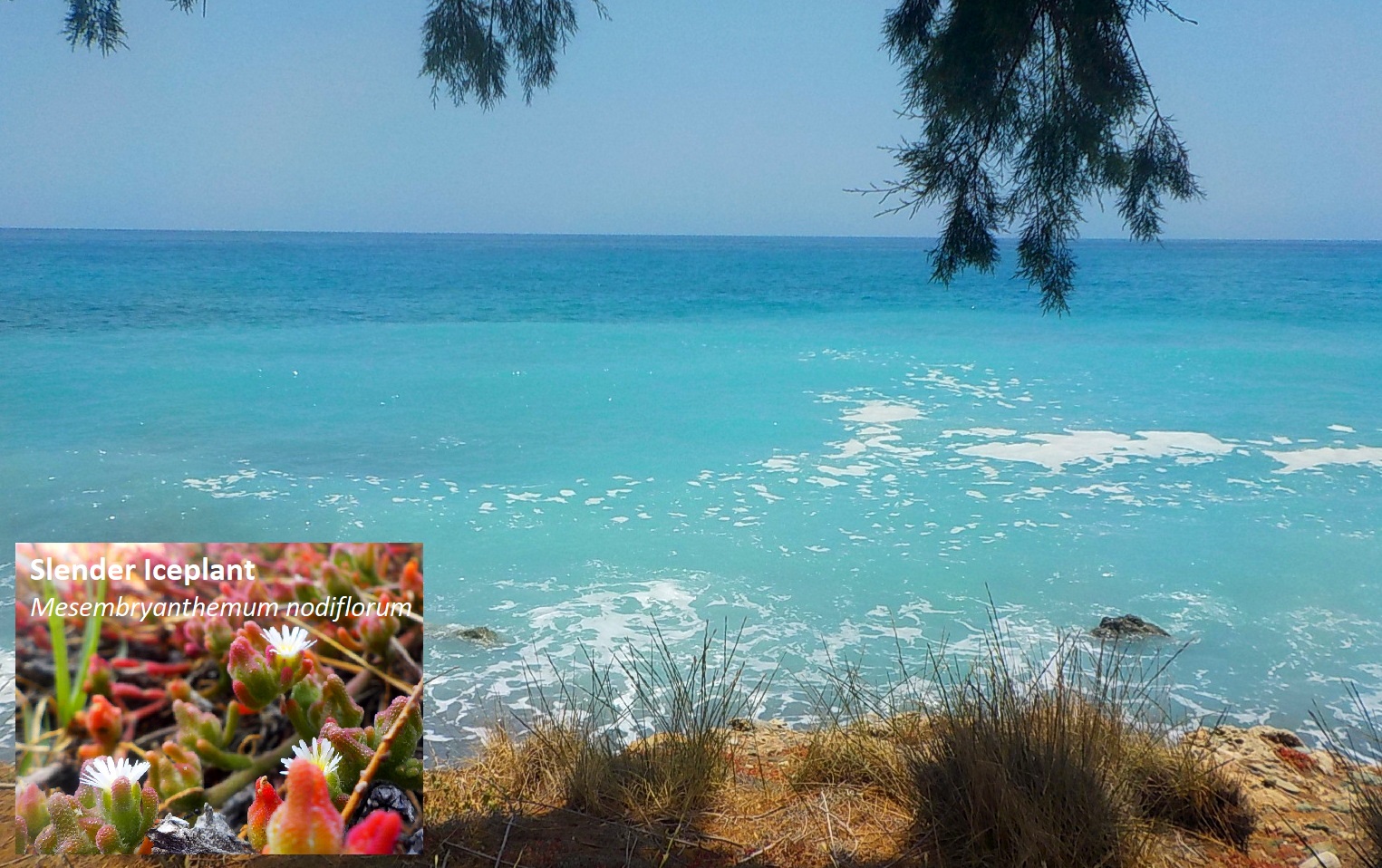
As it is now getting extremely hot, I suggest that we sit in the shade of this Tamarisk tree and explore the world at our feet. The most obvious thing is this mat of red foliage, giving the landscape a somewhat Martian appearance. It is the Slender Iceplant, Mesambryanthemum nodiflorum. Wikipedia declares this to be “native to Israel, Palestine, and Jordan, as also endemic to southern Africa.” This confuses me a bit because, to the best of my knowledge, a native plant exists naturally in the named areas (e.g. Israel, Palestine and Jordan) whereas, an endemic plant exists naturally only in the named area (e.g. southern Africa). By my logic a plant cannot be both endemic and native to different areas. Thoughts and clarification from any etymologically inclined botanists please. 

And on that little puzzler we’ll make our way back to the car as we have a lunchtime get together to attend in order to celebrate the re-opening of tavernas, post lockdown. Do not confuse the little bottles of hand sanitizer with the little bottles of raki.

And finally… I’ve had a lot of correspondence recently from people discovering giant spiders in their houses. I too, have had one as a house guest recently. They are Huntsman spiders, Eusparassus walckenaeri. Firstly, they are totally harmless to us humans so don’t throw your slipper at them. They are useful in the house because they eat insects and are particularly partial to the odd cockroach. If you have an inherent abhorrence of spiders this is a good one to get to know. It likes to live high up on walls and on the ceiling (so you always know where it is and it is not going to surprise you by suddenly appearing from under a cushion, or running across your feet). It is also large enough to be regarded as a small pet, like a mouse. Say hello and then leave it be, it will leave you be, in return.


See sample pages of all my books and latest blogs, and keep abreast of latest publications here:


All you need to know to identify any type of insect, spider, worm or snail very simply and find out more about it.
Yvonne: This was a gift for a family so that the children can understand what they see on days out. The second was for me. Logical and easy to use. If you know anyone who likes nature you can be confident that gifting this book will give years of pleasure.


The Eggs of Saramova
A science fiction novella for those who don't like science fiction. A fast-paced thriller that is, literally, out of this world (and it starts right here in Crete).
Too new for reviews yet!


A light-hearted look at life through the eyes of the fairer sex.
Janet: If you are short on time but enjoy reading and are maybe not into long extended novels then Not Just For... Twisted Women provides readers with concise stories that stand alone and most certainly entertain with their ultimate twists. Loved it.
Helen: A very good read! Well written and entertaining!
Margaret: Each quick tale gives a glimpse into a character's life and has an often humorous twist at the end. I would love to read more.
Yvonne: These days many people find it hard to find the time to read a novel, so this book of short stories is ideal to dip into. It is also makes a good gift.


Crete Nature Catch-up
*********************************************************************
LINKS:
Share your nature thoughts, photos and comments on Naturalists (the facebook page that accompanies this blog)

Explore the region with the #CreteNature interactive Hiking and Nature Map


Recent Posts