Showing posts with label #CumbriaNature. Show all posts

Wednesday, 17 May 2023

Buttermere and Crummock Water


Between Buttermere and Crummock Water, a small stream runs, by the name of Buttermere Dubs, which is where we are taking you this week. Dubs is a Scottish and northern English dialect word for pools of water, or puddles. There is a pleasant walk alongside where the ewes and the lambs lazily graze. With a cuckoo calling in the distance, we are being treated to a black and white birdie show, with Magpie, Pied Wagtail, a Grey Heron and even a White-throated Dipper exploring the banks of the stream. All very idyllic.


Passing through shady glades, more Spring flowers are beginning to appear. Sorrels, who's name means sour, and worts who's name comes from the Old English Wyrt, which simply means plant. Wort was often applied as a suffix to medicinal plants, with the prefix denoting the ailment it was supposed to cure. Thus Stitchworts would cure a stitch in your side and Dropworts may have been used to alleviate dropsy (or oedema, as it is now known). Pimpernel means peppery, but I wouldn't advise eating them as they are somewhat toxic.
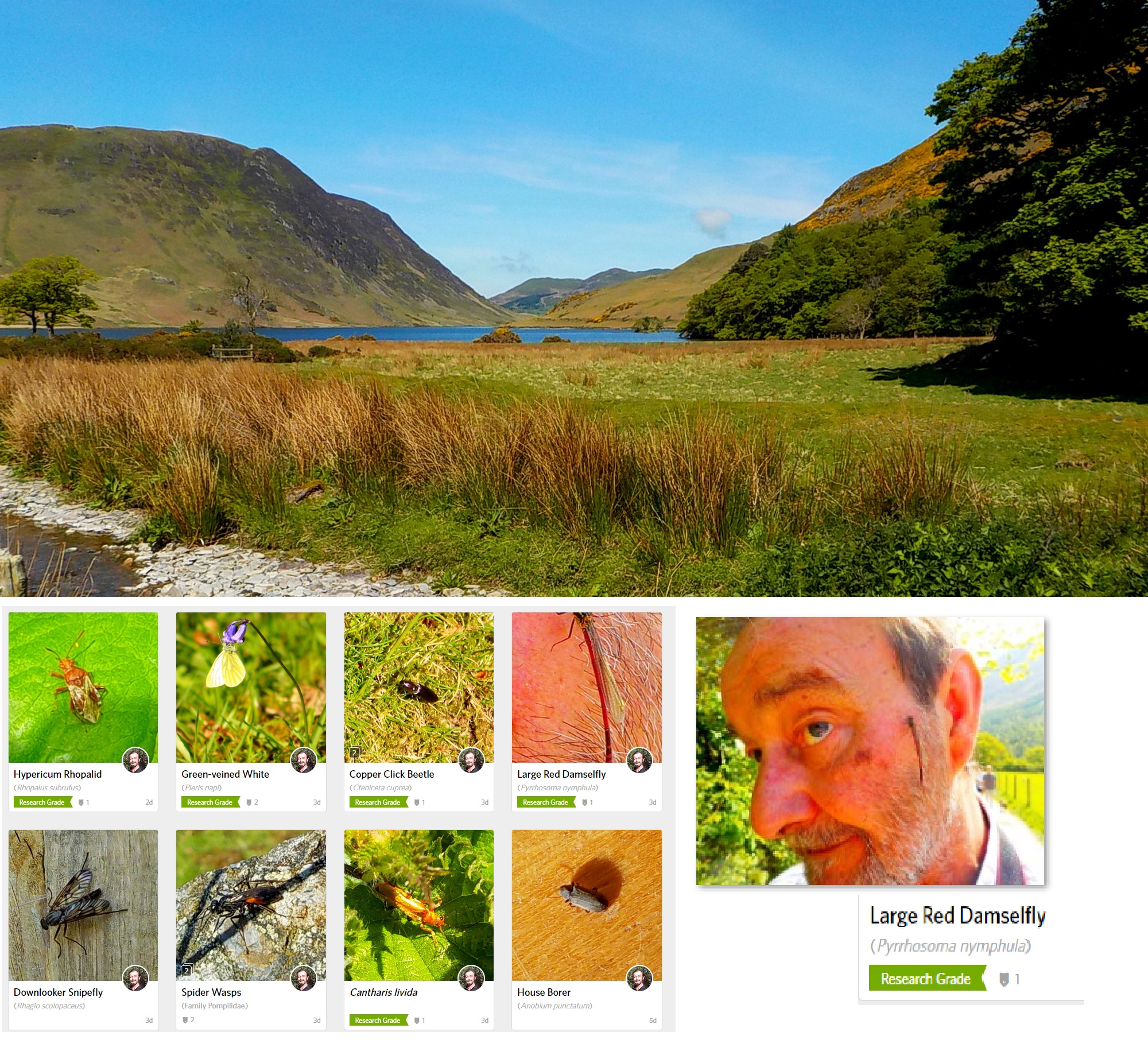


Insects are beginning to appear in greater numbers now. Usually, insects are relatively easy to photograph, but when they decide to sunbathe on your face, it can be a bit problematic! We also have our first True Bug of the year. True Bugs are a distinct order of insects, the Heteroptera (as opposed to the generic term bug that can apply to any creepy-crawly). This one is an Hypericum Rhopalid, so called because it is a member of the Rhopalidae family of scentless plant bugs, and it feeds primarily on Hypericums, or St. John's Wort. Here, the wort still identifies it as a medicinal plant, but it doesn't cure you of overbearing saintliness, it is merely that the flowers are traditionally collected around St. John's day on the 24th June. It is, in fact, a natural antidepressant, backed up by medical research.


We've now reached the edge of Crummock Water, so we'll turn back and make our way through the woods, back to Buttermere. Oh look, a Roe Deer. Given the general decline in British wildlife over the last century or so, it's nice to talk about a success story. In the early part of the twentieth century, Roe Deer were pretty much constrained to Scotland and up here in the Lake District. This population has spread south and east, and met up with reintroduced animals in the south of the country which have pushed northwards. They are still uncommon in Wales, but they're getting there.


And here we are, back at Buttermere, where the shallows are positively teeming with minnows. This shoaling behaviour is a defence mechanism against predation. They are only small fish so it pays them to forage in a group. If a predator approaches, some of the braver minnows will go to assess the danger and, providing they come back, will release a chemical which stimulates the shoal to bunch up. Basically it is a fear chemical, and individuals react by trying to get to the centre of the group. Safety in numbers. And now, it's time a spot of lunch. We have sandwiches, crisps, grapes and fizzy pop, but as my beloved has just pointed out, I seem to be a gateau short of a picnic.


Steve's Vintage Collectables. (click to visit)

I was originally going to specialise in old scientific instruments, but that proved to be a bit restrictive (and there was so much more interesting stuff out there). However, I chanced upon a few items at auction last week, and they make ideal Father's Day presents. Better for the planet than buying newly manufactured items. With over 100 items now in stock, at sensible prices, it's worth a look.


Steve's Books (click to visit)


Follow me on Steve's Nature Plus and also on Twitter (@Steve's Nature), Facebook (Steve Daniels),and Instagram (Steve Daniels Cumbria)

Or why not join the 2.5k members of our Naturalists group?


All the best,


Steve


Wednesday, 10 August 2022

The Tranquility of the Southern Lakes


Duddon Iron Furnace

Having enjoyed our trip to the south lakes last month, we decided to return to Moss Side Farm in order to explore the area a little more. A few miles from the farm stands this magnificent 18th century charcoal blast furnace from the days when iron ore was mined in the area. The motive power was a huge water wheel, sadly no longer in existence, the mill stream now almost dry and hosting a variety of wild plants including Lesser Burdock which I hadn't come across before. The carder bees were absolutely loving it. It's edible for us too, in its first year. The roots can be boiled, but you have to change the water after the first boil. Young stems can be eaten too, raw or cooked. Foraging is a useful hobby with the cost of living as it is at the moment. See Steve's Wild Kitchen for ideas and recipes.


Duddon Estuary

Last time out we went kayaking on the river Duddon. This time we decided to visit the Duddon estuary on foot, starting at Foxfield and working our way down to Askam-in-Furness (both of which are accessible by rail). A Little Egret flew overhead as the train crossed the bridge. I was used to seeing these birds in Crete, but as the climate warms, they have now migrated northwards and are resident in the UK. The banks of the estuary make perfect nest sites for Sand Martins, so let's stand and watch them for a bit as they bring food back to the nests. This must be their second brood as they generally have their first brood in May. I would think that this is quite far north for them to have two broods a year. Possibly the warming climate again.


Elter Water

After all that trekking about, a rest on the banks of Elter Water seems in order. This is one of the smaller bodies of water in the Lake District, lying between Coniston and Grasmere, and as navigation is prohibited, we can't get the kayak out onto it. However, it's a lovely day for just lazing about, admiring the scenery and watching the insects going about their business. More Carder Bees, this time pollinating the Knapweed; some Carpet Moths resting up in the long grass; and Blue Damselflies busy making more Blue Damselflies. Summer has arrived in Cumbria at last. Elter Water, incidentally, means Swan Lake, and Whooper swans regularly overwinter here.


Moss Side Farm

Meanwhile, back at the ranch (to use a phrase that originated as a stock subtitle in the days of the silent movies), we have an evening visitor in the form of a Goldcrest. Along with the Firecrest, this is Britain's smallest bird. Their thin beaks allow them to pluck insects from between pine needles and cones as this one is doing here. Down in the meadow below, the Barn Swallows are taking insects from the air. Something small, lithe and black has just scooted across the field and up over the dry stone wall. I think it was a Mink, but whether a native European or an American Mink, I wouldn't like to say. The American Mink was brought over in 1929 for the fur industry, but due to the misguided release of thousands of them by animal rights activists they have now run riot, much to the detriment of their European cousins and also water voles.


Hawkshead

Time to wend our way home again, but how about a stop for Sunday lunch in the pretty little village of Hawkshead? But first, Mattie needs a walk, and there's a pleasant circular route that will take us up into the fields and woods. It also passes through the churchyard of St Michael & All Angels, where William Wordsworth used to like to sit when he went to scool here. Unusually for a churchyard, there are information boards placed about with information regarding the windflowers to be found here. The delightfully named Fox and Cubs are showing well at present. Alternative names are Devil's Paintbrush (a tad inappropriate) and Grim-the-collier. The plant has a pelt of black hairs, reminiscent of the swarthy stubble of Grim the Collier of Croyden, a folklore villain and the title character of a 17th century play.


Thus ends another trip to the southern shores of Cumbria, but I doubt that it will be our last. Enjoy the summer weather, it's almost like being back in Crete again!


Steve's History of Things

In Association With

Steve's Vintage Collectables


Steve's History of Things 1


Introduction

Steve's History of Things 2


5 Good Reasons to Buy EPNS


Steve's History of Things 3


Fielding's Musical Tankards

Steves Hstory of Things 4


Jasperware

Steve's History of Things 5


Blood Pressure Monitors


All the best,

Steve


Click on the book to see inside

Beetles and Butterflies; spiders and scorpions; woodlice and worms. How do you tell them all apart? To say nothing of crane flies, dragonflies, bee flies and yet more butterflies. Are they all flies? If not, why call them so? If you're fascinated but confused by the beautiful world of the very small, then this is the book for you.


82 pages of information on all aspects of the world of minibeasts, with over 100 photographs and illustrations, this book will help you track down and identify any arthropod, in its adult or juvenile state, anywhere in the world.


UK Price only £14.99


See all of my books at author.to/SteveDaniels


Follow me on Steve's Nature Plus

and also on


Steve's Nature


Steve Daniels Naturalists


Steve Daniels Cumbria


Wednesday, 13 October 2021

Wythop Woods in Autumn


One of the great joys of Autumn is a walk in the woods. On a fine October morning, what can be better than to immerse yourself in the shades of yellow,red, brown and green and the earthy scent of a mixed woodland. Probe around in the moss at the base of a tree and you'll find a host of fascinating fungi. Last Autumn, when we visited Loweswater, I showed you the three main types of fungi that you are likely to come across, the Agarics, Boletes and Brackets. Wythop Woods, at the northern end of Bassenthwaite, has all three, but is particularly rich in Boletes. These tend to be large mushrooms with chunky stems and the underside of the cap is sponge-like as opposed to having gills like the agarics. None of them are deadly and some are really good to eat, so they are a good group to study. I only found Slippery Jacks and Dyeballs (Boletes have fabulous names) whilst I was living in Crete, so most of the British Boletes are new to me.


The Good, The Bad and The Edible


You're probably all familiar with these little pink flowers which grow in great profusion in temperate climes. This particular one is Herb-Robert, named after an 11th century French Abbot, herbalist and, post-mortem, saint. The majority of flowers in this family are either Cranesbills (Geranium) or Storksbills (Erodium) (Herb-Robert is a Cranesbill). The Geraniums in your garden are actually Pelargoniums (Pelargonium) which, although in the same family, naturally occur in warm temperate or tropical regions of the world.

Herb-Robert is not an edible plant but neither is it poisonous. The reason that it is inedible is that it doesn't taste very nice – not only to us, but also to rabbits and deer apparently. Gardeners have reported that allowing Herb-Robert to grow amongst their veg prevents rabbits and deer from munching on their prize exhibits. Mediaeval herbalists made many claims for its healing properties but modern research has discovered that the leaves can reduce blood sugar levels, so it may come into play in diabetes medications.


As we climb up through the trees we get tantalizing views of the lake below us. A few birds are flitting around, and I can hear a pair of ravens cronking above us, but the only bird that is sitting and posing for a photograph is our friend, the Robin (and I still swear that Ishbel keeps one in her pocket just to keep me happy when the other birds are playing hide-and-seek).


The lack of photogenic birds suddenly pales into insignificance as a Red Squirrel darts up a nearby pine tree. It's great to see one in its natural habitat as they've been driven out of much of England by the introduced Grey Squirrel. The map on the right shows their distribution as recorded by the British Mammals census of 2018.


And now... a bit of a moan about air pollution in Cumbria and a plea to those who are causing it – cyclists! We have some lovely routes around the county which are great for cycling, but they are rather narrow and twisting. Bicycles, in themselves, don't cause any pollution of course, but while you're cycling along, enjoying the scenery and chatting to your mate, the thirty or so cars crawling along at 15mph behind you are belching out exhaust fumes. So, please ride in single file and pull in to one of the many passing spaces to chat, admire the scenery and let the crocodile pass. Thanks.


All the best


Steve


PS There will be no blog for the next couple of weeks as we're off to Crete. See you when we get back.


I hate to remind you, but Christmas is coming. Books make great Christmas presents (and if you order now, you can read them before you wrap them!). The Quick Guide to Creepy-Crawlies, in particular, is ideal for children of all ages, giving them all the stuff they need to know about the world of minibeasts (and maybe giving them a new lifetime interest).


Steve's Books


Clicking on any title below will take you to the relevant Amazon page where you can read the first few pages, then click to buy if you so desire.


Chubby's Crematorium & Burger Bar

A book of humorous poems to cheer, amuse and entertain your friends with.


The Quick Guide to Creepy-Crawlies

All you need to know to identify any type of insect, spider, worm or snail very simply and find out more about it.

Yvonne: This was a gift for a family so that the children can understand what they see on days out. The second was for me. Logical and easy to use. If you know anyone who likes nature you can be confident that gifting this book will give years of pleasure.


The Eggs of Saramova

A science fiction novella for those who don't like science fiction. A fast-paced thriller that is, literally, out of this world (and it starts right here in Crete).

Too new for reviews yet!


Not Just For Twisted Women by Steve Daniels 

A light-hearted look at life through the eyes of the fairer sex.

Janet: If you are short on time but enjoy reading and are maybe not into long extended novels then Not Just For... Twisted Women provides readers with concise stories that stand alone and most certainly entertain with their ultimate twists. Loved it.

Helen: A very good read! Well written and entertaining!

Margaret: Each quick tale gives a glimpse into a character's life and has an often humorous twist at the end. I would love to read more.

Yvonne: These days many people find it hard to find the time to read a novel, so this book of short stories is ideal to dip into. It is also makes a good gift.


Wednesday, 6 October 2021

Berries, Birds, Bugs and Us


Last week, we were chugging down the Lancaster Canal and this week we're taking to the railways. To be more precise, the old Lowca Light Railway line which closed in 1973 and is now a lovely footpath. As you come out of the village you are greeted by a beautiful stand of White Poplars. These trees, with their distinctive two-tone leaves were sacred to Hercules in Roman mythology. Apparently he bound his arrows with a branch of White Poplar after he defeated Cacus, the fire breathing giant, son of Vulcan. Who knew?


The Good, The Bad and The Edible


Further along the track, there are trees and bushes bearing a profusion of red berries, all of which look very similar. The trick in telling them apart is to look at the surrounding leaves. The slightly elongated ones, top left, are Rose Hips. Top right are Hawthorn and bottom left are Rowan. Bottom right has me slightly foxed. It's part of the rose family of plants, quite possibly a Whitebeam, but I'm still checking it out. So, are they good, bad or edible? Medicinally, the Rose Hip is under investigation for its effects in reducing the pain of arthritis, whilst the Hawthorn has proved to be effective in reducing cardiovascular disease. The folk in the white coats are just working out the dosages. This also puts Hawthorn in the 'bad' category as an overdose can cause cardiac arrhythmia and seriously low blood pressure. All three are edible, mainly in the form of condiments – syrups and jams and so forth, as well as being used in wine making. The young leaves and buds of hawthorn (known as 'bread and cheese' in some parts), can be added to salads but are probably best avoided if you have a heart condition.


The berries are not only edible for us, but also for many birds, like this Starling. These beautiful, but often overlooked, birds generally prefer a diet of insects and other invertebrates, but as the insect life declines with the turning of the seasons, they are not averse to switching to these high energy berries. In return, the trees rely on the birds for expanding their range. The seeds within the berries, pass through the birds unharmed, to be dropped with a little package of fertilizer, far from the parent plant.


The seeds have to be fertile in the first place of course, which is where the insects come in. Before the tree can produce a fertile seed, its flowers need to be pollinated. I'm not sure if this Ruby Tiger Moth caterpillar will do any pollinating when it grows up, as many moths do not feed in the adult stage and hence, have no need to visit flowers. You'll often see these caterpillars, moving quite quickly across the path at this time of year, as well as the similarly hairy, black and red, Fox Moth caterpillars (see Fell Walking For Wimps 3).

Without the birds, the seeds don't get distributed; without the bugs, the flowers don't get pollinated. Berries, and other foodstuffs like fruit, veg and cereals don't grow and we starve. Which is why people like me are always honking on about protecting biodiversity. Self interest, when you think about it!


News From The Old Corn Mill


I haven't mentioned the river lately: it has been very low over the summer (quite easily fordable in places), but now that the autumn rains have started it is filling quite quickly. We still have our usual multitude of Mallards and Harry and Sally, the Grey Herons have produced a youngster whom we've named Connick (as in Harry Jnr.). There was a new member to the cast this morning; as I was eating my breakfast a Red Squirrel scampered past the iron railings in the foreground. By the time I got out there with my camera (less than a minute) he'd disappeared. Also, my bacon and eggs had gone cold by the time I came back.


Just a quick reminder, with Christmas looming, there is a selection of books below that make great presents. My latest, Chubby's Crematorium & Burger Bar, would be perfect for a Secret Santa gift. 23 laugh-your-socks-off ditties covering all stages of life from childhood to old age.


Until next week,


All the best


Steve


Steve's Books


Chubby's Crematorium & Burger Bar

A book of humorous poems to cheer, amuse and entertain your friends with.


£4.99 Paperback

The Quick Guide to Creepy-Crawlies

All you need to know to identify any type of insect, spider, worm or snail very simply and find out more about it.

Yvonne: This was a gift for a family so that the children can understand what they see on days out. The second was for me. Logical and easy to use. If you know anyone who likes nature you can be confident that gifting this book will give years of pleasure.


£14.99 Paperback

The Eggs of Saramova

A science fiction novella for those who don't like science fiction. A fast-paced thriller that is, literally, out of this world (and it starts right here in Crete).


£7.50 Paperback

£1.99 Kindle

Not Just For Twisted Women by Steve Daniels 

A light-hearted look at life through the eyes of the fairer sex.

Janet: If you are short on time but enjoy reading and are maybe not into long extended novels then Not Just For... Twisted Women provides readers with concise stories that stand alone and most certainly entertain with their ultimate twists. Loved it.

Helen: A very good read! Well written and entertaining!

Margaret: Each quick tale gives a glimpse into a character's life and has an often humorous twist at the end. I would love to read more.

Yvonne: These days many people find it hard to find the time to read a novel, so this book of short stories is ideal to dip into. It is also makes a good gift.


£4.99 Paperback

£1.99 Kindle


See sample pages of all my books and latest blogs, and keep abreast of latest publications here:

http://author.to/SteveDaniels


Wednesday, 29 September 2021

The Art of Slowing Down


Autumn is the season when nature slows down. Flowers set seed and leaves turn brown. Our bodies also react to the seasonal rhythms of shorter days and longer nights (even if our minds often don't). So, slow down with Ishbel, Jack the Navigator Hound, and I, as we take a leisurely trip along the Lancaster Canal. Drifting along at a sedate four miles per hour, a family of Mute Swans, like the Moorhens, Mallards and a young Grey Heron, are totally undisturbed by our presence. Peter and Ian take it in turns to pilot The Waterwitch and tell us the story of the canal which, at one time, was used to transport gunpowder from the nearby mills.


After an hour's pleasant meanderings, we disembark and a local guide, David, takes us on a walk along the next part of the canal to be restored. As David details the massive obstacles to be overcome, I get sidetracked by the plethora of insect life in the rampant undergrowth. A Noon Fly sunbathing on a leaf, a pair of Nettle-tap moths (their caterpillars feed on nettles) pollinating an Ox-eye Daisy and a Common Darter Dragonfly patrolling one of the larger pools.


Minibeasts tend to get scarcer as the season wears on but you don't have to look very far for them. I have quite a collection of aphids and midges in odd corners of the mill, which are kept in check by spiders such as this Lace-web. The only trouble is, as their name suggests, they make lacy webs, which are pretty unsightly, especially when dotted with odd bits of insect such as wings, legs and other items of exoskeleton. Not wishing to rename the Old Corn Mill 'Cobweb Cottage' I gave them all the old heave-ho a few days ago and removed the webs and spiders. I now have more happy midges than I can shake a stick at. Come back spiders, all is forgiven!


The Good, The Bad and the Edible


Walking back along the towpath for the return journey, the ivy is coming into flower. This is a plant of immense importance to our declining insect population (so please don't cut it back while it's flowering). Because it flowers so late in the year, it provides a lifeline of nectar.  It is, however, mildly poisonous and comes under the inedible category. That having been said, our ancestors used to chew the leaves as an expectorant.  They obviously knew a thing or two as nowadays extracts of Ivy are incorporated into modern cough medicines. 


On a definitely consumable note, Elderberries are now in season and, here at the Old Corn Mill, I shall be spending a pleasant afternoon in the kitchen making elderberry wine.


Until next week


All the best,


Steve


Steve's Books


Chubby's Crematorium & Burger Bar

A book of humorous poems to cheer, amuse and entertain your friends with.


The Quick Guide to Creepy-Crawlies

All you need to know to identify any type of insect, spider, worm or snail very simply and find out more about it.

Yvonne: This was a gift for a family so that the children can understand what they see on days out. The second was for me. Logical and easy to use. If you know anyone who likes nature you can be confident that gifting this book will give years of pleasure.


The Eggs of Saramova

A science fiction novella for those who don't like science fiction. A fast-paced thriller that is, literally, out of this world (and it starts right here in Crete).

Too new for reviews yet!


Not Just For Twisted Women by Steve Daniels 

A light-hearted look at life through the eyes of the fairer sex.

Janet: If you are short on time but enjoy reading and are maybe not into long extended novels then Not Just For... Twisted Women provides readers with concise stories that stand alone and most certainly entertain with their ultimate twists. Loved it.

Helen: A very good read! Well written and entertaining!

Margaret: Each quick tale gives a glimpse into a character's life and has an often humorous twist at the end. I would love to read more.

Yvonne: These days many people find it hard to find the time to read a novel, so this book of short stories is ideal to dip into. It is also makes a good gift.


Recent Posts