Showing posts with label lepidoptera. Show all posts

Wednesday, 28 June 2023

Rivers, Lakes, and Tarns


Firstly, let me wish you all a happy summer. The solstice passed last week, so where better to start our journey than at a stone circle. No-one has come up with a definitive reason as to why these were built, but solstices and equinoxes figure in most theories. 

Cumbria is particularly rich in these megalithic monuments, with over fifty of them. This is probably a numbers game: given Cumbria's climate, there's a reasonable chance that an errant shaft of sunlight will fall upon at least one of them on Midsummer's Day. This one is Blakely Raise, near Ennerdale, which is where we're off to next. It's pretty well windswept moorland up here, but there are odd patches of Cotton Grass dotted about. It's quite a useful little plant of the sedge family, having been used for candle wicks, paper making, wound dressings, and pillow stuffing. The leaves and roots are edible, and it has been used medicinally for the treatment of gastrointestinal disorders. It is also the county flower of Greater Manchester. The last two facts are probably unconnected.


Meanwhile, over at Ennerdale, the Lepidoptera are out in force. Meadow Browns are two a penny, and the Burnet Moths are hatching in great abundance. Unfortunately, the Cleg Flies are also pretty numerous. Although attractive to look at (as flies go), they have a vicious bite. It is only the females that bite; they need a blood meal in order to reproduce (and who would begrudge them that?).


Let's head south now to Devoke Water. Although the Lake District is famous for its sixteen lakes, there are also nearly two hundred smaller bodies of water; the tarns. This is the largest of them and it is magnificently remote. Buzzards wheel in the sky overhead, Swallows skim the water, and the occasional Northern Wheatear stands guard. In the drystone walls that line the lane, Pied wagtails and Wrens are nesting and escort us down the road, politely asking us to be on our way. The shallow puddles around the edge of the tarn are a great place for dragonflies, a true harbinger of long, hot summer days.


Heading north via the village of Ulpha, we run alongside the upper reaches of the River Duddon (the estuary of which, we visited last summer). A lovely spot to stop and have a picnic. There are minnows in the shallows, and a Grey Wagtail flitting about. Growing on a rock, down in the rapids is a lonely little Selfheal. A nice little pot herb that can be eaten raw or boiled, it's name derives from its use in traditional medicine. Good for cuts, scratches and boils apparently.


And finally... some news from the Old Corn Mill. We have a new young Heron on the block, possibly the offspring of Harry and Sally. One of the Mallards has had five ducklings, and she's sharing our neck of the Derwent with a Goosander and her brood of four. It's a veritable avian soap opera outside my front door.

Steve's Vintage Collectables. (click to visit)

I've just opened a new section in the shop this week: Terrific Toys & Games. Pretty self indulgent really, as I love old board games. Pop in and take a look.


Steve's Books (click to visit)


Keep an eye out for me at Wordsworth House on Saturday lunchtime. Poets Out Loud are part of Cockermouth Live and I may even give you a blast of comic poetry from Chubby's Crematorium and Burger Bar.


Follow me on Steve's Nature Plus and also on Twitter (@Steve's Nature), Facebook (Steve Daniels),and Instagram (Steve Daniels Cumbria)

Or why not join the 2.5k members of our Naturalists group?


All the best,


Steve


Monday, 4 April 2022

Minibeast Monday - Butterflies


One of the great delights of the Spring is the emergence of the butterflies. A moving kaleidoscope of colour amongst the freshly blooming flowers. Down around the Mediterranean you can find Plain Tigers and Swallowtails as well as a host of others. 


This is a gallery of the species that I observed in Crete over the many years that I spent there.


Up here in Cumbria, they are beginning to appear too. Some of them have overwintered, like the slightly battered looking peacock, but some have newly hatched, like these Small Tortoiseshells which are already courting. #courtship is one of the themes in this month's European Nature Almanack so I'd love to see your pictures.


Look out also for caterpillars. You will often find them on specific food plants. Swallowtails, for instance, simply adore fennel, whereas Small Tortoiseshells prefer a diet of stinging nettles.

If butterflies are your thing then here are a couple of books that you may like to take a look at, and an item that no entomologist should be without: a sweep net!  Butterflies and moths are also featured in The Quick Guide To Creepy-Crawlies on pages 40-41.


All of the books featured on my posts are now available to view, by category, on one page: Build Your Own Nature Library


All the best,


Steve


Follow me on Steve's Nature Plus


and also on


Steve's Nature


Steve Daniels Naturalists


Steve Daniels Cumbria


Monday, 21 February 2022

Minibeast Monday - Chrysalis


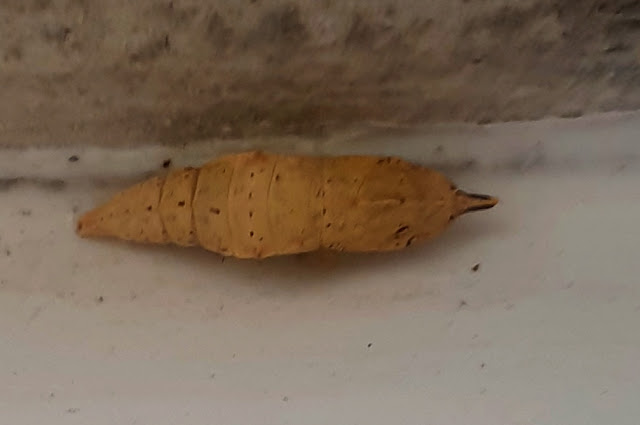
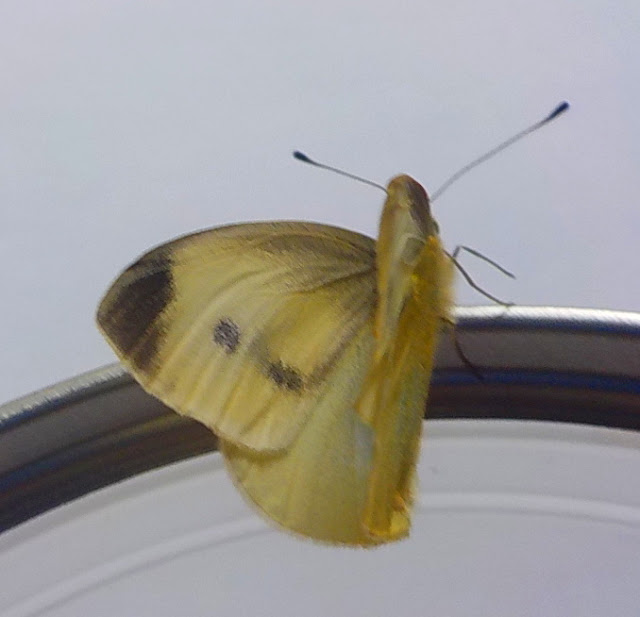
As the insects are beginning to appear up here in Cumbria, I thought it was about time to bring back Minibeast Monday. You may remember this fellow from the beginning of last month. I said it was the chrysalis of one of the Whites & Sulphurs butterflies (Pieridae family), but we should have to wait until it hatches to see which one. It has now hatched.


I have to admit, I'm not 100% sure whether it's a Large White (Pieris brassicae) or a Small White (Pieris rapae).The way to tell the difference is by the amount of black at the wing edges. This appears to have quite a lot of black for a Small White, but not quite enough for a Large White. I suspect, from its size, that it is a Small White. The only thing I can tell for sure is that it is a female. Both the Small and Large White females have two dots on their wings.


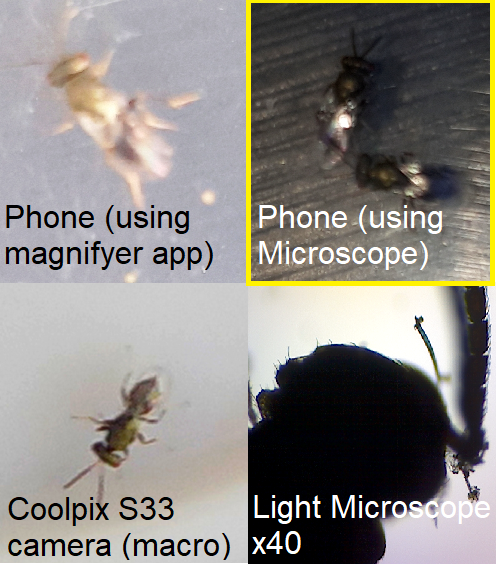
I also promised you last month that I would let you know how I got on with the Xinchia microscope attachment for my phone, and this little hatchling gave me a chance to do just that, because she was not alone. I'm still finding it a bit fiddly (but that's probably just me) but it does do the job, and for £7.99, it doesn't break the bank. (Click on the image above for more details). Anyhow, you can see for yourselves by looking at the pictures below:


When I went to release her, I found her container full of these little insects. They are Chalcidoid Wasps which lay their eggs in the larvae of other insects. The genus Brachymeria, in particular, have a fondness for laying their eggs in the chrysalises of butterflies and moths including the Small and Large Whites.

The top two pictures are from my phone. The first, using a free magnifier app, the second, bordered in yellow, using the Xinchia microscope attachment. As you can see, the resolution is much better. For comparison, the bottom two pictures were taken on my Nikon Coolpix, using the macro setting and finally under the light microscope in my lab.


And finally.... as the minibeasts are beginning to creep and crawl out of their hiding places, it's a good time to arm yourself with a book that tells you what everything is. There are dozens of different groups of creepy-crawly, ranging from Alderflies (which are not flies at all) to Woodlice. And many of them look very different in their juvenile and adult forms. Identifying anything is impossible until you know to which group it belongs. The Quick Guide to Creepy-Crawlies guides you through the simple steps to identification with easy to use keys, and tells you a bit about each group. It isn't cheap at £14.99, but with over one hundred colour photographs plus numerous illustrations, it's your complete guide to everyhting that creeps and crawls, wherever you are in the world. Click on the cover to look inside.

That's all for now. Despite storms Dudley, Eunice and Franklin, the River derwent is still behaving itself and The Old Corn Mill remains high and dry. See you later in the week,

Steve

Wednesday, 24 March 2021

Series 14 Springtime in Cumbria


Welcome to a new series of The Crete and Cumbria Nature Blog. Still in Cumbria, thanks to the necessary travel restrictions still in place, but I'm not complaining. Cumbria is a wonderful place to spend the Springtime. So, let's celebrate by looking out for the first signs of Spring, such as newborn lambs, primroses bursting through last years fallen leaves, trees and woody shrubs budding and flowering, and insects pollinating the plants as their blooms burst forth.


Continuing our railway theme from last week's imaginary trip on The Cockermouth Circle Line, our journey today starts at Keswick station and follows the old railway line towards Threlkeld. The line, which used to link Penrith to Cockermouth, was axed in the Beeching cuts of the 1960s, and is now a tarmacadamed walk/cycle track suitable for wheelchair users. Just listen to Spring beginning around the station with this symphony of birdsong.


The River Greta (which means stony stream in Old Norse) will be our constant companion on this walk, as it zigzags back and forth across our trail. There's a Woodpigeon down there, collecting sticks for what he laughingly thinks of as a nest. Whereas some birds construct intricate structures of grass, moss, wool and other materials, pigeons just seem to launch twigs at a tree and see what sticks. How their eggs and chicks remain aloft is one of nature's great mysteries.


There are ponds along the side of the trail, with Marsh Marigolds bursting forth. These are predominantly insect pollinated and have an unusual method of seed dispersal. When the seeds have matured they are surrounded by a 'splash cup'. When a raindrop hits the splash cup the seeds are bouced out. They are also surrounded by a spongy lifejacket so they simply float away from the parent plant. Like their relatives, the Lesser Celandine, which we have been seeing a lot of in recent weeks, their leaves are edible when cooked but poisonous when raw. (see Longlands Lake). And clumped together on the bottom of the pond we have frogspawn. You can tell that it's frogspawn and not toadspawn because of the way it clumps together; toads lay their spawn in long strings.


You'll have noticed that all the bridges, the tunnel and much of the infrastructure on this trail are brand new. In 2015, Storm Desmond produced such a torrent of water that all the old railway bridges were destroyed. Seeing the river so calm and peaceful today, it's hard to imagine the scale of the flood that could have wreaked such havoc. It took five years to repair the damage and the trail was only reopened at the end of last year. I've included a few pictures of fungi and lichens, not because they are signs of Spring, for they are with us all the year round. I just didn't want them to feel left out.


We also have caterpillars crawling about and this one features in my new series on
Steve's Nature Plus called Minibeast Monday in which I tell you a little bit more about the insects and other creepy-crawlies that appear in my blog posts. Much of the information is taken from The Quick Guide To Creepy-Crawlies which tells you who is related to whom, how to identify them in their various stages of life, and plenty of other interesting facts (like whether they are likely to bite or sting you). Everyone tells me that it's a very interesting and informative book but modesty precludes me from agreeing with them wholeheartedly. I still refer to it when I come across something I've never seen before.


I'll leave you with this beautiful picture of the River Greta flowing through the Lakeland pastures with a little Grey Wagtail bobbing around on the boulders. See you through the week on Steve's Nature Plus.


Happy Springtime,


Steve

LINKS:

Steve's Nature Plus Join me at The Old Cornmill and follow me throughout the week for all the news that doesn't fit into the blog.

Share your nature thoughts, photos and comments on Naturalists (the facebook page that accompanies this blog)


Wednesday, 26 August 2020

Fell Walking For Wimps 1 - Slate Fell


Twenty years or so ago, if I saw a hill, I felt an irresistible urge to climb it. Now, older and wiser, I have come to realise that majestic mountains and fabulous fells look at their most majestic and fabulous when they’re towering above you. True, when you get to the top, the views can be breathtaking, but these days, by the time I get to the top, I’ve not got a lot of breath left to take. Which is why I’ve decided to introduce the idea of Fell Walking For Wimps. No-one else appears to have bagged the title yet, so I’m having it.

Our little walk today takes us up over Slate Fell, to the East of Cockermouth, then back round to where we started, in a five mile triangle. Unlike Scafell Pike, England’s highest mountain (also in Cumbria), which rises to a little over 3,200 feet, Slate Fell is a far more modest 520 feet, and as we are starting at 220 feet then we are merely going to be strolling up hill at the start.

About three quarters of the way up now, and this little bank looks worthy of closer investigation. Let’s sit and take a closer look at it. No, it is not just an excuse for a rest. I’m still fighting fit. Starting with the yellow flowers which are not dandelions [dandelions have hollow, often pinkish, stems]. These are more closely related to chicory, look at the leaves. I see that there’s a bumblebee taking advantage of this pit-stop to refuel. That little mauve flower up the bank is wild thyme. There are two species generally to be found in Cumbria, Thymus praecox and Thymus serpyllum. I think this is the former. Combined with parsley, in a white sauce, it’s terrific with fish. One for Steve's Wild Kitchen when I eventually get the keys to my new flat. But, back to our bankside, even this scrap of sheep’s wool isn’t devoid of interest. There are tiny flies in it looking for even smaller things to eat. OK, that’s enough rest, um, investigating, for the moment. Onwards and upwards.

Naturalists, as you probably know, have an unhealthy preoccupation with dung. I’m no different, and I’ve noticed a lot of cow pats up here, so, let’s find a nice, sloppy one and see who’s at home. Flies, as you would expect, but a bit prettier than your common house fly. The big one, with a flash of orange on her wings is a Noon Fly (because you often see them in the middle of the day), and the little greeny/gold job is a Yellow Dung Fly. Both of these flies lay their eggs in this nutrient rich cow dung and their maggots help in its decomposition, ensuring that we’re not wandering about knee deep in the stuff. The other little fellow is a Water Scavenger Beetle. Most Water Scavengers are aquatic, as their name suggests, but these are specialists. They also lay their eggs in cow dung, but their larvae don’t eat the dung, they feed on the maggots of the flies. There’s a whole world of life going on in a cow pat.

We’ve now reached the Embleton road and we’re going to take a quick right turn and change from footpath to bridleway. That’s it, stretching out before us and there’s far more plant life as it is ungrazed. Quite a pharmacy in fact. For a start, we have some Selfheal, which the Native Americans use to treat boils, cuts and inflammations. Mixed with other herbs, such as mint, which we also have in here, it is supposed to be effective against halitosis. Mint, as well as being a good culinary herb, is well known for easing an upset stomach, and we also have some Wild Angelica here. You have to be very careful with this one as it looks so much like other umbilifers such as Cow Parsley and Hogweed. Up until the 20th century, both the stems and leaves were used as a vegetable and, medicinally, it was used to cure scurvy.

Here we are at the end of the bridleway and it’s about three miles back along country roads. It may not look too interesting but there’s a magnificent hedgerow and verge, a habitat in decline across the UK, and just to prove it’s importance we’re going to count the number of different plant and insect species that we see. Firstly we have some Ox-eye daisies being pollinated by various flies and wasps, including this lovely Marmalade Hoverfly. These are marvellous little flies that overwinter in the Mediterranean and then come all the way up here for the spring and summer in a multi-generational leap. We’ll record this one for the Marmalade Hoverfly Monitoring Scheme which is keeping an eye on them as indicators of the effects of climate change among other things. Next we have something which you may not recognise as an insect at all. These pompoms on a wild rose stem are the product of the Mossy Rose Gall Wasp. These are taken advantage of by another species of gall wasp that lays its eggs in the nutritious bundle, and the larvae of both wasps are likely to have two more wasp species lay their eggs in them! Finally, the whole lot may be eaten by a small mammal in a sort of two wasp roast. Some more ox-eye daisies now, this one being pollinated by our little friend from the cow pat, the Yellow Dung Fly, taking on some much needed fuel and down here, taking a rest in the grass, is a Shaded Broad-Bar moth.
I make that 43 different plants and 22 different insects. This will provide food for numerous small mammals (and big ones, I saw you stuffing yourself with blackberries along the way), as well as an important corridor between habitats.

Just a short stroll now, back to our starting point, but we’ll just pause at this little bridge over Tom Rudd Beck to look at the handiwork of the local children, commemorating this strange old year.


Quick admin note: I’ve changed the style of the blog to make it clearer and easier to follow by email or feed.


Until next week,

Stay safe and be happy,

Steve


All you need to know to identify any type of insect, spider, worm or snail very simply and find out more about it.
Yvonne: This was a gift for a family so that the children can understand what they see on days out. The second was for me. Logical and easy to use. If you know anyone who likes nature you can be confident that gifting this book will give years of pleasure.


The Eggs of Saramova
A science fiction novella for those who don't like science fiction. A fast-paced thriller that is, literally, out of this world (and it starts right here in Crete).
Too new for reviews yet!


A light-hearted look at life through the eyes of the fairer sex.
Janet: If you are short on time but enjoy reading and are maybe not into long extended novels then Not Just For... Twisted Women provides readers with concise stories that stand alone and most certainly entertain with their ultimate twists. Loved it.
Helen: A very good read! Well written and entertaining!
Margaret: Each quick tale gives a glimpse into a character's life and has an often humorous twist at the end. I would love to read more.
Yvonne: These days many people find it hard to find the time to read a novel, so this book of short stories is ideal to dip into. It is also makes a good gift.


See sample pages of all my books and latest blogs, and keep abreast of latest publications here:


Crete Nature Catch-up
*********************************************************************
LINKS:
Share your nature thoughts, photos and comments on Naturalists (the facebook page that accompanies this blog)

Explore the region with the #CreteNature interactive Hiking and Nature Map


Recent Posts