Showing posts with label odonata. Show all posts

Monday, 20 June 2022

Minibeast Monday - Dragons & Damsels


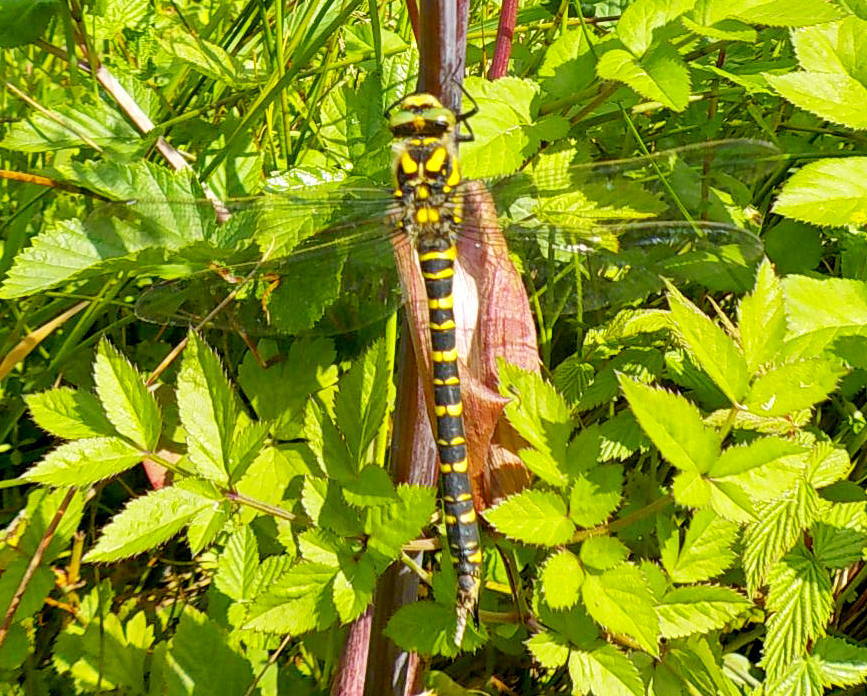
Golden-ringed Dragonfly(Cordulegaster boltonii)


Summer is here, and it's time to start looking for Dragons and Damsels. Dragonflies and Damselflies to be precise, although neither of them are true flies. They form the ancient order of insects called the Odonata.


Common Blue Damselfly (Enallagma cyathigerum)


There are two ways of telling them apart. Firstly, dragonflies hold their wings away from their bodies at rest, whereas damselflies fold theirs along their backs. Secondly, on closer inspection, dragonfly eyes are placed together, while damselfly eyes are held apart.


Dragonlfy exuvium (Anax sp.)


Their nymphs are aquatic, and when they emerge from the water, their skins split and the adults emerge. The shed skin is called an exuvium (plural exuvia) and they make an interesting subject to collect and study.


The Odonata are covered on pages 16, 17 and 78 of The Quick Guide to Creepy-Crawlies.


Paperback £14.99

Paperback £13.99

Dragonfly Jewellery from AOBOCO £29.99


Build Your Own Nature Library

All the best,


Steve


Follow me on Steve's Nature Plus


and also on


Steve's Nature


Steve Daniels Naturalists


Steve Daniels Cumbria


Wednesday, 9 June 2021

Canoeing Derwent Water


With so much water about in the Lake District, I thought that it was about time that we got out on to it. So, join me out on Derwent Water and we'll look at it through the eyes of a duck, starting out at the northern end where a heron is just coming in to land. As you can see from the inset photo, I am perfectly balanced – it's just the rest of the world that's out of kilter (something I've always suspected).


As we paddle our way south we find a pair of Canada Geese with four goslings. From laying to hatching takes about four weeks and the clutch size can be anywhere between two and nine eggs, with four or five being the norm.


The River Derwent , which passes by my front door, issues forth from Derwent Water and it seems to be well stocked with fish. I think that this one is a Rudd, but it could be a Roach. Rudd are a somewhat darker fish with an upward pointing mouth, as opposed to the silvery Roach with a downward pointing mouth.


We'll leave the canoe now and see if we can find a nice spot on the riverbank for a picnic lunch. It appears to be snowing, but it's just the seeds of the Goat Willows floating in the air. Those lovely, upright pink flowers are Bistort (Bistorta officinalis). The leaves of this, along with oatmeal, onion and nettles, are used to make the traditional northern lenten Dock Pudding. I must have a go at that sometime, although I can't say that it appears very appetising. Still, you never know.


This looks like a good spot, and we have plenty of Common Blue Damselflies (Enallagma cyathigerum), which shows that the water is not polluted with pesticide run-off. This other little insect with the apple green markings is a Sawfly. Yet another fly which isn't a fly. They are HYMENOPTERANS, related to Bees, Ants and Wasps, but unlike the rest of the order, they have no sting. (These are covered on page 42 of The Quick Guide to Creepy-Crawlies which you can view and order by clicking on the link).

And now, time for a sandwich, after all that exercise. For those of you following Minibeast Monday on Steve's Nature Plus, there won't be one next week as we're off to Scotland at the week-end, and won't be back until Monday night, but keep popping in as Harry the Heron appears to have found a girlfriend.

All the best,


Steve 


Steve's Nature Plus


Minibeast Monday * Podcast Tuesday * #CumbriaNature Wednesday * Foraging Friday * and other odd bits as they happen throughout the week.


Steve's Gallery


If you'd like to see some of the pictures in more detail, you'll find them in the gallery. These are also available for prints or digital downloads for commercial or scientific use.


Steve's Books


The Quick Guide to Creepy-Crawlies

All you need to know to identify any type of insect, spider, worm or snail very simply and find out more about it.

Yvonne: This was a gift for a family so that the children can understand what they see on days out. The second was for me. Logical and easy to use. If you know anyone who likes nature you can be confident that gifting this book will give years of pleasure.

The Eggs of Saramova

You can listen to this book for FREE as it is being serialized on the podcast The Author Reads


£7.50 Paperback edition

Not Just For Twisted Women by Steve Daniels 

A light-hearted look at life through the eyes of the fairer sex.

Janet: If you are short on time but enjoy reading and are maybe not into long extended novels then Not Just For... Twisted Women provides readers with concise stories that stand alone and most certainly entertain with their ultimate twists. Loved it.

Helen: A very good read! Well written and entertaining!

Margaret: Each quick tale gives a glimpse into a character's life and has an often humorous twist at the end. I would love to read more.

Yvonne: These days many people find it hard to find the time to read a novel, so this book of short stories is ideal to dip into. It is also makes a good gift.


£4.99 Paperback
edition


Crete Nature Catch-up

Series 1 - Welcome to Lasithi

Series 2 - The Rhythm Of Life

Series 3 - A Journey Begins

Series 4 - The Milonas Valley

Series 5 - This Is Ferma

Series 6 - Upland Villages

Series 7 - The Forty saints

Series 8 - Sunday Strolls

Series 9 -Stormy Weather

*********************************************************************

LINKS:

Share your nature thoughts, photos and comments on Naturalists (the facebook page that accompanies this blog)


Wednesday, 17 June 2020

Kapsa Gorge


Samaria Gorge is the ‘must do’ Cretan Gorge on every tourist’s check list. Great, it really is spectacular, but so are most of the hundreds of gorges on Crete, they just don’t have the marketing behind them. One of these is Perivolakia Gorge, the head of which, we visited back in December 2017. It is also known as Kapsa Gorge on account of the monastery of that name, perched on the eastern flank. It was to here that botanist Steve Lenton and I decided to make our first post lockdown foray (mainly because he was after some obscure species of Sea Lavender, endemic to this particular gorge) and I’m happy to go anywhere.

As usual, Steve went galumphing up the gorge in search of his flower, whist I pottered about, looking at everything in general. Once through the Tamarisk trees, the gorge became a riot of Oleander and Chaste Trees with Caper bushes hanging from the cliff walls. I also found a species of Mediterranean Thyme, Thymbra calostachya, which is endemic to Crete and only found in a few locations, here in the east of the island.


As these are all fairly aromatic plants, it is no surprise that butterflies are attracted to the gorge in considerable numbers; Whites, Blues, Brimstones and Speckled Wood were all flitting about as were the diminutive Cretan Small Heath, Coenonympha thyrsis. These little butterflies are also endemic to Crete and particularly prevalent in June. Some show considerable blue shading at the base of the wing whereas others show virtually none. Whether this is sexual dimorphism, or merely a general colour variation, I have been unable to determine. Maybe some specialist Lepidopterist can help me out here?


Chasing butterflies in a hot gorge in June is a rather silly occupation, so I retreated to a small cave. All was quiet, save the insects, the birds, and the occasional botanist crashing through the undergrowth, who shall remain nameless. Birds, like aeroplanes, have their own air corridors. Perching birds (Passerines), such as the Great Tit, like to keep below tree top level where there are plenty of branches on which to perch and sing. Crag Martins prefer the middle levels where there are plenty of crags, and a banquet of high flying insects on which to swoop down. Whilst, surveying all from on high, the Ravens keep up their sonorous cronking call.


Clinging to the walls of the cave are a number of Door Snails of the Albinaria genus. There are up to 30 different species of these (according to which malacologist you talk to) in central and eastern Crete, and each species has its own geographical range, often depending on who moved what stones where, and when. Historians have tracked human movement back to Roman times by observing the distribution of these door snails. This one, Albinaria teres, is quite widespread across Lassithi province.


Having located and sampled his obscure Sea Lavender, Limonium sp. to be determined, we decided to repair to The Oasis Taverna where a couple of beers brought forth roast pork, potatoes, stuffed courgette flowers, bread and cheese. We put the world to rights as usual (well, someone has to), Steve photographed his linoleum (sorry, Limonium) and I watched a pair of Southern Skimmers, Orthetrum brunneum, mating on the side of a soft drinks crate. Things really do go better with Coke, apparently.

How to recognise butterflies, dragonflies, snails and many other of the planet’s smaller life forms, s simply explained and illustrated in The Quick Guide to Creepy-Crawlies

See sample pages of all my books and latest blogs, and keep abreast of latest publications here:


All you need to know to identify any type of insect, spider, worm or snail very simply and find out more about it.
Yvonne: This was a gift for a family so that the children can understand what they see on days out. The second was for me. Logical and easy to use. If you know anyone who likes nature you can be confident that gifting this book will give years of pleasure.


The Eggs of Saramova
A science fiction novella for those who don't like science fiction. A fast-paced thriller that is, literally, out of this world (and it starts right here in Crete).
Too new for reviews yet!


A light-hearted look at life through the eyes of the fairer sex.
Janet: If you are short on time but enjoy reading and are maybe not into long extended novels then Not Just For... Twisted Women provides readers with concise stories that stand alone and most certainly entertain with their ultimate twists. Loved it.
Helen: A very good read! Well written and entertaining!
Margaret: Each quick tale gives a glimpse into a character's life and has an often humorous twist at the end. I would love to read more.
Yvonne: These days many people find it hard to find the time to read a novel, so this book of short stories is ideal to dip into. It is also makes a good gift.


Crete Nature Catch-up
*********************************************************************
LINKS:
Share your nature thoughts, photos and comments on Naturalists (the facebook page that accompanies this blog)
Explore the region with the #CreteNature interactive Hiking and Nature Map


Recent Posts