Showing posts with label swallow. Show all posts

Wednesday, 25 May 2022

Crosscanonby and Isel


The intention was to take Mattie for her first walk along the beach at Flimby, but with a force five gusting up the Solway Firth, she resembled not so much a dog on a lead, but a helium balloon on a string. We headed inland to the village of Crosscanonby to show her the delights of the countryside instead. Pheasants appeared and disappeared into the fields of waving wheat, their raucous cries startling her at every turn. Along the uncut field margins, Carder Bees were busy pollinating the clover.


As you know, I'm always on the hunt for plants to forage, but I was surprised to find this large stand of Fennel in the Cumbrian countryside. Fennel is indigenous to the Mediterranean, and it grew like a weed around my home in Crete. It has spread northwards throughout Europe and is not uncommon down south, here in England. This far north it's a rare find. I helped myself to a fair few fronds. It is also a traditional medicinal plant, good for digestive discomfort and as an eyewash. There were other old medicinals about as well: Herb Robert (liver and gall bladder) and Crosswort (rupture and rheumatism) also Cowslips and Sweet Woodruff, if you prefer your medicine fermented and poured into a glass,


Stinging nettles used to be used to treat rheumatism too (well, it took your mind off it at any rate) and makes good wine. Here though, it is being enjoyed by a whole host of Small Nettle Weevils.

The larvae of these beetles live underground and feed on nettle roots. As adults they come up and eat the leaves. It's not easy being a stinging nettle.


From Crosscanonby we travelled a little further inland to Isel for a walk by the Derwent. The Swifts were feeding above the river which brings me to the age old question: how do you tell the difference between a swift, a swallow and a martin, especially when they're high in the sky? It's all in the wings and tail. Wings first; if the wings are curved, it's a swift – if you lined them up wing tip to wing tip, they'd form a circle. With the other two, it's all in the tail; the swallow has two long tail feathers, streaming out behind and the martin has a short, forked tail.


And what did Mattie think of her first walk in the wild? Find out on Mattie'sPage!


I mentioned my home on Crete earlier. Christina and I spent 16 happy years there, before she succumbed to cancer in 2018. South east Crete is a beautiful place to live and the house is up for sale. Details are with the estate agent in nearby MakryGialos and can be viewed on line at Real Professionals Crete.


Hardback £10.14


Hardback £25.99 Paperback £21.99 Kindle £9.99


Medicinal Seed Herb Growing Kit £12.99

Build Your Own Nature Library

All the best,


Steve


Sponsored by Steve's Vintage Collectables

Join the growing trend of giving retro/vintage/antique gifts and slow down the modern planet destroying manufacturing techniques. 

#builttolast #weddingpresents #retirementgifts #birthdaypresents

Follow me on Steve's Nature Plus

and also on


 Steve's Nature


 Steve Daniels Naturalists


 Steve Daniels Cumbria


Friday, 25 February 2022

The European Nature Almanack - March 2022


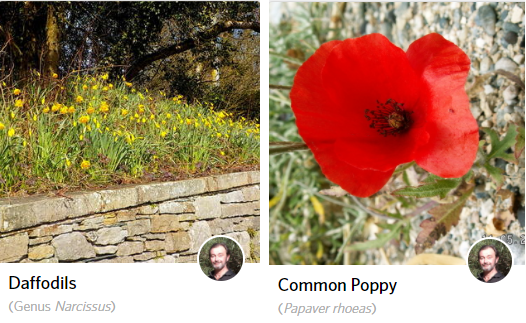
March is now upon us and one cannot live in the home town of William Wordsworth without making Daffodils the flower of the month for those of us in the north of Europe. The hosts of golden, nodding heads provide a wonderful, uplifting burst of colour after the sombre tones of winter. In the south of Europe, around the Mediterranean, Spring is in full bloom this month. I've recorded no less than 378 different plants in flower during March on Crete (as opposed to 109 here in Cumbria during the same period). The flowers I want you to look out for down south are poppies. Poppies belong to the genus Papaver and there are over 100 species. How many can you spot?


As the flowers come into bloom, so the insects start to emerge, and one that is common across Europe at this time of year is the Lady Beetle. This is the name that is being increasingly adopted throughout the English speaking world for these familiar creatures. Here in the UK we have traditionally called them ladybirds (but they're not a bird, obviously), and in the US they were called Ladybugs (but they're not true bugs either). They are part of the Beetle family, Coleoptera. There are over six thousand species worldwide, the most familiar to us in Europe being the 7-spot, Coccinalla septempunctata. The 'Lady' part of the name comes from the Christian 'Our lady' (Mary) who was depicted as wearing a red cloak in early paintings with the 7 spots representing her seven joys and seven sorrows.


Look out also for lady beetle larvae. As you can see, they are very different to the adults. You can tell it is a beetle larva from the hardness of its head (like a beetle's wing case), the six pairs of jointed legs at the front, and the lack of any additional leg-like appendages (called prolegs). A key to terrestrial insect larvae is given on page 77 of The Quick Guide to Creepy-Crawlies as well as explanations of terms like prolegs. A key to aquatic larvae is given on page 78.


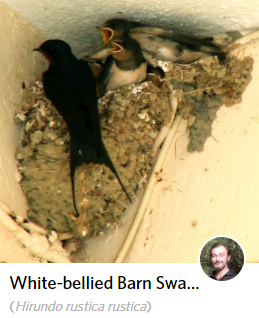
Birds are starting to nest now which gives me a chance to talk about the etiquette of bird photography, particularly with regard to nests and eggs. For many years photographing birds on the nest, or eggs, has been taboo. The reason being that you couldn't get such photos without disturbing the birds. Nowadays, with long distance lenses, and the discrete use of camera traps, it is possible to get photos without interfering with them. So, let common sense prevail. The bird mustn't be aware of your presence. Some birds, such as House Sparrows and these Swallows, nest in and around human habitation and you can take photos from a reasonably close distance. They still wouldn't appreciate you thrusting your phone into their nest though.


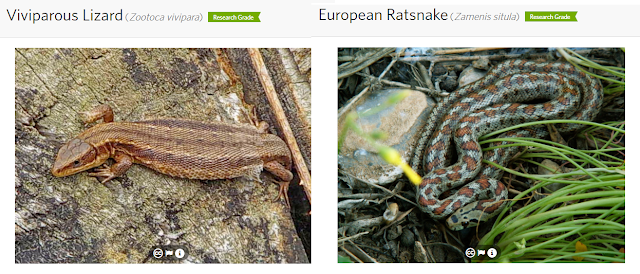
Lizards and snakes are beginning to come out of hibernation as the days get longer and warmer so keep an eye out for reptiles this month such as The Viviparous Lizard in the north and The European Ratsnake in the south. Both of them beautiful creatures.


Steve's Wild Kitchen


In Greece, March is the time to start collecting Xorta, wild spring greens. Many of these are from the Brassica or Amaranth families, but there are many others as well. Even here in the north of Europe there are over sixty different wild plants to forage. My particular favourite is Garlic Mustard (Allaria petiolata) with its subtle blend of both garlic and mustard. An essential ingredient of The Great Cumbrian Breakfast with lamb's kidneys, mushrooms and black pudding.


Wine of the month to try in March will be Meadowsweet (AKA Bridewort). This is a beautifully fragrant herb, with a honey like aroma, which should make a delicious dessert wine (it used to be used as an alternative to honey in making mead). Meanwhile, I'm still waiting for the nettles to reach a suitable height for picking for February's nettle wine. I'll keep you posted.


Steve's Books


Click on a cover for details


Chubby's Crematorium & Burger Bar

A book of humorous poems to cheer, amuse and entertain your friends with.


The Quick Guide to Creepy-Crawlies

All you need to know to identify any type of insect, spider, worm or snail very simply and find out more about it.


The Eggs of Saramova

A science fiction novella for those who don't like science fiction. A fast-paced thriller that is, literally, out of this world (and it starts right here in Crete).


Not Just For Twisted Women

A light-hearted look at life through the eyes of the fairer sex.


See sample pages of all my books and keep abreast of latest publications here:

http://author.to/SteveDaniels


Keep up with me throughout the month on Steve's Nature Plus or join the 1,300 members of our Facebook Group: Naturalists

All the best,


Steve


Wednesday, 4 June 2014

Phenomenal Phenology


Swift

After the exertions of the past fortnight up and down that ditch I thought you’d appreciate a quiet evening in the courtyard over a gin and tonic chatting about something you can all really get involved with and that is the phenomenal science of phenology. I say phenomenal because on the one hand it is terrifically simple and you need no scientific training whatsoever to be a phenologist and on the other hand your contribution could help to save thousands, if not millions, of lives in the future. A fantastic claim? Then let me explain. Take a look at those swifts up there.


Nesting Swallows
Those are the first swifts that I have seen this year and I shall record that fact as I have done every year since 2010. I do the same for the first swallows of spring as well and I finish up with a pretty little graph like this which gives me the impression that the birds are tending to arrive a little later than they used to. And that is all there is to it. From the Greek φαίνω (phainō), "to show, to bring to light, make to appear" + λόγος (logos), amongst others "study, discourse, reasoning" phenology is the science of recording when things happen in the natural world. I’m showing you the picture of the swallow with her brood not just because it’s a nice action picture but also to say that it is not just first sightings which you can record but first events as well such as first signs of nest building or when chicks fledge.


Poppy and Swallowtail Butterfly
OK, that’s what phenology is but what’s the point? Well, partially it can help to show the interconnectedness of the natural world. Take this phenology showing the relationships between flowers and insects for example. Poppies are representing the flowers and Swallowtail Butterflies are representing the insects. Notice how closely the appearance of the insects follows the appearance of the flowers. I see from my weather records that 2011 was a very dull spring with about six times the average rainfall in April.


Black Redstart
Which brings me round to the Englishman’s favourite subject: the weather. You don’t have to be a rocket scientist (or a professor of biology for that matter) to realize that weather and nature are very closely tied together. You do, however, have to see the big picture.  Take the autumn appearance of the Black Redstart for example. He can appear any time from day 294 (October 21st) to day 341 (December 7th) and this shows little or no correlation to the weather conditions out here. I would expect the dates to show quite a strong correlation to the weather conditions in north eastern Europe however as this is where they have spent the summer raising their broods and it is inclement weather up there that is going to trigger them to move.


Rising mean temperatures in south east Crete are contributing to desertification
Now to the saving lives bit. Weather is what happens on a day-to-day basis. If you add a lot of weathers together that’s climate and the climate, as we know, is changing. This in itself is no great problem to mankind: we’ve been through ice ages before and survived and we’re very adaptable creatures. It was only 5,200 years ago when we went through the last severe global warming event when the sun got the hiccups and the Sahara desert became uninhabitable. People just got up and moved to somewhere more hospitable. But there’s the rub: 5,200 years ago the world’s population was only 250,000,000 (imagine Indonesia being the only inhabited place today and the rest of the world being devoid of human life and you’ll get the picture). The current world population is now approaching 7,250,000,000 and 90% live in the tropics. And just to make it really interesting this is a period of rapid climate change and an awful lot of people are going to want to move very soon, at a very conservative estimate we’re talking tens of millions if not in excess of 100,000,000. 


This is where your phenology comes in. In the not so distant past we all had a much closer association with the natural world around us and by observing the plants and animals we had an intuitive feel of weather changes in the coming days or weeks. Now we have to examine the phenology of plants and animals on a global scale so that, in conjunction with the meteorologists and climate scientists, we can have some hope of predicting what will happen, where and when and help people to move in an orderly fashion rather than have them turn up on each others doorsteps when the wave breaks. There are already a number of phenology surveys around the world where you can record your observations and many more will surely follow. If your country isn’t yet listed then keep records anyway, they may be of vital importance.


Countries with phenology surveys:


    UK
  France  
  USA 
  India
Ireland  


***********************************************************************************
LINKS:


Naturalists (the facebook page that accompanies this blog)
 

Recent Posts