Showing posts with label Amphibian. Show all posts

Thursday, 11 May 2023

Up With The Lark


Elvis the campervan is still languishing in a garage down in Morecambe somewhere, so we took the on loan van up to Mawbray on the Solway coast at the weekend. It's a great spot for birding, and we were regaled by Skylarks from morning until night, with click accompaniment from the numerous Stonechats. Down on the beach, the sand martins were nesting, and the Oystercatchers and Sanderlings were having their breakfast. All very calming and peaceful after last weekend's shenanigans.


Flowers are beginning to make more of a show now, with blues and reds appearing among the yellow and whites of April. I'll just draw your attention to the little, inconspicuous plant at top left – Sea Sandwort. This is a marvellous little succulent, packed full of vitamins A and C. Where it grows, it does so profusely. You can cook it as a greens, or add it raw to salads to add a bit of crunch. Pick from the middle of a patch rather than the outside so that it continues to spread along the coast.


Insects continue to be worryingly scarce. Six species was the entire haul for the weekend. The Hawthorn flies had just hatched in considerable numbers, and there were other dipterans about. A Red-tailed bumble bee was looking for a nest site, and a lonely Green-veined White butterfly was flitting around in the grass. All little white butterflies look the same at first glance, but there are quite a few different species with various markings, so they're worth a closer look. A bit of stone flipping revealed a couple of beetles which I've provisionally identified, but have yet to have confirmed. I also turned up a Crane fly larva, looking a bit like a caterpillar. You can tell it isn't because it has no prolegs. You can also tell that it's not a beetle larva as it is soft headed. The Quick Guide to Creepy-Crawlies has two pages of larvae identification keys; one for terrestrial larvae and one for aquatic larvae. A must have book for any budding entomologist.
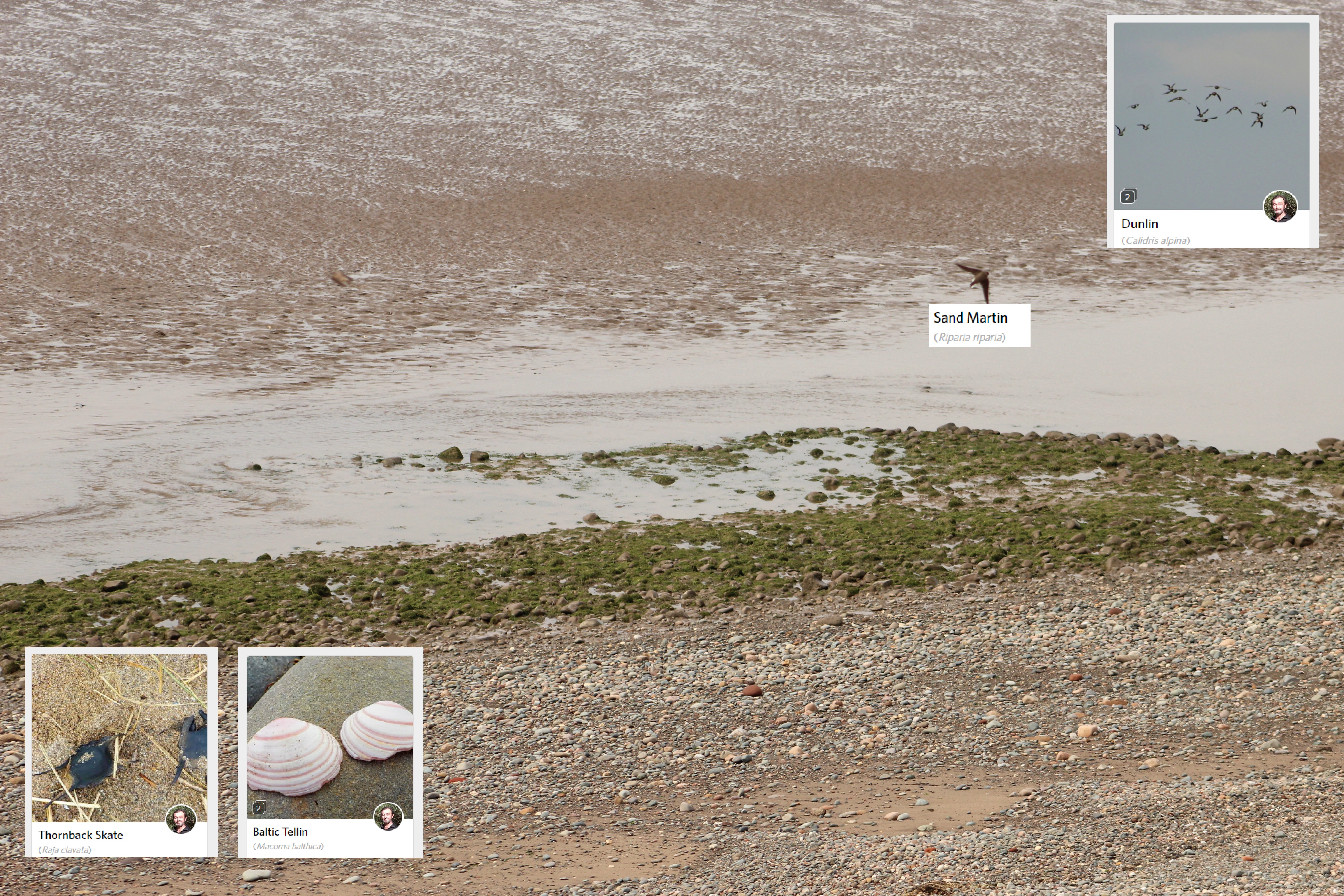


Back down on the beach and a flight of Dunlin take to the air whilst the Sand martins cavort along the shore line. Quite a few Thornback Skate egg cases lying around (see Shark!) and a Baltic Tellin shell looking very pretty in pink. Most Baltic Tellins are white, but they also come in orange and yellow as well as this rather fetching pink example.


Mawbray is famous for it's Natterjack Toads, so we took a look in the ponds. Plenty of Common Frog tadpoles but no sign of their illustrious cousins unfortunately. Natterjacks are very vocal at night, but we didn't hear any either. In the grass around the ponds St. George's Mushrooms were reasonably prolific (a good edible mushroom) and there were a few Dung Roundheads among the cow pats.


A lovely weekend, rounded off by this beautiful sunset, reflected multiple times across the Solway Firth, with the Scottish hills in the background.


Steve's Vintage Collectables. (click to visit)

I'm still showcasing the royal memorabilia, but this will gradually be replaced as new items get added to the shop. If you're looking for the royal thimbles, they went out to America earlier this week, and the Hillstonia vase sold yesterday evening.


Steve's Books (click to visit)

A good time to buy The Quick Guide to Creepy-Crawlies as the minibeasts start to appear in all their variations.


Follow me on Steve's Nature Plus and also on Twitter (@Steve's Nature), Facebook (Steve Daniels),and Instagram (Steve Daniels Cumbria)

Or why not join the 2.5k members of our Naturalists group?


All the best,


Steve


Wednesday, 19 September 2018

Crete Nature Almanack 2018 Autumn


Autumn is nearly upon us and the birds are already flying south from northern Europe and either staying or passing through Crete on their way to sub-Saharan Africa. Find any stretch of water and you are likely to see birds such as Ruddy Turnstones, Arenaria interpres (top left); Common Sandpipers, Actitis hypoleucos (top right); and possibly even a Spotted Redshank, Tringa erythropus (bottom right). Look out also for the first appearance of the Black Redstart, Phoenicurus ochruros (bottom left), which usually arrives down here on the south east coast somewhere between late October and the end of November.


The flowers will start to appear after the first autumnal rains which have been getting gradually later over the past five years; from September 16th in 2013 to September 29th in 2017. I have chosen just three of them, but can you spot the connection? The first one is the Autumn Buttercup, Ranunculus bullatus, which grows throughout the Mediterranean, including north Africa. The second is the Autumn Squill, Prospero autumnale, which although it can be found throughout southern Europe and the Middle East, for some reason can also be found in Great Britain according to Kew Garden's world checklist. The third one is Crocus laevigatus, which is endemic to Crete and is one of a number of crocuses sometimes known as the Autumn Crocus as, like the others, it flowers at this time of year.


The rains also bring forth the snails, of course, and the familiar Garden Snail, Cornu aspersum, starts to appear in considerable numbers in gardens and supermarkets across the island. Apart from being edible did you know that its yucky, slimy secretions are used in American skin creams? The second one is the Chocolate-band Snail, Eobania vermiculata, which also appears in gardens but not so often in supermarkets. They are edible but considered inferior to Garden Snails by the Greeks so we export them to France (mind you, that little nugget of information is 37 years old, so don't quote me on it). Finally, the Green Garden Snail, Cantareus apertus, which has a shell that can vary from creamy yellow, through olive green, to almost black but is easily recognisable if you pick it up. It will blow bubbles all over your hand which reeks of slightly off garlic and lasts for days. Incidentally Wikipedia notes that In Crete this species is active for 3–4 months after the first rainfalls in October.” Rubbish; I've found them out and about at the end of March.


As the seasonal rivers and streams start to fill, listen out for the a capella amphibian assembly after dark. The frogs and toads become very vocal in the autumn. The main singers being the Green Toad, Bufotes viridis, (left) which I think is a very dull name for such a beautiful animal, the endemic Cretan Frog, Pelophylax cretensis (middle). This is a particularly vivid specimen, they are usually much duller, and the diminutive European Tree Frog, Hyla arborea, which, although small, certainly holds his own in the croaking stakes.


Autumn also sees the opening of the mushroom season and lets hope we have a better one than last year when they were very few and far between. In fact, the only ones I found were these Mica Caps, Coprinellus micaceus, a nice, edible mushroom but you have to get them in the pan within the hour and, given the other caveats (see Voila - Turkish Delight ) one wonders whether they're worth collecting at all. Hopefully, this year we'll find a few more species.

That's it for the almanack; next week sees the start of Steve's Sunday Strolls and for those of you who are on the island during the next fortnight here is where you can join me:

Sunday 23rd September
11 am
Sisi
(see last week's post for details).


Sunday 30th September
11 am
Ag. Charalampos, Lassithi Plateau


A gentle stroll around one corner of the Plathini-Lagkada Wildlife Refuge and a handy village taverna where we can chat about what we have seen afterwards.


The Extra Bit

A big thank you to all who have taken the time to investigate my book of short stories and an even bigger thank you to those of you who have actually bought a copy (Amazon Kindle £1.99 or currency equivalent).


Photographic Bit

Many of you have asked me what photographic equipment I use so for details of aperture settings, shutter speeds etc. my pictures will be on Flickr within a few days and that has all the geeky stuff.Pictures were edited with FastStone Image Viewer and combined with Microsoft Paint.


*********************************************************************
LINKS:
Share your nature thoughts, photos and comments on Naturalists (the facebook page that accompanies this blog)

Explore the region with the #CreteNature interactive Hiking and Nature Map


Recent Posts