Showing posts with label The Quick Guide to Creepy Crawlies. Show all posts

Thursday, 11 May 2023

Up With The Lark


Elvis the campervan is still languishing in a garage down in Morecambe somewhere, so we took the on loan van up to Mawbray on the Solway coast at the weekend. It's a great spot for birding, and we were regaled by Skylarks from morning until night, with click accompaniment from the numerous Stonechats. Down on the beach, the sand martins were nesting, and the Oystercatchers and Sanderlings were having their breakfast. All very calming and peaceful after last weekend's shenanigans.


Flowers are beginning to make more of a show now, with blues and reds appearing among the yellow and whites of April. I'll just draw your attention to the little, inconspicuous plant at top left – Sea Sandwort. This is a marvellous little succulent, packed full of vitamins A and C. Where it grows, it does so profusely. You can cook it as a greens, or add it raw to salads to add a bit of crunch. Pick from the middle of a patch rather than the outside so that it continues to spread along the coast.


Insects continue to be worryingly scarce. Six species was the entire haul for the weekend. The Hawthorn flies had just hatched in considerable numbers, and there were other dipterans about. A Red-tailed bumble bee was looking for a nest site, and a lonely Green-veined White butterfly was flitting around in the grass. All little white butterflies look the same at first glance, but there are quite a few different species with various markings, so they're worth a closer look. A bit of stone flipping revealed a couple of beetles which I've provisionally identified, but have yet to have confirmed. I also turned up a Crane fly larva, looking a bit like a caterpillar. You can tell it isn't because it has no prolegs. You can also tell that it's not a beetle larva as it is soft headed. The Quick Guide to Creepy-Crawlies has two pages of larvae identification keys; one for terrestrial larvae and one for aquatic larvae. A must have book for any budding entomologist.
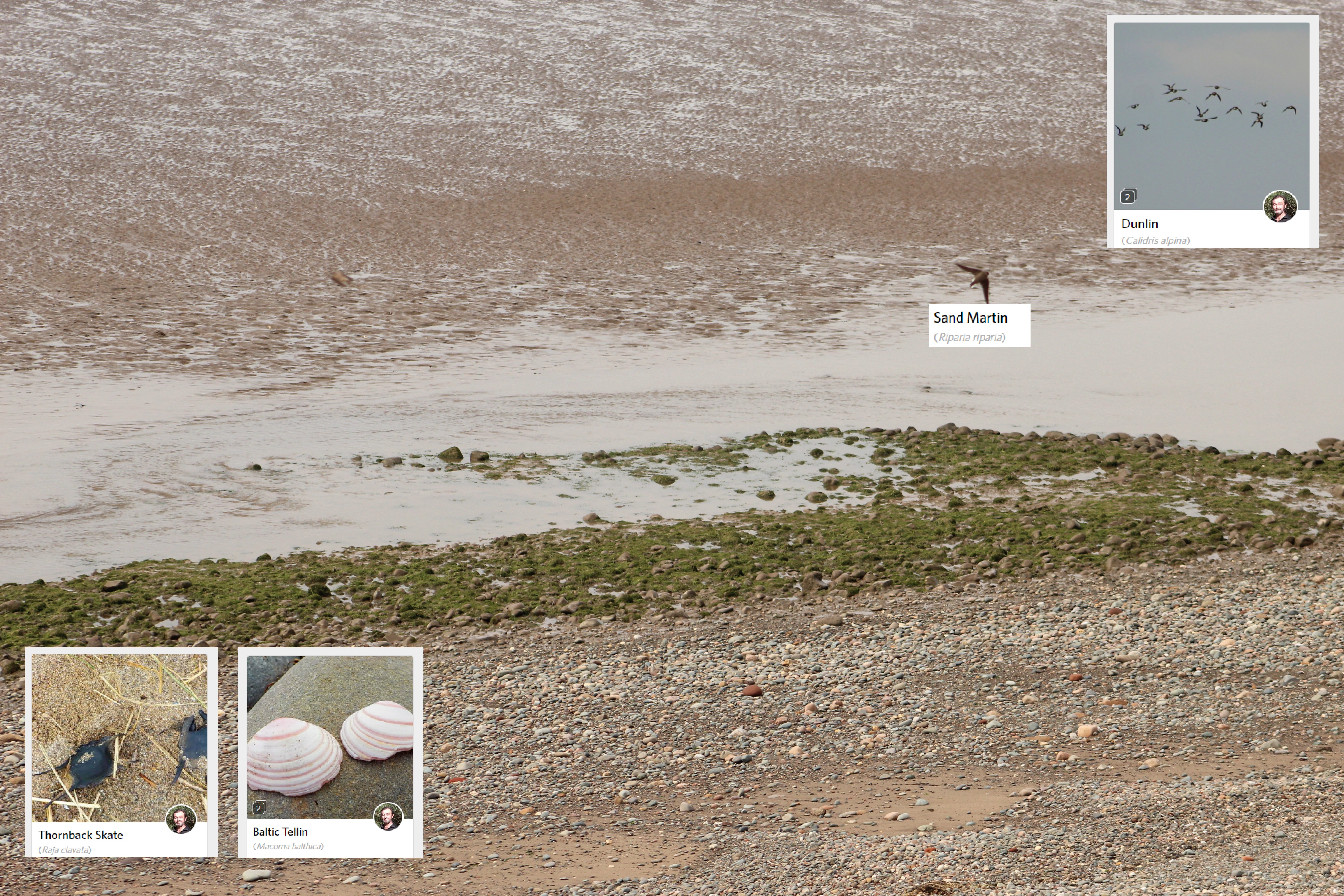


Back down on the beach and a flight of Dunlin take to the air whilst the Sand martins cavort along the shore line. Quite a few Thornback Skate egg cases lying around (see Shark!) and a Baltic Tellin shell looking very pretty in pink. Most Baltic Tellins are white, but they also come in orange and yellow as well as this rather fetching pink example.


Mawbray is famous for it's Natterjack Toads, so we took a look in the ponds. Plenty of Common Frog tadpoles but no sign of their illustrious cousins unfortunately. Natterjacks are very vocal at night, but we didn't hear any either. In the grass around the ponds St. George's Mushrooms were reasonably prolific (a good edible mushroom) and there were a few Dung Roundheads among the cow pats.


A lovely weekend, rounded off by this beautiful sunset, reflected multiple times across the Solway Firth, with the Scottish hills in the background.


Steve's Vintage Collectables. (click to visit)

I'm still showcasing the royal memorabilia, but this will gradually be replaced as new items get added to the shop. If you're looking for the royal thimbles, they went out to America earlier this week, and the Hillstonia vase sold yesterday evening.


Steve's Books (click to visit)

A good time to buy The Quick Guide to Creepy-Crawlies as the minibeasts start to appear in all their variations.


Follow me on Steve's Nature Plus and also on Twitter (@Steve's Nature), Facebook (Steve Daniels),and Instagram (Steve Daniels Cumbria)

Or why not join the 2.5k members of our Naturalists group?


All the best,


Steve


Wednesday, 16 November 2022

Much-Birding-in-the-Marsh


When the wind is howling, fit to blow you off your feet, going out for a walk can be a bit daunting, even for the most enthusiastic of naturalists. Much better to pack a thermos of hot soup and head for one of your local bird hides.


[Tip: search 'bird hides near me' in Google Maps]


Which is where I'm taking you today. Campbell Marsh RSPB reserve, to be precise. Up on the Solway Firth. The first hide is open, facing the wind, and you can hardly prise the door open. Nothing much going on at the second, but third time lucky. We're out of the wind, and there are birds to be seen. A large flock of Widgeon, albeit a distant flock. However, we do have a Little Egret pottering about down here, and he's just been joined by a Grey Heron. Little Egrets are on the rebound in Britain. They used to be plentiful (in 1465, a banquet for the new Archbishop of York reputedly included a thousand of them). They were then slaughtered in their millions in Victorrian times, to provide feathers for women's hats, which is one of the main reasons that the RSPB came into being, and finally, they got fed up and moved south to mainland Europe. They were virtually extinct in the UK by the 1950s.


Apart from the heron and the egret, there doesn't seem to be much happening outside at the moment. Meanwhile, I suggest we take a tip from that Orb Weaver spider up there, happily devouring some species of fly, and break open the soup.


Lights, camera, action. A flock of Barnacle Geese are just honking in. Back in the 12th century, it was thought that these birds hatched from the Goose Barnacle, hence their common English name. In Ireland, the myth persisted until fairly recently, and they could be eaten during Lent, as they were considered to be fish, and not poultry. I have a sneaking feeling that this was just a work-around!


It's all happening now. A trio of Whooper Swans have just arrived. These are larger than the similar looking Bewick Swan, and have more yellow on their beaks. They overwinter here, having bred in subarctic Eurosiberia. When they prepare to migrate, they have a sort of head bobbing competition. The bobbiest bird gets to lead the migration. Swan democracy!


And another Little Egret has just arrived, much to the chagrin of the initial Egret, who was first upon the scene. At least, this looks to be more of an aerial argument, rather than a courtship display. But who knows? This November has been the warmest on record, so maybe they think it's Spring. A wonderful display, though, whatever the motivation.


Oh, this is really the icing on the cake. A pair of Marsh Harriers. The lighter colured male is highly distinctive, whereas the darker female is a little harder to recognise. To add to the confusion, the dark one could be a juvenile. The young of both sexes look very similar to the adult female. These are wetland specialists, feeding on small mammals, small birds, insects, reptiles, and frogs. They are ground nesting, typically in reed beds. Nearly extinct in the UK by the early 20th century, due to persecution, habitat destruction, and pesticide poisoning, they have come back strongly, and are rated as 'of least concern' by the IUCN.


So, from a slow start, it has turned into quite an exciting morning. Oh, and if the title of this post rings a bell, then you must be even older than me. Much-Binding-in-the-Marsh was a BBC radio comedy show from the 1940s and 50s. And, talking of things from the past, following on from Steve's History of Things, I have just launched a new magazine which you can find on Steve's Nature Plus.


All the best,


Steve


Beetles and Butterflies; spiders and scorpions; woodlice and worms. How do you tell them all apart? To say nothing of crane flies, dragonflies, bee flies and yet more butterflies. Are they all flies? If not, why call them so? If you're fascinated but confused by the beautiful world of the very small, then this is the book for you.

82 pages of information on all aspects of the world of minibeasts, with over 100 photographs and illustrations, this book will help you track down and identify any arthropod, in its adult or juvenile state, anywhere in the world.

See all of my books at author.to/SteveDaniels


Follow me on Steve's Nature Plus

and also on Twitter Steve's Nature, Facebook Steve Daniels Naturalists, and Instagram

Steve Daniels Cumbria


Monday, 28 February 2022

Minibeast Monday - Bugs, True Bugs, and the Hemipteroid Assemblage


Let us clear up a bit of confusion. What, exactly, is a bug? In general terms it is used to denote any minibeast with legs, particularly in American English. To a naturalist, however, a bug is something more specific. Welcome to the Hemipteroid Assemblage. This is an umbrella group of insects containing Lice, Booklice, Thrips and a large group of mainly sap sucking insects called the Hemiptera often referred to as the True Bugs, although this term is also used for the sub-group Heteroptera.


The Hemiptera is a very diverse looking group of insects (some of which don't even look like insects at first glance) which includes such things as Psyllids, Cicadas, Scale Insects, Aphids, Moss bugs and Leafhoppers. 


It also includes the HETEROPTERA, which are more typically 'bug like' in appearance. The picture below shows the three groups that you are most likely to come across when you're out and about but there are also four other groups:

  • Enicocephalomorpha includes Unique headed bugs, Gnat bugs

  • Dipsocoromorpha includes Jumping ground bugs

  • Gerromorpha includes Water striders, Water measurers and Velvet water bugs

  • Leptopodomorpha includes Shore bugs, Spiny shore bugs


As you can see, this is a huge group of insects with well over 80,000 species to find including many that are extremely beautiful when seen up close. The great majority, being sap suckers, are completely harmless to humans. Photographing them in the wild is a lot easier if you have a sweep net!

(Click pic for details)

It is also extremely useful if you have a guide book. The insects that make up the Hemipteroid assemblage, and how to identify them is covered in pages 18-23 of my Quick Guide To Creepy-Crawlies.  

(Click pic for details)


Wednesday, 1 April 2020

Hinterland


Hold your hand out in front of you, at arm's length, fingers pointing upwards. Gradually move it towards you. At a certain point, it will become fuzzy and out of focus, thus proving that you really cannot see what is right in front of you. The same is true of the hinterland, the area beyond what is visible, or known. A description, which for most people, describes a semicircle, of 500 yards or so, around their front gate. The area that we pass through every day and seldom give a second glance. So, this is the project for the week and it's the perfect time to do it. You don't have to use the car and nobody is going to look over your shoulder and ask what you are doing. They may think you a little eccentric but, at the moment, eccentricity is the new normal. Think of it as a public service: you're something to watch on a dull day, while staring out of the window, at nothing in particular.


White Mustard, Sinapis alba

I am lucky with my hinterland, as it contains olive groves and a small, seasonal stream. Even so, it is an area which I've tended to neglect over recent years, for the simple reason that it has become too familiar. As I needed some White Mustard, Sinapis alba, yesterday, for a little project involving snails, I revisited the banks of the little stream. Here, I knew that white mustard grew, in some profusion. I took my camera with me, to see how many different types [orders] of creepy-crawlies I could find.


HEMIPTERA Calocoris nemoralis

The HEMIPTERA, or True Bugs [as opposed to the general term 'bugs' which covers all creepy-crawlies, especially in American English], were represented by two or three different species of Mirid Bug, such as this Calocoris nemoralis of the Miridae family.


COLEOPTERA Oxythyrea cinctella
The COLEOPTERA, or Beetles, came in the form of this Middle Eastern Flower Scarab, Oxythyrea cinctella of the Scarabaeidae family, as well as a good number of 7-spot ladybirds, Coccinella semipunctata of the Coccinellidae family.


LEPIDOPTERA Acontia lucida

The LEPIDOPTERA, or Butterflies and Moths were much in evidence with Small White, Pieris rapae, Common Blue, Polyommatus icarus, and Speckled Wood, Pararge aegeria, butterflies, all flitting about in the sunshine. The only one to sit still and be photographed was this Pale Shoulder Moth, Acontia lucida, of the Noctuidae family.


HYMENOPTERA Apis melifera
The HYMENOPTERA, or Bees, Ants and Wasps, provided a nice, buzzy, Spring soundtrack as the Western Honey Bees, Apis melifera, of the Apidae family, went about their business of collecting pollen with which to make honey. In the process of which, they inevitably transfer pollen from flower to flower and ensure a good harvest for next year.


ORTHOPTERA Acrididae family

The ORTHOPTERA, or Grasshoppers and Crickets, were busy jumping about and these two landed on the same rock at the same time. One, I think, is a Chorthippus species and the other, a Band-winged Grasshopper, both of the Acrididae family.


All the above are insects [having six legs], but there was one arachnid [having eight legs], bustling about in the undergrowth: this lovely Harvestman. Most people think that this is a type of spider but it isn't. Harvestmen form the order OPILIONES and, despite their size, are totally harmless. Their body shape is different to a spider and they only have one pair of eyes, whereas spiders have three or four pairs. This one, investigating my arm, is a member of the Phalangiidae family.

OPILIONES Phalangiidae family

I nearly forgot the White Mustard, which I came out to pick in the first place. I haven't been able to photograph any birds today as my bird camera is en route to Cumbria with about a third of my furniture. I, of course, am locked down, the same as everybody else. However, I can tell you that there are Chaffinches, Great Tits, Sardinian Warblers, Greenfinches, Blackbirds and Hooded Crows all heralding the arrival of Spring. Oh, and I also saw a little mouse in the garden the other day, so the small, furry mammals are about too.


Until next time, stay safe, avoid people and enjoy nature. I wish you all well, wherever you may be.

The Quick Guide To Creepy-Crawlies not only gives pictures and easy descriptions of twentytwo insect orders (in both their adult and juvenile states), but also pages of molluscs, myriapods, isopods, arachnids and all the other creepy-crawlies that you are likely to find in your hinterland. Suitable for adults and children alike, I am putting it on special offer (a third off, except in the USA where a minimum price applies) until the end of April. So, order a copy, take your camera or phone with you, photograph what you find, and identify them when the book arrives. Congratulations! You've just got yourself a new hobby!


Was £14.99     $17.31    16.14

Now £10.00    $16.48    €11.52


Crete Nature Catch-up

The Eggs of Saramova
A science fiction novella for those who don't like science fiction. A fast-paced thriller that is, literally, out of this world (and it starts right here in Crete).
All you need to know to identify any type of insect, spider, worm or snail very simply and find out more about it.
A light-hearted look at life through the eyes of the fairer sex.
See sample pages of all my books and latest blogs and keep abreast of latest publications here:


*********************************************************************
LINKS:
Share your nature thoughts, photos and comments on Naturalists (the facebook page that accompanies this blog)

Explore the region with the #CreteNature interactive Hiking and Nature Map


Wednesday, 25 March 2020

Back Yard Safari


Feeling bored yet? If you're missing the big wide world outside of your front door, go out of the back door instead. There's another, even more wonderful world, in the back garden. Whether it's a beautifully manicured lawn with regimented borders, or looks a bit like a bombsite, there's a host of interesting creatures out there waiting to be investigated. Birds, bats, butterflies; molluscs, mice and moths; the list is almost endless. As I proved, from a hospital balcony a few years back, you can be a naturalist anywhere. See How To Be A Naturalist, Anywhere


Small mammals, amphibians and reptiles are great favourites and there are a number of ways in which you can observe these. A small garden pond will often attract frogs and toads, as well as providing a source of water for other creatures. A bird feeder will attract a host of garden birds, but if you can't get out to buy wild bird seed at the moment, a simple platform with household scraps (fruit is a favourite) will bring them in. A small mammal trap is best for things like mice and shrews but an alternative is to bury a bucket in soft earth, bait it with something tasty, then cover it with wood, propped up about an inch at one end. You will probably also get a fair few snails. If your finances run to a camera trap, then you can get photos of some great nocturnal creatures as well, like this Stone Marten who visited my bird table one night.

My own personal passion is, as you probably know by now, the insect world. Did you know that there are about thirty different orders of insects and hundreds of different families making up those orders? About five years ago, I wrote a post giving a quick run-down on how and when those insect orders evolved. I ended the post with this picture of twelve of the most common orders that you are likely to find in your back garden. See Whiffling through the Woodpile – a short history of insects


This proved to be a very popular post and eventually led to me writing The Quick Guide To Creepy-Crawlies which not only gives pictures and easy descriptions of twentytwo of those insect orders (in both their adult and juvenile states), but also pages of molluscs, myriapods, isopods and all the other creepy-crawlies that you are likely to find in your garden. Suitable for adults and children alike, I am putting it on special offer (a third off, except in the USA where a minimum price applies) until the end of April. So, order a copy, take your camera or phone out of the back door, photograph what you find, and identify them when the book arrives. Congratulations! You've just got yourself a new hobby!


Was £14.99      $17.31      16.14

Now £10.00      $16.48      €11.52


Due to a technical problem at facebook, many people did not see last week's post. If that includes you, you can read it here: It's a Small World (microscpically small – all about the unseen world of Archaea, Bacteria and Viruses).


Crete Nature Catch-up

The Eggs of Saramova
A science fiction novella for those who don't like science fiction. A fast-paced thriller that is, literally, out of this world (and it starts right here in Crete).
The Quick Guide to Creepy-Crawlies
All you need to know to identify any type of insect, spider, worm or snail very simply and find out more about it.
Not Just For Twisted Women by Steve Daniels 
A light-hearted look at life through the eyes of the fairer sex.
See sample pages of all my books and latest blogs and keep abreast of latest publications here:
http://author.to/SteveDaniels


*********************************************************************
LINKS:
Share your nature thoughts, photos and comments on Naturalists (the facebook page that accompanies this blog)

Explore the region with the #CreteNature interactive Hiking and Nature Map


Recent Posts