Showing posts with label flora. Show all posts

Monday, 13 June 2022

Arran Special - 1. Arrival


The Isle of Arran lies off Scotland's west coast, nestling securely in the Firth of Clyde, and it's to be our home for the next six days. Described as 'Scotland in Miniature', it boasts a wealth of wildlife including Arran's big 5: Red Deer, Seals, Golden Eagles, Red Squirrels and Eurasian Otter. So, join Ishbel, Mattie and me as we pitch up on the island's south coast, at the encouragingly named Seal Shore Campsite, and we'll see how many of the big 5 we can find.


The ferry from Ardrossan on the mainland takes an hour and there are plenty of opportunities for a spot of bird watching from the top deck. As our sister ship steams past, with the islands of Padda and Ailsa Craig in the background, we have a couple of Greats: Black-backed Gull and Cormorant; Guillemots, both Common and Black as well as Common Gulls and Common Eider. And look! There's a Porpoise – he was there, honest.


Here we are at the campsite and what a glorious view. There's a story behind those black rocks out there. Once upon a time, a very long time ago, about 200 million years ago in fact, the supercontinent of Pangea began to break apart. As the continental plate was stretched ever thinner, cracks began to appear, and boiling hot magma erupted, flaming, through the surface. These black rocks are the remains of that monumental event. The continents of North America and Eurasia were born here. That's a pretty awesome way to start a holiday. Maybe someone should put up a blue plaque or something.
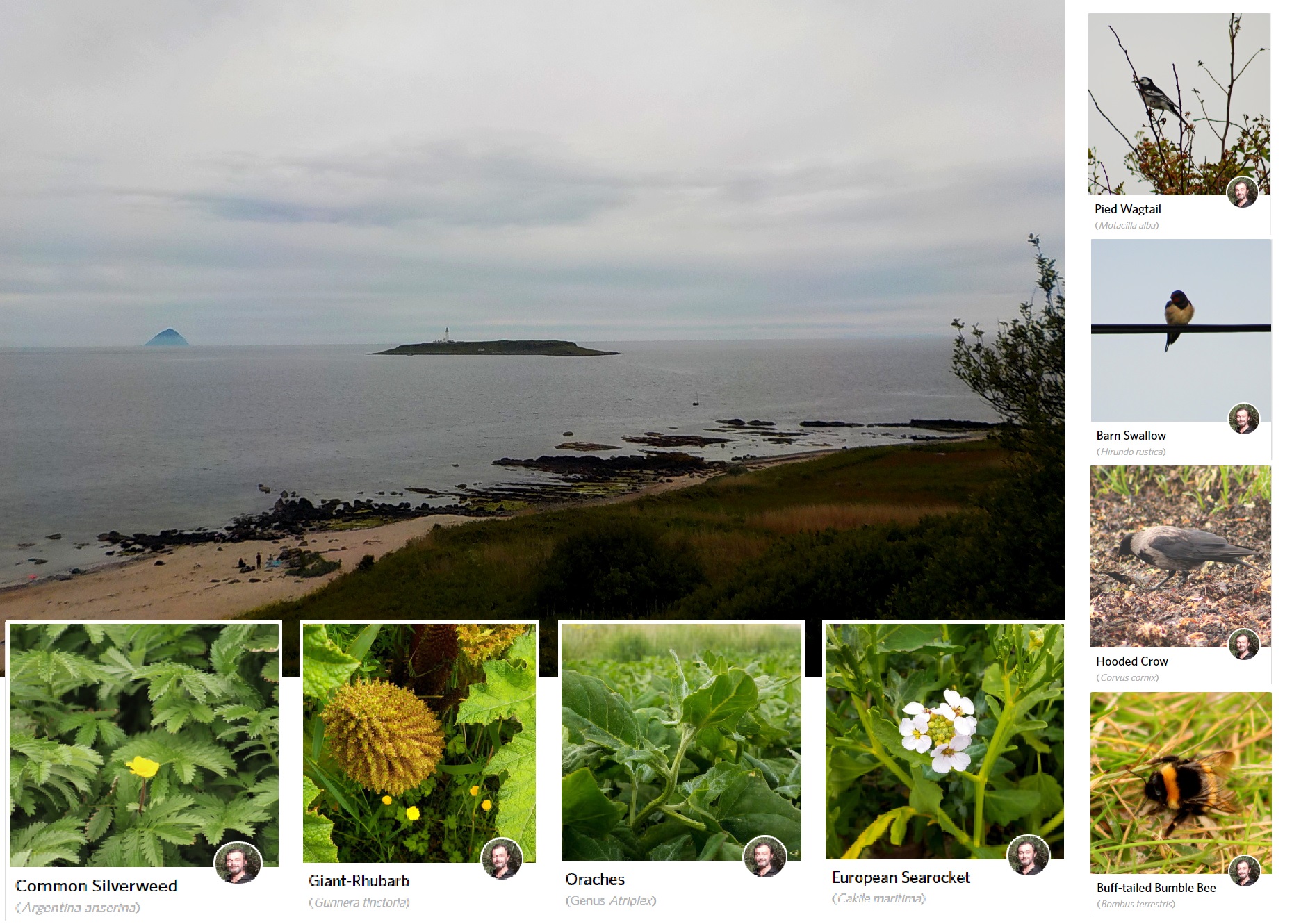


The other good thing about this site is that it's on the Arran Coastal Way which encircles the island in a 65 mile (105km) loop. I don't propose that we attempt the whole lot tonight, but we could all do with stretching our legs after the long journey, so let's explore a bit of it. I make no claims to be a coastal botanist, but most of the shoreline seems to be bounded by Common Silverweed and some sort of Orache, interspersed with Giant Rhubarb (with stalks and leaves above head height) and Sea Rocket. There are a fair number of Bumble Bees about, doing the pollinating. Buff-tailed, by the looks of it, and the evening birds include Pied Wagtails, some Hooded Crows prodding about in the seaweed and a few Swallows pretending that it's summer. In truth, it's getting a bit chilly, so let us repair to the local hostelry, conveniently situated next door, and see what's on the menu.


If you're into camping this summer, here are a few things on offer that you may like:

Pair of Padded Chairs


Fire Pit and Gloves

Was £21.99 Now £15.79


Solar Charger

Was £19.99 Now £18.99


Pair of Padded Chairs

Was £79.99 Now £67.99


Until tomorrow,


All the best,


Steve


Arran Special 2 – In Search of Seals https://bit.ly/snb17-1-2

#nature #wildlife #birds #flora #insects #mammals #rockpooling


Follow me on Steve's Nature Plus


and also on


Steve's Nature


Steve Daniels Naturalists


Steve Daniels Cumbria


Wednesday, 11 May 2022

Here Be Volcanoes! - Eycott Hill

Eycott Hill Nature Reserve, Cumbria, UK


Here be volcanoes! OK, Cumbria may not be the first place that comes to mind when considering the volcanic hotspots of the world, but some 460 million years ago this place was on fire. This was the bed of The Iapetus Sea, which was being squished as continents drifted into one another, setting off volcanoes and lava flows all over the place. Between then and now, this has been land, sea and ice at one time or another and pretty well tilted as you can see from the information board provided by the Cumbria Wildlife Trust. These rocky hummocks are the bits of volcanic lava, still visible after all these years. And how do they know all this? Those neat holes in the rocks are not made by incredibly strong boring beetles, as you may imagine, but by the lesser spotted geologists, who have been taking, and studying, samples of the ancient lava.


The flora up here is pretty special too. There are twenty species of sedge and eighteen species of Sphagnum moss up here (I think I've identified these correctly, but please feel free to put me right). There are marsh violets and mountain pansies and the beautifully lace-like Parsley Fern.


As I said in this month's European Nature Almanack, May is a good month to look out for reptiles and amphibians becoming more active after months of hibernation. This little fellow is a newt. We have three species here in the UK: the Smooth, or Common Newt, the Palmate Newt and the Great Crested Newt. This one has a shallow crest running from neck to tail, and there is no webbing on the back feet, so I think that it's a Smooth Newt. To be absolutely certain I'd have to check that he has black spots on his throat, but I don't want to disturb him.


We have owls and small mammals too. We haven't actually seen any (these are two owls I made earlier, so to speak), but we do have evidence in the form of a regurgitated owl pellet. After half an hours prodding about, I've managed to extract 22 small mammal bones including leg, shoulder, vertebrae and occasional pieces of skull.


Now, it wouldn't be me if I didn't find a couple of insects to play with, and what a pair they are. The first beauty is an Emperor Moth, a grand name for a grand insect. This is one of about 2,300 species of large Saturnid moths, but the only one you'll find in the UK. They only live for about a fortnight as adults, because their only purpose is to mate. They cannot even eat, and have to rely on the food resources they built up as a caterpillar. The other fellow is a Dor Beetle. These are earth boring dung beetles who dig tunnels (up to 2 metres long in some species) beneath a pile of dung. This particular species is coprophagous, that is, it eats dung and provisions its nest with the same, but many Dor Beetles live on a diet of mouldy leaf litter. Can't say that either appeal to me particularly.


And now, a Special Offer for all you budding bug spotters out there. I have 25 signed, limited edition copies of The Quick Guide To Creepy-Crawlies to send out on a first come – first served basis. The standard version is £14.99 on Amazon + p&p but I'm offering you these signed, limited edition copies for only £12.00 + p&p.


Amazon price £14.99 plus p&p

Signed, Limited Edition Offer:

£12 + £1.50 p&p = £13.50

$14.75 + $4.25 p&p = $19.00


14 + €4.00 p&p = €18.00


Remember, there are only 25 and it's first come, first served!

All the best,


Steve


Follow me on Steve's Nature Plus and also on


 Steve's Nature


 Steve Daniels Naturalists


 Steve Daniels Cumbria


Wednesday, 8 April 2015

Evolution: Top to Bottom


Over the past few weeks we’ve been to the top of the ridge, walked along the valley floor and discovered a marvellous gorge somewhere in between. Today I thought we’d go top to bottom starting on the ridge and gradually making our way down to the lower slopes looking at the origins of the various lifeforms that we encounter along the way. 

Up here amongst the limestone crags it never fails to amaze me how life will exploit any opportunity to take hold. In every little nook and cranny where there’s a bit of nutrition to be had something will get itself going. This is a bit like the Rock of Ages because in the tiniest cracks we have lichen, that curious symbiosis of algae and bacteria that first appears in the fossil record about 400 million years ago, some ferns that came along about 40 million years later and also some flowering plants that didn’t make their appearance until about 160 million years ago. That’s 240 million years of evolution on one slab of ordinary rock.


Male pine cones
We’ll gingerly make our way down into the pine trees below us and see what’s going on down there. More life getting going; this time on the pine trees themselves. It must be spring! Although the tree looks as though it is covered in tiny golden flowers they are in fact the male, pollen producing cones. The wind takes the pollen and deposits it in the more familiar female cones, a cycle that can take up to two years from beginning to end. Going back to our evolutionary record we were talking about up at the Rock of Ages, pine trees came between the ferns and the flowering plants, about 300 million years ago.

Greenfinch
We’re about half way down now and that flat rock looks particularly inviting so let’s rest awhile and listen to the birds. W. H. Davies may have started his poem “Leisure” with the lines: “A poor life this if, full of care, We have no time to stand and stare.” but personally I prefer to sit. I can hear blackbirds, chaffinches, Sardinian warblers and the long drawn out dzeee of a greenfinch somewhere below us. These are lovely little finches with their bright yellow wing bars which are resident here on the island. Personally I don’t think their song is the prettiest with all those wheezes in it but the Maltese go mad for them apparently and have been trapping and breeding them for years. All a matter of taste I suppose. It’s difficult to pinpoint when birds first evolved from feathered reptiles but if we take Archaeopteryx to be the first true bird (and that in itself is debatable) then we’re looking at birds first appearing about 150 million years ago.


Slanting Landscape with inset Grasshopper
Onwards and downwards this time and everything is on the slope. It really is quite unnerving sometimes to realize just how quickly the ground beneath your feet could suddenly tilt as it has here. Look how the first couple of feet of that pine tree is growing out at the same angle as this overhanging slab of rock. At some time in the not so distant past they were both perpendicular. The pine has had to readjust its growth as you can see by where it suddenly bends. Hello, here’s someone you wouldn’t expect to find up here, it’s a Mediterranean Splendid Grasshopper [see footnote]. The reason I say that is because this particular species is usually to be found among the dune grasses near the beach. However, over the past couple of years the habitat at the mouth of this valley has been bulldozed to make way for a couple of beachside properties and, finding himself homeless he seems to have made his way up here. Beachside development isn’t a major problem down here in south east Crete but on other Mediterranean islands and in the Canaries it’s getting to be quite an issue for this little animal and its relatives. Let’s hope he can adapt to his new environment. There’s a lot more competition from other grasshopper species up here though so he’ll have to be tough to survive. Grasshoppers arrived on the scene about 250 million years ago following the Permian-Triassic extinction event, the worst of Earth’s Mass Extinction Events and the only one known to have caused such a major annihilation of the existing insect life on the planet.


Dodder engulfing Cretan Ebony
We’re getting near the valley floor now but a couple of kilometers inland so we’re still at about 150m and this pile of orange spaghetti that looks like Cousin Itt from The Addams Family is one of the most curious plants I’ve ever come across. It is a parasitic plant related to bindweeds called Cuscuta or Dodder in English. It produces masses of small seeds which can survive in the soil for ten years or more and when it germinates it immediately has a problem; little or no chlorophyll with which to photosynthesize. Using its limited embryonic food supplies it has to sniff out a host plant quickly or die. And I do mean literally sniff one out. Not only can it detect the volatile chemical signals given off by other plants but, given a choice, it will actually show a preference for tomatoes say over wheat. Having found its host, in this case Cretan Ebony, it grows a special appendage called an haustorium which it inserts into the host’s vascular system and steals the nutrients. Quite horrific really. Parasitic plants obviously developed after the plants on which they live and this one is a member of the Convolvulacae family which first arrived on the scene about 68 million years ago. 


Well, here we are at the bottom, a little group of Homo sapiens  who only evolved as a distinct species one or two hundred thousand years ago. A mere nothingth in the evolutionary history of the Earth that we've witnessed on our trip down into the valley. And now, if you look back up the side of this self same valley you may just discern a small, white speck high above us. That’s where we left the old jalopy so if you’ll just nip up and get it I’ll meet you at the beach. Didn’t think you’d fall for that one somehow. Ah, well – up we go.

Until next week – happy hunting.

Weather Note: I’ve just finished compiling my meteorological statistics for the first three months of the year and this has been the coldest and wettest start to the year down here on the south east coast of Crete since I started recording eleven years ago. Brrr! Let’s hope for better weather to come.

***********************************************************************************
Footnotes
Special thanks this week to Stephen Lenton of cretanflora.com for identifying Cuscuta for me and the Angiosperm Phylogeny Website for details of it’s evolution.
Also I am reliably informed by Axel Hochkirch of the Orthopterists' Society that the grasshopper in question is a Calliptamus species, most likely Calliptamus barbarus. Although this genus is not listed as present on Crete by Fauna Europea it does appear on more specialist Orthopterists' lists. Much as I am indebted to Axel for his correction this doesn't alter the fact that the poor Mediterranean Splendid Grasshopper is still under threat from beach side development.

LINKS:
Naturalists (the facebook page that accompanies this blog)


Recent Posts