Showing posts with label Cockermouth. Show all posts

Monday, 27 February 2023

Beyond Crete


For sixteen years, I lived a somewhat idyllic life on the island of Crete in the Mediterranean, and many of you know me from The Crete Nature Blog. I returned to the UK in 2020, settling in Cockermouth in Cumbria, where my life has changed, almost beyond recognition. It is now, I am glad to say, just as idyllic (albeit somehat damper) and new adventures await.


As well as having a host of new wildlife to observe, new plants to pluck from the hedgerows and cook in Steve's Wild Kitchen, I have also developed an interest in human history and begun to collect various curios to adorn my new 'bachelor pad' set in The Old Cornmill, on the banks of the River Derwent. These, I live with for a while and then sell on through my little online antiques shop, SVCwithEtsy. It makes a little beer money, but it's mainly for the joy of finding out the history behind the object.


I have also acquired a new life partner in Ishbel, who shares my love of nature and objects from a byegone age, which is presumably what she sees in me. Apart from me, she has also recently invested in a turn of the century campervan. It is in this, along with Mattie the hyperpup, that we intend to explore this beautiful country. So, join us, if you will, as we explore the countryside, take in a few antiques fairs along the way, sample as much local produce as we can, and generally appreciate Cumbria, Westmorland and beyond.


Make a note now, to subscribe to Steve's Nature Plus.


PS You may have noticed, in the second picture, a set of volumes held between two industrial book ends. This is my first full length novel, The MONOM, which is now available as a paperback and ebook on Amazon. This is the fifth book I've written since leaving Crete, and you can see them all on my author page.


All the best,


Steve


SVCwithEtsy.


Follow me on Steve's Nature Plus

and also on Twitter Steve's Nature, Facebook Steve Daniels Naturalistsand Instagram

Steve Daniels Cumbria


Thursday, 17 February 2022

Storm Special2 - Where's Dudley?


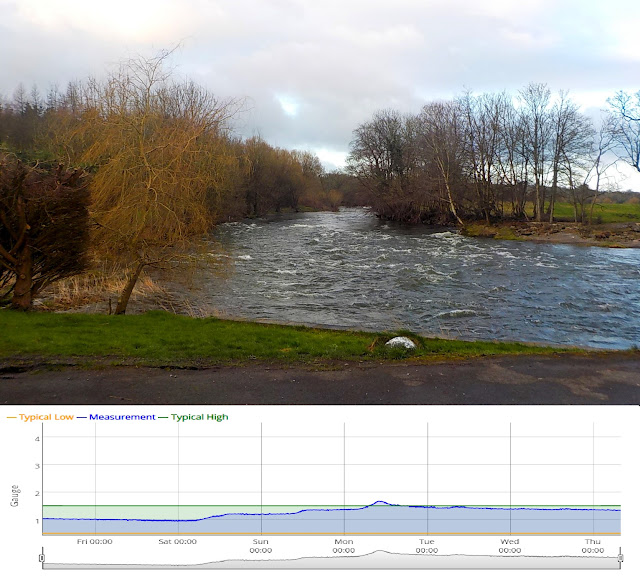
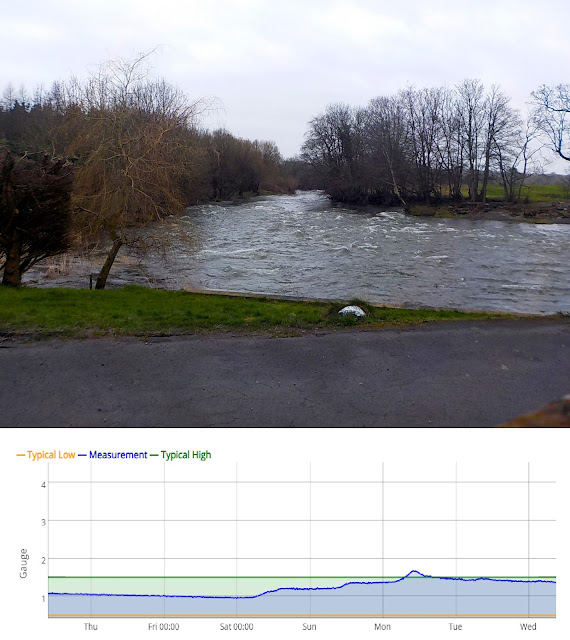
Winds of 90mph, hundreds of homes without power, trees and power lines down and widespread disruption on trains, roads and ferries. So the newspapers tell me. Here at the Old Corn Mill it was a quiet night, a little blowy but nothing special and I woke up this morning to bright sunshine and a feeling of where's Dudley? As you can see, the river level actually dropped a little overnight. 


We cannot be too complacent however as storm Eunice is coming over tonight and we have a yellow warning for wind and snow. It may well pass to the south of us, but it is developing rapidly and probably hasn't had time to listen to the meteorologists, so it could go anywhere. We'll have to wait and see.


I've just been out for a walk to see if there is any snow on the hills and as yet, there isn't. I also had a look to see if there was any storm damage. Three comotose wheelie bins seemed to be the sum total. Anyhow, that's the story (so far) from Cockermouth. How was it for you?


As I've been watching the river levels, an advert for this book keeps appearing on the site. I had a look this morning and it's a rather beautifully illustrated tome, detailing the history of floods and our attempts to control them, right up to the present century. Well worth a look (click on the picture to read the first chapter).


Talking of books, it's about time I stoppped rabbiting on about the weather and got on with producing a Kindle version of my own latest book. (You can click and read a sample of that as well). For those of you who've only just found me on the internetty, you can see all of my books, blogs, recipes and other stuff on Steve's Nature Plus.

That's all for now,

Stay safe wherever you are,

Steve


Wednesday, 16 February 2022

Storm Special 1 - The Lull Before


Following our Wet Weekend in Windermere, Monday saw the River Derwent rise to just above its typical high level of 1.5M. We now have two storms coming in back to back, Dudley this afternoon and Eunice on Friday. The north of england is on AMBER ALERT.
I'll keep you updated over the next few days for what, I expect, will be rather an exciting time. Not only will there be a lot of rain but the winds are forecast to gust at over 80mph tonight.


A picture may be worth a thousand words but a video is more exciting. Keep an eye on the old, moss covered, slipway on the opposite bank over the next few days. I reckon water will be streaming down it by tomorrow morning.

I've just read the sample pages of this book about British weather, produced by the Met Office. Definitely on my books-to-get list. Very interesting and very readable. Click on the pic if you want to read the sample pages.


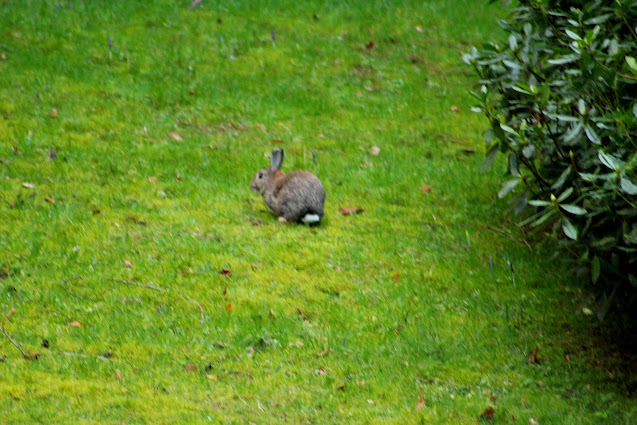
#MammalsInCemeteries is one of the photo themes in this months EuropeanNatureAlmanack, so here's one to start you off. This is the European Rabbit, Oryctolagus cuniculus, native to the Iberian Peninsula, but now to be found on every continent of the world with the exception of Antarctica. Post your February photos of #MammalsInCemeteries on our facebook page, Naturalists. The best will be included in the February round-up in next month's almanack.


I've always rated Collins Field Guides very highly. I haven't got this one yet but I've got a birthday coming up, so I may well put it on my list. :) 


Follow me on Steve's Nature Plus for the latest blog updates.
Bye for now
Steve

Storm Special 2 - Where's Dudley?

Wednesday, 21 April 2021

The Cocker Line


 A few weeks back, I took you on a local walk which I referred to as The Circle Line, alluding to the London Underground. Continuing this theme, were off on the Cocker Line today, following the river out of town and into the farmlands to the south.

Even in the town, as we walk along Rubbybanks Road there is plenty of life on the river. I've often seen wagtails and dippers along here and today there's a grey heron perched on an overhanging branch on the Kirkbank.


Leaving Rubbybanks, we'll circle up onto the Greenway (once the old Cockermouth to Penrith railway line which we visited at Keswick-Threlkeld), cross the river, dive through some woodland and emerge into the fields. Along the banks, as you can see, the Speedwell, Wood Anemone and Saxifrage are coming into flower.


As we continue to follow the river bank, small rills flow down from the hills on the far side, and fungi, too tantalisingly distant to identify, adorn the fallen branches.


The dandelions are out too, providing food for various small flies. These are very difficult to put a name to. All true flies are in the order Diptera and most of them are in the suborder Brachycera. These are the flies that look like flies, so to speak, as opposed to mosquitoes, midges and crane flies that are in other suborders. Within the Brachycera are Calyptrate flies (which include the familiar house flies as well as the dung flies, flesh flies and blow flies) and the superfamily Syrphoidea which encompasses the big-headed, hover and drone flies such as that Eristalis down there. There are well over a hundred different fly families, and if you want to see how they all relate to each other here's a mind-boggling diagram.


There's a farmhouse here with a track called Simonscales which will take us back into town, or we could carry on all the way to the village of Low Lorton, some miles away. However, we have an appointment to meet some friends, that we haven't seen since before Christmas, in a pub garden in town. Low Lorton will have to wait for another day, but meanwhile we have some Muscovy Ducks on the opposite bank (where all birds live). Despite their name these ducks have no more relationship with Moscow than turkeys have with Turkey. They are native to Mexico, Central and South America.


I can never look at a duck without feeling hungry (see Crispy Duck in Steve's Wild Kitchen). I wonder if they do food in this pub? Let's go and find out.


Steve's Books


The Quick Guide to Creepy-Crawlies

All you need to know to identify any type of insect, spider, worm or snail very simply and find out more about it.

Yvonne: This was a gift for a family so that the children can understand what they see on days out. The second was for me. Logical and easy to use. If you know anyone who likes nature you can be confident that gifting this book will give years of pleasure.

The Eggs of Saramova

A science fiction novella for those who don't like science fiction. A fast-paced thriller that is, literally, out of this world (and it starts right here in Crete).

Too new for reviews yet!

£7.50 Paperback edition


Not Just For Twisted Women by Steve Daniels 

A light-hearted look at life through the eyes of the fairer sex.

Janet: If you are short on time but enjoy reading and are maybe not into long extended novels then Not Just For... Twisted Women provides readers with concise stories that stand alone and most certainly entertain with their ultimate twists. Loved it.

Helen: A very good read! Well written and entertaining!

Margaret: Each quick tale gives a glimpse into a character's life and has an often humorous twist at the end. I would love to read more.

Yvonne: These days many people find it hard to find the time to read a novel, so this book of short stories is ideal to dip into. It is also makes a good gift.


£4.99 Paperback edition


See sample pages of all my books and latest blogs, and keep abreast of latest publications here:

http://author.to/SteveDaniels


Crete Nature Catch-up

Series 1 - Welcome to Lasithi

Series 2 - The Rhythm Of Life

Series 3 - A Journey Begins

Series 4 - The Milonas Valley

Series 5 - This Is Ferma

Series 6 - Upland Villages

Series 7 - The Forty saints

Series 8 - Sunday Strolls

Series 9 -Stormy Weather

*********************************************************************

LINKS:

Share your nature thoughts, photos and comments on Naturalists (the facebook page that accompanies this blog)


Wednesday, 17 March 2021

Cockermouth Circle Line


I've always liked the London Underground, from the woosh of the trains to the unique aroma of the platforms, and especially the schematic map. When I worked in a microbiology lab in London in the 1970s, I always got a seat on the tube by the simple expedient of donning a lab coat and carrying a sandwich box covered in biohazard stickers. We don't have an underground here in Cockermouth (nor an overground any longer thanks to Dr Beeching), but I've adopted the schematic map to plan my local walks. Welcome to the Circle Line, starting at my local station: The Old Cornmill. 


I haven't mentioned the height of the River Derwent recently, mainly because it has been behaving itself and not causing me to deploy the flood defences. After a weekend of steady rain (which, for the first time in five months, prevented me getting out and about) it rose to its typical high level which is not enough to worry the mallards. So, let us proceed eastbound, stopping first at Back Lane.


Here we find a wall covered in dying ivy, which gives us a chance to have a good look at how it manages to grow up a wall without falling off. Firstly, it sends out small roots from the stem to get an initial purchase. These then send out even smaller rootlets that get into the tiniest of crevices and produce an adhesive (with separate hardener, would you believe). Finally, they change shape, screwing themselves into position, then lignify (turn to wood). So, if you want to affix something permanently to a wall, copy ivy – glue it, then screw it.

The scientific name, Hedera helix, means grasping and spiralling. They didn't know about the glueing back then.


Turning our back on the ivy and peering over the opposite wall we have an uninteresting factory (from a naturalist's point of view) fronted by a pair of interesting reservoirs. There's usually something to see here, and today is no exception. Over there on the far bank (where else?) we have an Oystercatcher. I usually see these running along the sea shore, at the water's edge (see A Fjord By Any Other name - Solway Firth) and most Oystercatchers around the world are, indeed, coastal birds. The European Oystercatcher however, along with a couple of other species, also breed inland.


Our next stop along the line is North Fields (change here for the Northern Line to Woodhall farm) with a view of Cockermouth Castle in the distance and the landmark King's Church spire. We also have a flock of Herdwicks, and where we have sheep we have dung. Time for a prod! I see that the Yellow Dung Flies have hatched and are busy making the next generation. And if we turn it over... that looks to be a little dung beetle burrowing its way into the warm goo. Quite possibly an Aphodius species such as we saw at Watendlath Tarn. We're going to continue our journey to the bottom left corner of the field. Next stop, Gote Mills race.


I explained all about Gote Mills Race last year in Down By The Derwent, so I won't go over it again. The sluice gate is closed so let's delve beneath the logs lying amid the Snowdrops and see who's home. There are a couple of small snails, very delicate and shiny, so I expect that they are Glass Snails of the Gastrodontinae family; a Shiny Woodlouse, Oniscus asellus, and a pretty little Arion slug. I must admit, I was hoping for the odd reptile or amphibian down here but no matter, every living thing has an interesting tale to tell. No room to tell them here, but if you subscribe to Steve's Nature Plus I often go into more detail about the lifestyles of our native creatures.


Last stop, Memorial Gardens. We're back in civilisation now with plenty of garden feeders in the area so we have a good number of birds, such as this Blue Tit, singing in the trees. I do believe that was a Red Admiral butterfly we just disturbed, and over there – our first Bumblebee of the year. The insects are starting to appear, birds are singing for mates and it's the Equinox at 9.37am on Saturday. Spring begins this week-end. Yippee!


With all these insects and other invertebrates beginning to appear, why not treat yourself to a copy of The Quick Guide To Creepy-Crawlies and find out more about the amazing world of the minibeasts.


Happy Springtime


Steve


LINKS:

Steve's Nature Plus Join me at The Old Cornmill and follow me throughout the week for all the news that doesn't fit into the blog.

Share your nature thoughts, photos and comments on Naturalists (the facebook page that accompanies this blog)


Wednesday, 9 December 2020

Wonderful Whinlatter


Bassenthwaite Lake from Whinlatter Forest

At the end of the First World War England had a timber shortage. To combat this, the government embarked (no pun intended) on a program of tree planting. Now, a little over one hundred years later, we have the wonderful Whinlatter Forest, England’s only true mountain forest. There are miles of well marked walking tracks, magnificent views, adventure areas for children and wicked mountain biking routes. This is where we’re off to today.


Robin, Erithacus rubecula  and Treecreeper, Certhia familiaris 

Somewhat inevitably, we have a Robin accompanying us on our walk (I think that our intrepid local guide secretly brings one with her). We also have some Treecreepers, making their way, stealthily up the trunks of the trees in search of insects. If you see a bird going up a tree, like this, then it’s probably a Treecreeper. If you see one coming down head first then it’s probably a Nuthatch.


Whinlatter is all about trees and, at this time of year, they do a roaring trade in Christmas trees. In fact, there are so many people wandering about with a section of forest under their arms, that it’s a wonder that there is any left to walk in. There’s a choice of Fir, Pine or Spruce and a handy guide as to the advantages and disadvantages of each type. For instance; Spruce is the traditional one that smells of the Christmases of childhood. It is also the one that has you picking needles out of the carpet at Easter. Pine and Fir keep their needles better and Fir has well spaced branches, ideal for decorating. Pine is a much bushier tree and has an invigorating aroma. So you pays your penny and you takes your pick. Slightly more pennies for Pine and Fir, than for Spruce.


Some of the trees have fungi growing on them. These, with their delicate, conical caps and slender stems are Bonnets, of the Mycena genus. There are over 500 of these worldwide, and telling one from another usually requires a microscope. Some are edible, some are poisonous and most aren’t worth bothering about from a culinary viewpoint. Some of them even glow in the dark. I see that Jack the navigator hound has photobombed the picture again. I wonder if we can retrain him as a truffle hound? 


News from the Corn Mill

River Derwent at Cockermouth

One of the many beauties of living here is that it’s only a ten minute walk to the middle of town, and most of that is alongside the River Derwent through the Memorial Gardens. As you can see, the river has been behaving itself very well for the past week. Hopefully it will keep doing so for the next month as the flood barrier for the front door won’t be here until next month. Must go now as the dining table and chairs have just arrived. So, until next time,


Stay happy and stay safe,


Steve

Steve's Books


The Quick Guide to Creepy-Crawlies

All you need to know to identify any type of insect, spider, worm or snail very simply and find out more about it.

Yvonne: This was a gift for a family so that the children can understand what they see on days out. The second was for me. Logical and easy to use. If you know anyone who likes nature you can be confident that gifting this book will give years of pleasure.


The Eggs of Saramova

A science fiction novella for those who don't like science fiction. A fast-paced thriller that is, literally, out of this world (and it starts right here in Crete).

Too new for reviews yet!


Not Just For Twisted Women by Steve Daniels 

A light-hearted look at life through the eyes of the fairer sex.

Janet: If you are short on time but enjoy reading and are maybe not into long extended novels then Not Just For... Twisted Women provides readers with concise stories that stand alone and most certainly entertain with their ultimate twists. Loved it.

Helen: A very good read! Well written and entertaining!

Margaret: Each quick tale gives a glimpse into a character's life and has an often humorous twist at the end. I would love to read more.

Yvonne: These days many people find it hard to find the time to read a novel, so this book of short stories is ideal to dip into. It is also makes a good gift.


See sample pages of all my books and latest blogs, and keep abreast of latest publications here:

http://author.to/SteveDaniels


Crete Nature Catch-up

Series 1 - Welcome to Lasithi

Series 2 - The Rhythm Of Life

Series 3 - A Journey Begins

Series 4 - The Milonas Valley

Series 5 - This Is Ferma

Series 6 - Upland Villages

Series 7 - The Forty saints

Series 8 - Sunday Strolls

Series 9 -Stormy Weather

*********************************************************************

LINKS:

Share your nature thoughts, photos and comments on Naturalists (the facebook page that accompanies this blog)


Explore the region with the #CreteNature interactive Hiking and Nature Map


Cretan Flora Flowers of Crete BIRDS OF CRETE Crete Birding

Greek Butterflies and Moths Aquaworld Aquarium

Visit Greece (National Government Tourist Office)


Wednesday, 25 November 2020

Series 13 Welcome To The Old Corn Mill


To recap: having lived in Crete for the past 16 years, I have now decided to get the best of both worlds by dividing my time between Crete and the UK. This has meant buying a property over here, to whit, a portion of a 200 year old corn mill, in Cockermouth, Cumbria. This gives me the novelty of living close to my mother and one of my sisters. I’m not sure what Cockermouth has done to warrant us all descending upon it as, for the past forty years, we’ve lived as far apart from each other as possible. As a naturalist, I am as interested in what lies outside my front door as what lies inside. In this case it is the River Derwent. It usually lies outside, but in 2015 it came in through the front door, and in the ‘Great Flood’ of 2009, which put most of Cockermouth under water, it crept over the windowsills. For that reason we’ll be keeping a close eye on the river level. At the moment it is running at 1.479 metres, which is just about within its normal level.


Enough waffling, let’s go and explore our new playground. There is a stretch of woodland on our way up to the village of Papcastle with a helpful roadside sign instructing the red squirrels to slow down. This is good news for me as I’m not as quick with the camera as I used to be. No squirrels this morning but plenty of Christmasy Snowberries. This is a north American plant which was imported into the UK in the late 19C as an ornamental and has now become widely naturalized. The native Americans used it as both soap and soup, oddly enough seeing as it is mildly poisonous, but crushing the berries between your palms gives you an instant hand lotion.


Once into the village, which in Roman times rivalled Carlisle in size, there is a farm track down to the riverside pastures which is full of interesting stuff. Plenty of Ivy coming into flower, providing a good winter harvest for birds and insects alike. Particularly these tiny white flies this morning. I’m pretty sure that these are biting midges of the Ceratopogonidae family, as opposed to the non-biting midges of the Chironomidae family. You don’t have to stand around getting bitten (or not) to tell them apart; male non-biting midges have feathery antennae, male biting midges don’t.


Aha! A log pile. Let’s see who’s about. The big fellow (1) is a Roundback Slug of the Arionidae family. Very common slugs that are difficult to tell apart as their colouration is influenced by their diet. The smaller chap, sitting on his head, (2) is also a Roundback but part of a subgroup, known as the Fasciatus, which have a false keel running down the back. Sandwiched between the two (3) looks to be a larva of some kind, while up in the top right (4) is an Elongate-bodied Springtail of the Tomoceridae family. Although they have six legs, they are not insects but hexapods. To qualify as an insect you must have had two pairs of wings at some point in your ancestry. (There is a section on hexapods – springtails, coneheads and diplurans in The Quick Guide to Creepy-Crawlies).


Here we are, down by the riverside and I spot a handy seat where we can sit and watch the river for a bit. Not much in flower at the moment, the odd bit of Yarrow but, thankfully, no Himalayan Balsam (see Urban Oasis). What we do have though, is a couple of Waxcap fungi which tell us something about the grass at our feet. This is a habitat known as Waxcap Grassland, which is declining throughout Europe due to modern agricultural practices. It is nutrient poor grazing land – sheep in the case of this one – which supports fungi biodiversity in general and waxcaps in particular. This Pink Waxcap, Porpolomopsis calyptriformis, which appears to have been well nibbled, is vulnerable to extinction on the IUCN red list, so that has to be our find of the day.


Unfortunately, the public footpath ends at somebody’s garden gate just along here which means that we can’t get into the woodlands beyond. I’ll have to get to know the neighbours! We have, on the opposite bank (where all birds live), a herd of Mallards, a herd being just one of many collective nouns for a group of ducks. Flock, team, paddling and raft being some of the others. But there is a stranger in the camp, the duck on the extreme right is not a Mallard but a Goosander, Mergus merganser, a sea duck that breeds in Scandinavia but comes down here for some Cumbrian warmth in the winter. They are piscivorous (fish eating) ducks and they will often work as a team, forming a semicircle around the fish and shepherding them into the shallows, where they are easier to catch.


So, that’s our first foray into our new hunting grounds and I’m sure we’ll find many more interesting things in these diverse habitats as the seasons turn.

Steve's Books


The Quick Guide to Creepy-Crawlies

All you need to know to identify any type of insect, spider, worm or snail very simply and find out more about it.

Yvonne: This was a gift for a family so that the children can understand what they see on days out. The second was for me. Logical and easy to use. If you know anyone who likes nature you can be confident that gifting this book will give years of pleasure.

The Eggs of Saramova

A science fiction novella for those who don't like science fiction. A fast-paced thriller that is, literally, out of this world (and it starts right here in Crete).

Too new for reviews yet!


Not Just For Twisted Women by Steve Daniels 

A light-hearted look at life through the eyes of the fairer sex.

Janet: If you are short on time but enjoy reading and are maybe not into long extended novels then Not Just For... Twisted Women provides readers with concise stories that stand alone and most certainly entertain with their ultimate twists. Loved it.

Helen: A very good read! Well written and entertaining!

Margaret: Each quick tale gives a glimpse into a character's life and has an often humorous twist at the end. I would love to read more.

Yvonne: These days many people find it hard to find the time to read a novel, so this book of short stories is ideal to dip into. It is also makes a good gift.


See sample pages of all my books and latest blogs, and keep abreast of latest publications here:

http://author.to/SteveDaniels


Crete Nature Catch-up

Series 1 - Welcome to Lasithi

Series 2 - The Rhythm Of Life

Series 3 - A Journey Begins

Series 4 - The Milonas Valley

Series 5 - This Is Ferma

Series 6 - Upland Villages

Series 7 - The Forty saints

Series 8 - Sunday Strolls

Series 9 -Stormy Weather

*********************************************************************

LINKS:

Share your nature thoughts, photos and comments on Naturalists (the facebook page that accompanies this blog)


Explore the region with the #CreteNature interactive Hiking and Nature Map


Cretan Flora Flowers of Crete BIRDS OF CRETE Crete Birding

Greek Butterflies and Moths Aquaworld Aquarium

Visit Greece (National Government Tourist Office)


Recent Posts